Showing posts sorted by relevance for query child as craftsman. Sort by date Show all posts

Friday, August 13, 2010

child as craftsman

David Henry Feldman, in a 1977 paper, "The Child as Craftsman" described the role of metaphor in formulating the scope and method of education. What he described as the earliest metaphor he labeled as the individual differences/traits metaphor
The child's traits or capabilities would determine the extent to which he could absorb the knowledge presented by the teacher...The teacher, by virtue of having mastered the knowledge himself, did not need to demonstrate any special ability to teach. His responsibility was to determine what was taught, and when and how.
In other words, the child was an empty vessel and the teacher was a pitcher of knowledge prepared to pour until the child had reached his or her own individual capacity.

What Dr. Feldman called the environmental patterning metaphor made the assumption that
the "basic mechanisms of learning are the same for all individuals (even for all organisms) ... and the amount that one learns should be a direct function of the environmental experience one has had...The environmentalist metaphor... removed the responsibility from from the shoulders of the overburdened child and placed it on the shoulders of the now overburdened teacher. No child was deemed to naive or dull to learn. Learning was a function of the environmental arrangements that a good teacher was able to make.
The third metaphor which Feldman called the stage development metaphor "is loosely based on the work of developmental theorists, Piaget, Erikson, Kohlberg, Werner, Loevinger, and others."
The child is seen as proceeding through a series of qualitatively distinct stages, each of which provides powerful rules for interpreting reality and guiding behavior.
If you look at modern education, you will find evidence of each of these three metaphors variously applied, giving foundation to various schools and methods, and shaping the objectives of various teachers in classrooms in America. Looking at the state of American education one would assume that a new metaphor might be in order. In his 1977 article, Feldman offered "The Child as Craftsman" as a fresh alternative.
To see a child as a craftsman means to see him as a person who wants to be good at something. It also suggests that the child continually takes pride in accomplishment and has a sense of integrity about his work, regardless of the actual level of the work produced. The notion is somewhat akin to Robert White's competence motivation, except that White's notion implies more of a need to feel mastery over uncontrolled forces in the environment. The child a craftsman no doubt is move by what White refers to as "effectance motivation," but the metaphor is intended to go beyond this to include a more direct link to specific fields of endeavor and to suggest why some activities are so much more compelling to a given child than others...

Perhaps the most important implication of the metaphor is to suggest that it may well be the main purpose of education to provide conditions under which each child will identify and find satisfaction through a chosen field or fields of work.
I will be offering much more on the "child as craftsman" in the days, weeks, months and years to come.

Thursday, April 28, 2011

metaphors for learning...

1. Children are empty vessels but of varying volumes. The teacher fills them up to their capacity. This is the classic approach.
2. The Biological and psychological urges model. Students are sets of biological and psychological urges and the teacher's job is to combat or control student urges through the use of conditioned response psychology. Doesn't this sound like fun? Both Skinner and Freud would like it.
3. Blank Slate metaphor: B.F. Skinner approach to teaching. The teacher, through a system of rewards (test scores and grades)gives direction to the student's growth. If the student's slate is already scribbled beyond comprehension and use, refer back to metaphor 2, or administer drugs.
4. Stages of development: Children are growing both in physical size and intellect. It is the teacher's job to recognize the stage of development and offer the appropriate lessons, reading, math, etc. timed on the basis of that recognition. This is the Piaget model.
5. The child as craftsman, a metaphor presented as an alternative by educational psychologist, David Henry Feldman and essentially ignored:
To see a child as a craftsman means to see him as a person who wants to be good at something. It also suggests that the child continually takes pride in accomplishment and has a sense of integrity about his work, regardless of the actual level of the work produced. The notion is somewhat akin to Robert White's competence motivation, except that White's notion implies more of a need to feel mastery over uncontrolled forces in the environment. The child as craftsman no doubt is moved by what White refers to as "effectance motivation," but the metaphor is intended to go beyond this to include a more direct link to specific fields of endeavor and to suggest why some activities are so much more compelling to a given child than others...

Perhaps the most important implication of the metaphor is to suggest that it may well be the main purpose of education to provide conditions under which each child will identify and find satisfaction through a chosen field or fields of work.
Readers interested in the child as craftsman metaphor might enjoy Daniel Pink's new book Drive: The surprising Truth about What Motivates US. You can read an excerpt here, in which Pink describes research by Harry Harlow and Edward Deci with rhesus monkeys in which intrinsic motivation is revealed. I would postulate that intrinsic motivation is what drives the craftsman. It may also explain the child at the back yard basketball hoop and those relentless free throws when no one is watching. It may explain why someone would dedicate his or her life to the arts or literature, while knowing that the pay may not be as great as that offered in banking or grand theft auto. For those who do not understand the value of intrinsic motivation, or its potential for application in schools, I recommend a healthy dose of the arts.

Yesterday in the Clear Spring School wood shop, we had creative day and some students in the first, second and third grades made small pieces of furniture for their own use, tables, benches and a ladder. Some made tops, another made a sign for the Clear Spring School open house on Saturday, 1 to 3 PM. In addition the students helped me to make new flag poles decorated with geometric solids as shown below for their patrol groups. The school camping trip will be next week.

Today I am working in my own shop and having meetings at school.

Make, fix and create.

Tuesday, September 21, 2010

what is a craftsman?

In order to extend the child as craftsman metaphor, it is important to examine the concept of "craftsman" and to see how it offers a more reasonable, more easily measurable form of school assessment requiring no experts or trained expertise, but is instead most deeply engaging of those who have the greatest interest in the success of each child. I heard an interview this afternoon with the director of the new documentary on education, "Waiting for Superman." He mentioned that nearly all parents are interested in the success of their own children. Its why he chooses to send his children to an independent school. until we develop the national will to make certain each and every child has an opportunity for the same level of success. Unfortunately, parents are rarely empowered to participate in meaningful ways that would help guarantee ALL children's success. If you are lucky enough to send your child to a better school, that's about as good as it gets. Waiting For Superman is somewhat controversial in that its focus is on charter schools and 5 children keeping their fingers crossed for admission to the opportunities that a higher quality school might bring. But I think we have bigger issues to discuss here than charter schools which will always be limited to a few students randomly singled out for success... A fresh look at student and school assessment has the potential of being even more revolutionary.

Both Richard Sennett, in the Craftsman and David Henry Feldman, in "the Child as Craftsman" essay extend the notion of craftsmanship beyond the traditional idea of making stuff. Sennett uses the term in his example of code writers for computers. And so, we can explore many things having a craftsman-like quality. Even the mathematician standing at the black board working through a quadratic equation could be examined through his or her display of craftsman-like qualities. It is easier to follow him or her to the understanding of a correct solution if the letters and numbers of the equation are written legibly and in the right order and with a craftsman's concern with personal expression rather than being carelessly expressed. There are even craftsman-like qualities involved in "crafting" today's blog post.

I keep going back in my thoughts to the old saying, "In Bali, we have no arts, we do everything as well as we can." In other words, "who needs arts when we have craftsmanship in everything? When each and everything is done with an eye toward the expression of quality and care?" There are qualities inherent within craftsmanship of caring and growth that reflect those qualities we would most like our children to learn in school and that most closely reflect what we want them to BE when they get out on their own as adults.

As I mentioned before, using what is expressed through the arts as a form of assessment is not an exact quantitative or statistical science, but rather one that can be reasonably well understood by anyone interested in taking time to observe and compare. It is like the difference between measuring the wind using the Beaufort Scale, or using an anemometer. The anemometer will tell you approximate wind speed in the abstract scale of miles per hour or kilometers per hour, but not its direct effect or the relevance of that effect on the sails and the performance of your boat. The anemometer is an abstract tool upon which we might easily become dependent but that is less descriptive of real circumstances. Testing in schools gives us an abstract view of educational reality understood by few. But do you want to know if your school is going 35 mph or whether it is performing in the best interests of your child?

As I've been saying, creating a new framework and user friendly means of assessment won't all happen overnight, and being a collaborative experience, you can help. As I see it right now, the Beaufort Scale of Educational Excellence will be a scale in which the four fundamental principles of educational sloyd will be linked with other discernible indicators of growth and health in confidence and love of learning.

Today is to be a busy day in the wood shop.

Tuesday, November 02, 2010

child as...

Mario sent the following quote about US president Jimmy Carter from a Splintered History of Wood
"When I tire of the computer screen, I can walk twenty steps to my woodshop and immerse myself in my current project," Carter says. And why does an octogenarian, financially secure, Nobel Peace Prize recipient, Emory University professor, Carter
Center (Waging Peace. Fighting Disease. Building Hope.) leader, and prolific author continue to make sawdust?

"What we need in our lives is an inventory of factors that never change. I think that skill with one's own hands—whether it's tilling the soil, building a house, making a piece of furniture, playing a violin, or painting a painting—is something that doesn't change with the vicissitudes of life. [Woodworking is] a kind of therapy, but it's also a stabilizing force in my life—a total rest for my mind." -President Jimmy Carter
Today, I have been thinking about the child as craftsman metaphor and what it contributes to our understanding of education. Nearly the same point could be made, through "the child as athlete", or "the child as musician," or "the child as builder," or "the child as farmer," or "the child as dancer," or "the child as..." and here I name all the wonderful human occupations that reflect the full range of serious adult human intelligences that are represented in Howard Gardner's Frames of Mind.

Today I am reading the latest issue of Wooden Boat (Nov/Dec 2010) and it contains an article about the Spaulding Wooden Boat Center in Sausalito, CA. Its founder, Myron Spaulding (1905-2000) designed and built his first wooden boat at the age of 16, and in addition to designing, building and sailing yachts, had a parallel career as a violinist with the San Francisco Symphony Orchestra. It is typical for healthy full dimensioned human beings to have a wide range of interests, and capabilities. Just as Jimmy Carter's wood shop is only a few feet from his computer on which he corresponds and manages a full range of other important projects, human beings including children must be encouraged in their full dimensions.

I am attempting again to turn my attention to the idea of a Beaufort Scale of educational assessment, and my first point is that it has no similarity to the artificial construct of standardized testing. Rather than only measuring math skills, logic and reading skills, it is concerned with joy of learning and the full range of human intelligences... the child as craftsman and athlete and more. It is a frame through which to bear direct witness to real learning as expressed joy. To see Archimedes sprinting naked in unrestrained enthusiasm for his discovery, is an expression of joy. It represents the top of the scale, and is what parents, teachers and students should be aiming toward in creating an educational model.
In the photo above, you can see the flipping story stick I use in setting up the router table for routing recesses for knife hinges to fit. In the trial fit at above, the hinge still protrudes too far. When I square the end of the routed groove with a chisel, I'll have a perfect fit.

Wednesday, September 15, 2010

Today in the woodshop

Today in the CSS woodshop my first, second and third grade students continued making their trains. This is a nice project, in that it is large enough that the students see clearly that it can't be done and taken home in a single class, and they are excited about the results. We use a simple method to connect the cars to each other using a bent nail and a wire fencing staple.


I want to talk just a bit about assessment and the role that the arts can play in bringing assessment out of the domination of standardized testing expertise and into the hands of the lay scientist... the parent wanting to see results and the greatest growth opportunities for his or her child.

Most standardized testing necessarily has to do with things that can be measured by a battery of questions having approved right and wrong answers. Even the essay portion of the SAT has to do with the following the rules of proper and effective writing.

And so, let's look at what corporations say they want in someone they hire. They want: creative problem solving, teamwork, and demonstrated responsibility. A schooling built on the basis of what we can most easily measure through standardized testing does not deliver on any of these three things.

I want to go back for just a moment to some earlier posts about David Henry Feldman's essay, The Child as Craftsman. I have been granted permission by the author to distribute it to interested scholars, so will send it to you if you make a request for it via email.

In the Child as Craftsman, Feldman offers three metaphors for schooling. I will grossly simplify: One the child is an empty vessel to be filled to his or her capacity by the nearly all knowing teacher. The second metaphor is related to Pavlov's and Skinner's work on environmental conditioning, and offers that learning is "a function of the environmental arrangements that a good teacher is able to make." The third metaphor is one derived from Piaget and other developmental psychologists, that the child goes through universal stages of development, and that these are natural and sequential for all children. Feldman uses A.S. Neill mentioned in yesterday's post as an example of an educator taking the Piaget metaphor to the extreme.

Feldman offers a "new metaphor," that of the child as craftsman, and simultaneously points us toward a different way of assessing performance and learning success.

He proposes "twin signs of progress toward a fruitful education for the future... 1) an increasing number of individuals engaged in and committed to pursuit of mastery of their field and 2) the number of novel, unprecedented, or unique contributions that occur in these fields." The interesting thing here, is that you don't have to be an educational expert, trained in statistics to walk into a classroom and observe whether or not it is fulfilling its mission. Assessment by the arts is the only way to measure the three things that American employers want schools to produce.

It is interesting that a trained and experienced educator CAN walk in to a classroom and quickly see its effectiveness. He or she will see students seriously engaged (or not). He will see students working effectively in teams (or not) and he or she will see evidence of creative problem solving in the form of projects at varying levels of completion (or not). A parent visiting the class can witness exactly the same thing, and has the additional opportunity of seeing the child's enthusiasm each morning as they prepare for school.
"What the best and wisest parent wants for his own child, that must the community want for all of its children. Any other ideal for our schools is narrow and unlovely; acted upon it destroys our democracy." - John Dewey
The new movie, Waiting for Superman was produced by Davis Guggenheim who would drive by 3 public schools on his way each morning to take his children to private school and felt a sense of guilt that he was unable to give the best quality education to others as well. I am looking forward to seeing the movie, as I suspect that Guggenheim was inspired by what John Dewey knew to be true. School should not be contrived but should be made authentic and true for each child.

Craftsmanship (and the arts) is the essential metaphor for the new education, not because it provides an alternate means to assess, but because it is really how we learn, how we grow, and how we become engaged passionately with the future.

On another subject the poll at right was interesting. Thank you all for taking time to participate. Just under half my readers were interested in woodworking. Just under half found my writing strangely entertaining. A full 91 percent were here for the philosophy of hands-on learning. I feel complimented by each response. Make, fix, do. There is growth and pleasure in the whole thing.

Saturday, November 29, 2014

rightly conducted...

This from Robert Keable Row, 1909, the addition in bold parenthesis is mine:
Rightly conducted, manual arts and industries furnish abundant exercise for all forms of intellectual activity, under conditions most favorable to mental (and moral) development.

If the purpose of education is that of creating situations of dependency, in which people are enchained as consumers and left without the where-with-all and without the initiative or power to create change in their own lives, we've made the right schools for it. Put 30 or more students in a classroom, stuffed to the point that teachers have no choice but to invest the greater part of their attention in maintaining control, rather than in the delivery of meaningful content, and you've placed both the teachers and students in an untenable situation. After years of dependency, and idleness students may turn to crime simply to have some control over their own lives.

Would it not be better that they be offered craftsmanship instead? It lies within the scope of the child's most natural inclinations. As proposed by Comenius, and as shared so many times before in this blog that I feel redundant in bringing it up,
"Boys ever delight in being occupied in something for the youthful blood does not allow them to be at rest. Now as this is very useful, it ought not to be restrained, but provision made that they may always have something to do."
Instead, we leave them restrained in seats, losing thereby, our most powerful educational resource, their attention. The following is from David Henry Feldman's paper, the Child as Craftsman:
To see a child as a craftsman means to see him as a person who wants to be good at something. It also suggests that the child continually takes pride in accomplishment and has a sense of integrity about his work, regardless of the actual level of the work produced. The notion is somewhat akin to Robert White's competence motivation, except that White's notion implies more of a need to feel mastery over uncontrolled forces in the environment. The child as craftsman no doubt is moved by what White refers to as "effectance motivation," but the metaphor is intended to go beyond this to include a more direct link to specific fields of endeavor and to suggest why some activities are so much more compelling to a given child than others...

Perhaps the most important implication of the metaphor is to suggest that it may well be the main purpose of education to provide conditions under which each child will identify and find satisfaction through a chosen field or fields of work.
The price we pay for for failing to engage children in craftsmanship is enormous. Think of the waste of lives of those young men and women who turn to crime, or spend their early years incarcerated, instead of becoming productively and creatively engaged. Think of the loss of dignity, that comes from our failing to enlist them in craftsmanship.

I know this blog won't be one that gains the attention necessary to turn the tide, change the direction in American education. So we must take matters into our own hands.

Make, fix and create...

Sunday, March 13, 2016

students and wrens.

Last night we had a very successful fundraiser/art auction at the Rogue's Castle Manor outside Eureka Springs. I sold a cabinet from my book Building Small Cabinets and two boxes and of course my own contributions were dwarfed by the generosity of so many other artists.  Clear Spring School is not supported by tax dollars and community support is essential. We are relieved to have the fundraiser complete for this year.

As part of my review of materials for my trip to Portland, I've posted the essay by David Henry Feldman, The Child As Craftsman online where my readers can access it.

There is a natural inclination that has not been fully studied, for children to differentiate themselves from each other. For instance, when one sibling may be really good at sports, the other may choose to gain notice in the field of academics. So it happens not just in schools but also in homes.

When I was a very small child, I faced competition and correction from my sister Ann. As children, we were always supplied with colors, paper and paints, and she became the "artist" of the family. Comparing my own work with hers, I felt inept, and she reminded my constantly of her superior skills by drawing on my paper as well as her own. These kinds of early childhood experiences add up and are mulched into our perceptions of self.

David Henry Feldman is a recognized expert in child development whose primary focus has been on the highly gifted child. His paper, the Child as Craftsman is one I've referred to many times before in the blog, and I make it available here with his permission, as I believe it is important.

If you understand the child's need to differentiate and distinguish him or her self through the development of some specialized skill you realize that a one size fits all standard of schooling ignores the educator's most important assets... the child's own inclination to develop and grow.

But then of course most schools have long ignored the basics of child development. Great universities of education tend to ignore child development, as what teacher, given the current standards in class size, has any time or opportunity to consider the needs of an actual child?

Looking at education through the lens that Piaget offered, we know that children are pushed beyond their developmental levels consistently, forcing them to hate schooling.

When I started out as a woodworking teacher, I had hoped that I might help others to understand the value of hands on learning. I found the problems in education to be far greater than I imagined. But the hands provide a lens on learning. If we look at education from the perspective of the hands, and understand the essential role that the hands through craftsmanship (whether in the wood shop, or practice studio, or laboratory) can play, we are given a simple formula for educational renewal: Put the hands to work in support of learning.

The image above is our newspaper box which has been taken over once again by a nesting wren. It happens this same time each year, and my wife has suggested we simply go with the flow of nature rather than attempt to fight with the inevitable: hence the sign to alert the newspaper carrier to avoid the box. There are some things we can change and some things we should change and some things we must change. One thing that we should, could and must change involves the education of our children. Would it not be best if we were to put their natural passions to work in our own behalf? Unlike wrens which are absolutely true to their own species and standardization, human beings are programmed toward diversity of skills and individual adaptations upon which our culture and civilization are fabricated.

Friend and shop teacher Jonathan Dietz at Weston Middle School in Weston, Massachusetts outside Boston has offered a gallery of his student's work. The collection consists of band sawn boxes, assembled boxes, small tables an a number of small interesting things of the student's own design.

Make, fix, create, and extend to others the opportunity to learn likewise.


Sunday, November 18, 2018

in reflection.

I am going through some of what I consider to be important stuff on this blog with an eye toward finding those things of particular importance to add as sidebar material in my new book that is now in the process of being edited for publication. This material I think is important, and from a wisdom of the hand blog post, Saturday, August 21, 2010.

"A few days ago, I posted on the subject of David Henry Feldman's metaphor, The Child as Craftsman, http://wisdomofhands.blogspot.com/2010/08/child-as-craftsman.html and today I want to share Dr. Feldman's exploration of assessment. Our fixation on assessment is what drives our continuing "no child left behind" like testing psychosis, even within the Obama administration.

"Testing is a holdover from earlier metaphors discussed in an earlier post, which for the sake of making my writing a bit easier this morning I won't repeat.

"And so, how does one measure progress in schools in which each child is known to be a craftsman. Feldman suggests two measures, both of which came up recently in our small hands conference at Dearborn. To quote Dr. Feldman,
""The first is simply a restatement of the educational aim of engagement in a more precise form; to the extent that greater numbers of individuals find fields to pursue, find work that engages their energies and through which they derive satisfaction, education can be considered to be making progress."
"Imagine this relative to the level of disengagement we too often see in American classrooms.

"Feldman's "second criterion of educational progress" follows from his thoughts about creativity. That if
""education is done well, creative contributions will tend to take care of themselves. In other words, an education which fosters sustained commitment, satisfaction and joy in accomplishment will naturally lead to occasions that require one to go beyond the limits of one's craft. To reach the limits and find yet another problem to be solved, a goal to be achieved, an idea to be expressed, a technique to be worked out--these are the conditions which favor creativity.
"Feldman concludes,
"I submit that the twin signs of progress toward a fruitful education for the future are; (1) an increasing number of individuals engaged and committed to pursuit of mastery of their fields and (2) he number of novel, unprecedented, or unique contributions that occur in these fields."
"Feldman states further,
"If young children were prepared for a future of craftsmanship it might be possible to strike a better balance between the inculcation of basic skills and the encouragement of human expression; a balance, I hope, that does full justice to the universal and to the unique in each of us."

An example of the child as craftsman is my student, who once his bridge had been tested and proven to support over 400 lbs. without distortion, he insisted on adding additional support. You can also see it in the work by my Kindergarten students making "color wheels" on Friday.

Make, fix and create...

Friday, August 20, 2010

Beyond Universals in Cognitive Development

I have been reading David Henry Feldman's book Beyond Universals in Cognitive Development and it is a tough read for a woodworker. It's not that I don't have the intellect for it, but that just as a professor from Tufts might have to work his brain around how to cut a dovetailed joint, I am a bit unused to the domain.

Here is a woodworker's nutshell, and a bit about how things dovetail with the Wisdom of the Hands, and I offer my apologies to Dr. Feldman if for any reason I have missed the point.

Children, regardless of location or culture, go through universal stages of development, provided they are in an environment offering at least minimal opportunities for those stages to occur. Child development study as initiated by Piaget and others has been largely focused on those "universals". Kids walk, talk, begin cognitive processing, development of the ability to reason, at a pace, within a time frame, that can be observed throughout the world. Dr. Feldman suggests that developmental psychologists look beyond the universals to those developmental aspects which drive a child toward unique, as well as universal expression.

That is where the "child as craftsman" metaphor comes into the picture. You really don't have to spend very much time with children to learn that they are very interested in finding ways to excel and express exceptionalism. In fact, one could suggests that one of the universals in child development is, given adequate environmental support, the impulse toward the unique through the development of specialized skills and abilities.

There is an interesting parallel in the making of furniture. Furniture craftsmen in the Studio furniture movement, try to establish a look for their work that is distinctive, that can be regarded as "signature," a unique expression. The irony is that in order to gain recognition for unique expression, one has to touch upon or incite a sense of the universal within the viewer or potential buyer... Not a sense of "Oh, that's different." But a sense of "Wow, that touches me and means something to me!" And so, you can see that the life of a craftsman is a balancing act between the unique and the universal. If craftsmen can do it, can it also be balanced in our nation's schools?

The photo above shows one more step in making a small walnut display cabinet. You will have to use your powers of creative visualization to see what I'm doing. As the edges become tapered from the bottom of the cabinet to the top, the edges will also become tapered in thickness, narrowing toward the top. There are many things involving human intelligence that can't easily be put in words. And yet in academic settings discursive ability has long reigned supreme. Now, with failing schools and failing economy, the time has clearly arrived for the strategic implementation of the hands... and (thanks to Dr. Feldman) recognizing "the child as craftsman."

Saturday, January 14, 2012

No hands left behind...

Educational Psychologist David Henry Feldman had proposed a new metaphor for education which he called "the Child as Craftsman." The idea was that children hold the potential for excellence in craftsmanship as part of their innate developmental inclination. By neglecting that inner child of creativity that longs for the development and expression of skill, our children are diminished in nature and in character. Any artist or craftsman reading this blog would immediately understand what most educators seem to have overlooked. I urge all to remember sometime in the past in which we may have spent time striving to be good at something... hours at the free-throw line is just one example. The inclination and motivation to find some area in which a child is able to excel is universal.

The child as craftsman is an essential metaphor for understanding our way forward as American educators, parents, craftsmen and artists of all kinds. Becoming a nation of craftsmen requires that we begin to address the matter of craftsmanship with our children and in our schools and homes. This is not a new topic in the blog. I've written about Feldman many times before and of course I never wander far from the topic of craftsmanship. Use the search block at upper left and type in David Henry Feldman to read more.

Currently the No Child Left Behind Act sets standards for reading and math, but there are other important forms of assessment that David Henry Feldman laid out in two steps.
"The first is simply a restatement of the educational aim of engagement in a more precise form; to the extent that greater numbers of individuals find fields to pursue, find work that engages their energies and through which they derive satisfaction, education can be considered to be making progress."
One of the greatest failings of modern education is that of failure to engage, as children either sit bored and disinterested or become disruptive. Feldman's "second criterion of educational progress" follows from his thoughts about creativity. That if
"education is done well, creative contributions will tend to take care of themselves. In other words, an education which fosters sustained commitment, satisfaction and joy in accomplishment will naturally lead to occasions that require one to go beyond the limits of one's craft. To reach the limits and find yet another problem to be solved, a goal to be achieved, an idea to be expressed, a technique to be worked out--these are the conditions which favor creativity."
Feldman concludes:
"I submit that the twin signs of progress toward a fruitful education for the future are; (1) an increasing number of individuals engaged and committed to pursuit of mastery of their fields and (2) the number of novel, unprecedented, or unique contributions that occur in these fields."
This is not exactly measuring to see if students arise at some artificial minimalized standard of success, but rather an open ended model for assessment that recognizes with today's kids the sky's the limit.

I've spent the morning loading a trailer with small cabinets to deliver to the Historic Arkansas Museum for my show that opens next Friday. It feels great to have so much work safely packed and ready to travel.

Make, fix and create...

Wednesday, November 07, 2012

working knowledge...

In a rather nice article on "Reactivating Agriculture Education; High school reviving vo-ag, FFA programs", passed along by Reuben, the photo caption describes the object being assembled by students as a "drill." It is interesting to me that writers could be so out of touch from DIY capacity as to mistake a scroll saw for a drill. But then given the overall decline in woodworking programs over the years, we have writers who have no knowledge of physical reality what-so-ever.

Today I am leaving for Louisville, KY for the ISACS conference where I will make two presentations on the Wisdom of the Hands. One particular point that I will share with fellow teachers will be the concept of the "child as craftsman." The following is from David Henry Feldman's essay of that name:
To see a child as a craftsman means to see him as a person who wants to be good at something. It also suggests that the child continually takes pride in accomplishment and has a sense of integrity about his work, regardless of the actual level of the work produced. The notion is somewhat akin to Robert White's competence motivation, except that White's notion implies more of a need to feel mastery over uncontrolled forces in the environment. The child a craftsman no doubt is move by what White refers to as "effectance motivation," but the metaphor is intended to go beyond this to include a more direct link to specific fields of endeavor and to suggest why some activities are so much more compelling to a given child than others...

Perhaps the most important implication of the metaphor is to suggest that it may well be the main purpose of education to provide conditions under which each child will identify and find satisfaction through a chosen field or fields of work.

In other words,

Make, fix and create...


Sunday, February 03, 2013

diverse...

More boxes...
On Friday I was interviewed by a graduate student concerning the role of diversity in our community as it relates to the arts, and I was reminded of what powerful lessons there are to be learned through living in a community of the arts. A large number of artists are folks who exist to some small degree outside the norm, and here they are normal. In fact, Eureka Springs has been described as a place where misfits fit in, and that is truly a good thing. If you can imagine humanity as a whole field of lemmings, all headed to the sea, we'll be the few headed in the wrong direction upon whose lives renewal of human culture will become manifest.

Throughout the US, education has been driven by standards, whole schemes of standards, and now that we've seen No Child Left Behind left in the dustbin of stupid notions, we are now racing toward a thing called common core standards in which all kids are to be brought to common standards as measured again by standardized tests. In other words, and from the standpoint of administration, we might as well name each child Ditto, whether boy or girl.

And yet children will not be made the same. Diversity is inherent in the human genome. Children, left on their own seek ways in which they may find excellence in expression of self. Abraham Maslow had called that inclination "self-actualization" which does not mean that human beings at their height are at a pinnacle of sameness and mediocrity, but rather diverse and unique in their expressions of human culture.

David Henry Feldman described the "Child as Craftsman" and while he wasn't thinking of craftsmanship in narrow terms, the idea of child as artist might apply as well. We each are compelled to discover things that we are good at... things that set us somewhat apart from our siblings and from our peers, and in which we can find our own unique personal definitions of success.

Last night I had dinner with a friend who claims he can't read, but who's building an elevator of his own design and fabrication to go between his basement and first floor. Then we attended an amazing house concert where Rebecca Loebe performed. She is an itinerant singer/songwriter whose voice can only be described as amazing. I've heard voices like hers on TV. But live music in a small venue (the local UU church), made it one of the most moving and beautiful musical experiences of my life.

Success narrowly defined is stupidity. Education at its best is NOT where all children meet standards imposed from outside their own lives and interests. A better model is one in which children are encouraged and enabled to express themselves fully and completely in the arts. The funny thing is that parents tend to become frightened when their children are in some way different from others. But our differences and diversity are the hallmark of our humanity and if for some reason we survive for more centuries than this one we are now in, it will have been because of the arts.

Reuben sent the following link about Jim Newton, "Patron Saint of Do-it-yourselfers."
As you can see in the photo above, I continue to make boxes, and will be doing so throughout the year, both to see and to illustrate the new box making book.

Make, fix and create...

Tuesday, October 19, 2010

performance and skill

Diane Ravitch has offered an essay on the Myth of Charter Schools that some of my readers will find interesting. It is in response to the movie, Waiting for Superman that actively promotes charter schools without noting that 83 percent perform no better or worse than public schools as measured by standardized tests.

I have been reading The Arts and Cognition, Johns Hopkins University Press, 1977, and in particular an essay by Vernon A. Howard, "Artistic Practice and Skill." Howard describes two conventional views of what an artist does... the first he calls the Athena Theory which usually "emphasizes the artist's spontaneous imagination, inspiration, creativity and the like." The other, the Penelope Theory, "stresses more the honed skills and abilities that are also necessary for the making of mature works of art." For the greatest works, both are required. The Athena Theory, is most easily witnessed in its finished product, while the other can be witnessed as it unfolds in the classroom, or in the hands and the senses of the artist at work. Howard says of these two theories,
The Athena Theory is at best, a flimsy first-line defense against faulty accounts of artistic endeavor and at worst a last resort of aesthetic Platonists who would make of the artist a blind seer of his own works.

Unlike the Athena Theory, the Penelope Theory is less an inheritance from philosophy than a distillate from the artist's work experiences. It depicts the artist in his studio as a kind of devoted weaver of works, doggedly repeating the same sequence of motor acts, parts or wholes of works or performances until he "gets it right."
Can you see that dogged determination is what we too often miss in American schooling? And hence why the the development of skill through the arts is essential?

It is interesting being in a wood shop with kids. Even in the isolation of my own shop, as I hone skills and practice the work of making things from wood, there are aspects of performance to it as I observe myself in action and as I bear witness to my own growth. In the school wood shop, the dramatic effect of performance is even more prevalent as students demonstrate their development of skill and artistic vision to themselves, to their teacher and to each other. The "child as craftsman" metaphor sees the child as being someone motivated by the need to demonstrate skill and be acknowledged for its expression. With the recognition of the importance of skill, each classroom in America might become a place in which all children find artistic expression and engagement. Perhaps the superman we wait for, is waiting within each child, and not perhaps what we would expect to find on the silver screen.

Today in the css wood shop, 7th, 8th and 9th grade students began making band sawn boxes using the wood blanks shown above. Each student drew a slip of paper numbered to match a specific blank from the pile of woods. Some are sycamore, some red oak, cedar, or mimosa. Starting with unusual woods will guarantee many possible creative outcomes in making boxes.

The following is a bit more from Vernon A. Howard in his essay, "Artistic Practice and Skills."
"Among the cognitive aims of practice is knowledge not only that one has succeeded or failed to perform up to a given standard, but why. Even where achievement artifacts like a score, sketch or print (or a box for that matter) can be examined at leisure for the levels of skill they reveal, further scrutiny of certain intrinsic features of the skill activities themselves, such as fluency in the use of a notation or improper handling of a brush or chisel, may yield important insights into the causes of one's success or failure."
The important thing here, is that Howard is talking about reaching standards, but known, observable ones, inherent in the task at hand, that can be grasped and seen as relevant to growth of skill, technique, artistry, and more. How different that is from the standardized testing that has become the dominant feature of American education. Imagine standards that also provide evidence of exactly where and what can be improved. The arts have it, hands down. Make, fix, create.

Saturday, August 21, 2010

the child as craftsman assessment method

A few days ago, I posted on the subject of David Henry Feldman's metaphor, The Child as Craftsman, and today I want to share Dr. Feldman's exploration of assessment. Our fixation on assessment is what drives our continuing "no child left behind" like testing psychosis, even within the Obama administration.

Testing is a holdover from earlier metaphors discussed in the earlier post, which for the sake of making my writing a bit easier this morning I won't repeat.

And so, how does one measure progress in schools in which each child is craftsman. Feldman suggests two measures, both of which came up recently in our small conference at Dearborn. To quote Dr. Feldman,
"The first is simply a restatement of the educational aim of engagement in a more precise form; to the extent that greater numbers of individuals find fields to pursue, find work that engages their energies and through which they derive satisfaction, education can be considered to be making progress."
Imagine this relative to the level of disengagement we too often see in American classrooms.

Feldman's "second criterion of educational progress" follows from his thoughts about creativity. That if
"education is done well, creative contributions will tend to take care of themselves. In other words, an education which fosters sustained commitment, satisfaction and joy in accomplishment will naturally lead to occasions that require one to go beyond the limits of one's craft. To reach the limits and find yet another problem to be solved, a goal to be achieved, an idea to be expressed, a technique to be worked out--these are the conditions which favor creativity.
Feldman concludes,
"I submit that the twin signs of progress toward a fruitful education for the future are; (1) an increasing number of individuals engaged and committed to pursuit of mastery of their fields and (2) he number of novel, unprecedented, or unique contributions that occur in these fields."
Feldman states further,
"If young children were prepared for a future of craftsmanship it might be possible to strike a better balance between the inculcation of basic skills and the encouragement of human expression; a balance, I hope, that does full justice to the universal and to the unique in each of us."

Thursday, October 25, 2012

captured by a noble notion...

One of the too often unmentioned purposes of modern education is that of connecting with, substantiating, and activating the nobility as well as the intelligence and character of each child. Each child has the potential of exercising nobility. Many children arrive on the planet with a sense of justice, a sense of moral outrage when they are witnesses to injustice, and  in schooling we need to develop means through which that sense of justice and injustice can be refined, and brought in service to our culture and our nation. All children have some sense of longing to be good at things that they can understand and that allow them to distinguish themselves in some way from others and from the commonplace.

John Rouse and students at BFBB
There are a number of ways to activate a child's sense of nobility. David Henry Feldman who had made a study of the gifted and talented wrote of the child as craftsman. Boston Family Boat Building as shown in the photo at left links a sense of history to the child's inclination to explore and develop real skill.

At the Clear Spring School, my high school students are making cigar box guitars. Some are being led step by step through a process that they just don't quite understand. Others are enthusiastically engaged, and can hardly wait to hold their finished guitars in hand. I am having to be somewhat dictatorial through the process in order to make certain we arrive at useful completed objects. The object of a noble notion is never complete. Instead, it is like a doorway open to the future in which things are changed and made better. Some grand notions are wasted and may seem to lead to naught. Some are practice for greater things.

A noble notion is a thing that grabs you and connects you with things larger than yourself and the drawing forth of noble notions from each child is one of the most crucial elements of civilization and too often forgotten in American education.

The video above illustrates another use of noble notion. Can children be drawn from themselves and become impowered to act as the driving force of human cultural renewal, even under the nearly worst of circumstances? You can bet on it.

Make, fix and create..

Sunday, February 17, 2013

Islands of competence...

At dinner the other night, a friend, who is also a teacher mentioned a metaphor which I had not heard before, but that resonated with me, as I knew immediately what it meant. "Island of competence" is a term devised by Dr. Robert Brooks, who writes about resiliency, motivation and family relationships. In case the term does not immediately grab you as self-explanatory the way it did me, you can read just a bit more on Dr. Brook's site. Dr. Brooks wrote:
..."islands of competence" was not intended simply as a fanciful image but rather as a symbol of hope and respect, a reminder that all individuals have unique strengths and courage. If we can find and reinforce these areas of strength, we can create a powerful "ripple effect" in which children and adults may be more willing to venture forth and confront situations that have been problematic.

This metaphor influenced the questions I posed and the strategies I initiated in my clinical practice. For example, whenever I meet with parents, teachers, or other professionals to discuss children who are burdened with problems, I ask them to describe the child's islands of competence. Next, I ask how we might strengthen these islands and display them for others to see. I have witnessed the ways in which these questions can alter the mindset of adults as they shift their energy from "fixing deficits" to "identifying and reinforcing strengths."
Doing something well provides a foundation for doing other things well. Doing something well shifts one's sense of self. I purposefully repeat myself, Doing. (Can the fourth time, please be the charm?) Unfortunately in much of American education, activities are all too strongly focused on a narrow range of passive academic pursuits, avoiding the range of available islands of activity in which competence can be discovered.

Children need to dance, move their bodies, raise their voices in rhythm to music. Children need to do their writing in huge letters that set their whole bodies in motion. Children need to make useful, beautiful things that can last centuries and secure meaningful relationships between home, school, history, the natural environment and themselves. Children need to do real things that engage all their senses and provide islands of competence upon which to build their lives.

Much earlier in the blog, I had written about David Henry Feldman's metaphor, "The child as craftsman." It is worth reading again, as the metaphor is active along the same lines. One of the things that we learn whenever we are with kids is that they self-distribute, each deliberately seeking ways in which they can define themselves and express different skills in relationship to each other. This happens in classes and also in families. They want to demonstrate and prove to each other what they know and can do. And yet, we've created schooling in which children must be tested by others while we ignore their most natural inclination to test and measure themselves and to grow from what they have discovered as their own strengths.

When we devise education to be confined within narrow bounds, we limit the opportunity for children to discover their own islands of competence.

One of the things I like about the island metaphor is that islands are things that we "discover." After having discovered an island, we discover next that it is part of an archipelago. Then next, just as did Columbus, we discover whole continents of knowledge and skill, ripe for learning.

On the same subject, My wife and I watched a documentary last night on slam poetry in Chicago schools. Louder than a Bomb is both a documentary film, and an annual competition. Poetry can be an island. Listen and see what you think.

Islands of competence, can also apply within narrow bounds in a specific discipline like woodworking. For instance, look at what you are good at. What discrete activities within the discipline are you best at and take the greatest pleasure in? Do you like sawing? Do you like chiseling? Do you like planing or sanding things perfect to the touch? Use the self-confidence derived from that as the launching point in the conquest of your next island.

Today in the wood shop, I'll be fitting bottoms to boxes and making lids.

Make, fix and create...

Friday, September 24, 2010

next

I've started working on a spreadsheet to lay out the particular factors involved in a Beaufort-like scale of educational excellence. It will take me some time to get it right, as observing children is not quite as easy as observing the effects of the wind. Part of that challenge is that while we can't see the wind, its effects are physical, and the effects of learning on a child are often unseen unless we are watching closely at subtle markers. Children often tend to keep things to themselves.

Here in Eureka Springs, at the last school board meeting, there was controversy concerning the growing class sizes at various levels in public school. Some parents are rightfully concerned that classes are often too large and that teachers are really student wranglers rather than educators. When there are 26 students in a class can a teacher be very observant of subtle effects of learning on each child? Is it enough that we have standardized testing as a substitute for direct observation of learning?

Anyone who lives with a child learns to observe subtle effects that would be hidden in a classroom and a simple scale useful to parents in observing growth in learning would be a useful tool in that it would allow parents to reclaim their rightful authority in student and school assessment.

One of the things that intrigues me in the "child as craftsman" metaphor is that while children are often unable to really talk to their parents about their school experience, craftsmanship lays learning out on the table where it can be much more easily observed in that it is expressed in physical form. Having physical evidence of learning is the perfect launching point for meaningful discussion of learning growth. Kids should be invited to talk about the things they make, and through that invitation, a parent can pry open the doors of the classroom and get a profound look at what happens in school.

One of the major questions in current education debate is whether or not parents are entitled to test data on school and teacher performance. Even the experts are concerned that testing can be severely misunderstood, is often inaccurate, and very often misinterpreted. Put that testing data in the hands of parents unschooled in statistics, and lacking expertise, and what do you get? It should be accepted that parents are the ones most entitled to information about school performance. That is really why we need new simple, easy to see and understand, direct means of school and student assessment that works and reflects real learning.

As I work on the scale, I welcome your insight and participation.

Sunday, September 26, 2010

standards

This morning I am remaking some parts that I had cut to the wrong size, and it is easier to remake the parts than to adjust the size and fit of everything else. There are some more complicated ways I could address my problem by making changes in design, but for the sake of simplicity, I am re-planing fresh stock and re-cutting joints. It is always easier to redo when I have the materials available, than it was to have made the parts in the first place because the process is fresh in my mind and the tools at hand.

Can you see that all this has to do with standards? Each and every decision we make has to do with standards. In school, standards have been set for levels of knowledge. It is easy to measure what a person knows. From an intellectual framework, you can also measure what a person knows how to do, but that is on softer ground, as it is harder to actually do than to simply know the procedures. You can set and observe standards for behavior, and students are either in compliance with those or are disciplined or expelled. And of course those standards can be all over the map, with things accepted at one school and community being unacceptable in another. So when we talk about uniform school standards, we are really only talking about those things that can be most easily measured on a standardized test. And those things may reflect some commitment to learning and some natural intellectual capacity. But those things that are most easily measured are not the human qualities most predictive of student success. What about creativity and creative problem solving? What about the resilience of character that sustains disciplined follow through? And what about the skills and qualities of character that provide the foundation for real teamwork and leadership? These are the qualities most desirous in new hires according to American corporations, but are the qualities most neglected by standards in American education.

So, as you can see, it is impossible to think about a simple form of Beaufort Scale for educational excellence without first addressing the matter of standards, and the questions, "What are they, how are they to be set and by whom?"

Otto Salomon said that all learning should proceed from the known to the unknown, and as a craftsman, and not an expert in educational assessment and educational standards, I proceed with this from the foundation of what I know and step from there onto less sure ground. Should standards be a issue shared and discussed only by those at the top? Or can the metaphor, "child as craftsman" help us to see that the values instilled by craftsmanship allow a child to become self-assessing and driven by intrinsic qualities toward lifelong learning and success?

You may see that the standards movement is driven by those wanting to extract the most value from our kids, rather than by those who value them the most. Their strategy is to hold teachers accountable for cheap performance, rather than holding schools accountable for fostering and sustaining growth.  I have laid out three particular values, of creative problem solving, resilience of character, and teamwork, as being important components of assessment.  I will not ignore reading and math, but the assessment of those subjects should best be done at the beginning of the school year to help the teacher know what students needs are so that they can be addressed, and at the end of the year to know that progress has been made.

The real question is not how to set standards and what they should be, or whether those standards should be set at a community or national level, but how do we encourage children to set standards for themselves? That all has to do with craftsmanship.

Charles H. Hamm, Mind and Hand:
It is thus that the trained hand comes at last to foresee as it were that a false proposition is surely destined to be exploded. The habit of rectitude gives it prescience. It invariably discovers, sooner or later, that a false proposition, when embodied in wood or iron, becomes a conspicuous abortion, involving in disgrace both the designer and the maker. A false proposition in the abstract may be rendered very alluring; a false proposition in the concrete is always hideous. One of the chief effects of manual training is, then, the discovery and development of truth; and truth, in its broadest signification is merely another name for justice; and justice is the synonym of morality.

Friday, April 13, 2012

quantum cats and indeterminate states of mind...

In contemplating means to understand quantum mechanics Erwin Schrödinger wrote in 1935:[3][2]
One can even set up quite ridiculous cases. A cat is penned up in a steel chamber, along with the following device (which must be secured against direct interference by the cat): in a Geiger counter, there is a tiny bit of radioactive substance, so small that perhaps in the course of the hour, one of the atoms decays, but also, with equal probability, perhaps none; if it happens, the counter tube discharges, and through a relay releases a hammer that shatters a small flask of hydrocyanic acid. If one has left this entire system to itself for an hour, one would say that the cat still lives if meanwhile no atom has decayed. The (wave) psi-function of the entire system would express this by having in it the living and dead cat (pardon the expression) mixed or smeared out in equal parts. It is typical of these cases that an indeterminacy originally restricted to the atomic domain becomes transformed into macroscopic indeterminacy, which can then be resolved by direct observation. That prevents us from so naively accepting as valid a "blurred model" for representing reality. In itself, it would not embody anything unclear or contradictory. There is a difference between a shaky or out-of-focus photograph and a snapshot of clouds and fog banks.
—Erwin Schrödinger, Die gegenwärtige Situation in der Quantenmechanik (The present situation in quantum mechanics), Naturwissenschaften
(translated by John D. Trimmer in Proceedings of the American Philosophical Society)
Does any of that seem similar to what goes on in a classroom as teachers attempt to assess the value of student work? What goes on the mind of a child is as obscure to most observers as is the state of the Schrödinger's quantum cat.

There are distinct challenges in teaching a classroom of students and anyone who has taken a bit of time to observe the workings of his or her own mind will know that human attention can be observed in either wave or particle states. The cat is either dead or alive to the experience of learning. The mind can fixate on a single point, or it can fade in and out, drawn hither and yon between the moment, the past and the future. When a teacher stands before a classroom of kids the likelihood of all being intellectually engaged at the very same time is small. Even the most effective and engaging teachers are challenged to keep all student attentions on that which is assumed each must be learn. But student attention is much more generally like a wave than a particle of singular focus. Within the minds of any of his or her students is Schrödinger's cat either paying attention to the lesson or dead to the moment perhaps to suddenly rewaken or then again die a thousand deaths as interests ebb and flow, wax and wane, and as connections within the brain are made either by the instructor's lessons or by other distractions in the room that lead each student's consciousness hither and yon. It seems what we've accepted in American education is at best a blurred model, a fuzzy cat neither dead nor alive.

No doubt, as you were reading this you needed to do some mind wandering of your own... what a great chance to observe how the mind works.

The teacher standing at the head of the class often has no real idea whether the cat of attention is dead or alive. And sometimes lessons learned will not really become apparent until years down the road.

Lessons are a bit different when students are directly engaged in making real objects that express useful beauty. Within each student engaged in real things, whether music, making or laboratory science, the quantum cat is most certainly alive.

Richard Bazeley, shop teacher from Australia sent a photo of his children's work and asked how we can develop an assessment process that takes account of the work's value and content.
Others here in the US are working on the same thing.

You will recognize the Clear Spring School Math Facts Box. In it, I can observe his student's care in their making of it, persistence in its completion, creativity in its expression. These vlues do not necessarily fit a statistical assessment like that demanded in most educational environments. Fortunately, at the Clear Spring School, we can assess student performance and student engagement according to non-statistical values. With our objective of fostering life-long learning, the ability imparted to the child to reflect on one's work through self-assessment takes on greater importance than 3rd party assessment by teachers or administrators. Most assessment schemes place an incredible, almost impossible burden on teaching staff. For instance, in Richard's case, he has 24 students to shepherd through the process of making the math facts box. There more than enough for him to do just to keep his students safely engaged and to offer personal instruction where required. The ideal would be for students to develop skills of self-assessment. That is one of the important things that comes to light through the "Child as Craftsman" metaphor for education.

Make, fix and create...

Tuesday, December 23, 2008

Woodworking at Clear Spring School

The following is adapted from my paper which I delivered in Finland in September and is intended for publication in the Lee Valley/Veritas Woodworker's Newsletter:

Woodworking at Clear Spring School, The Wisdom of the Hands by Doug Stowe

"Let the youth once learn to take a straight shaving off a plank, or draw a fine curve without faltering, or lay a brick level in its mortar, and he has learned a multitude of other matters which no lips of man could ever teach him" --John Ruskin, "Time and Tide", 1883.

When I was in high school and college I worked summers and holidays in my father’s hardware store and would slip away for an hour or so each afternoon to restore an old car under the guidance of a master craftsman. He said one day, “Doug, I don’t know why you study to be a lawyer, when your brains are so clearly in your hands.” His comment was prophetic. It led me to reexamine my academic path, alerted me to the pleasure I received in learning and working through my hands, and ultimately caused me to question the artificial and unproductive separation between hands-on learning and academic pursuits. I became a professional craftsman, and then author of woodworking books and articles.

You may have noticed that in most schools, wood shops have been discontinued to allow greater emphasis to be placed on academic studies As a craftsman, author and parent, I had found myself in conversations on the internet in which I learned that wood shops were no longer considered relevant in our “information age”, and that we would all earn our livings by moving electrons from one server to another. Instead of making things would buy everything we needed from China or some other developing nation.

Something else you may have noticed is that according to widely published statistics, over 30 percent of American high school students fail to graduate. An additional, but unmeasured number of our best and brightest students are bored with their high school educations. Add the numbers of disinterested, and deliberately disruptive students who manage to squeak through at graduation, and you might begin to think we could be doing a better job at educating our children and preparing them for their futures.

In my own shop I never felt what I was doing was obsolete. Woodworking enabled me to use a variety of skills, integrating the arts, science, history, mathematics and business. It occurred to me that woodworking in school could become central to the learning experience, making all the other conventional studies more relevant and meaningful to children’s lives. If learning were more relevant, more meaningful and more fun, school would more readily engage our children’s attention and more surely lead to their success. Thanks to my early craftsman mentor I had noticed something about my own hands that I believed to be a valuable tool in education. When the hands are engaged, the heart follows.

In the fall of 2001, we launched the Wisdom of the Hands program at Clear Spring School to demonstrate the value of woodcrafts as a part of school curriculum. We named the program Wisdom of the Hands in the belief that bringing the hands into direct action in behalf of learning would enhance learning in all areas of conventional school curriculum and for all students, even those planning to pursue college educations. We started at the high school level and over the next two years, extended the program throughout grade levels 1 through 12. During that time I began my own research on the role of the hands in learning and I discovered that many of my own ideas were widely shared by educational theorists since the mid 1700’s and are very much a part of modern scientific research today.

Tools
One of my favorite quotes is from Abraham Maslow (American Psychologist 1908-1970): “It is tempting, if the only tool you have is a hammer, to treat everything as if it were a nail.” This tells how much our tools are a part of us, how they influence our thoughts and capacities and perceptions of self.

The primary method we use in the Wisdom of the Hands program to interject the hands throughout the school curriculum is through the making of tools, for it is through the use of tools that the hands take their most active role in the expression of intellect.

Thomas Carlyle said, “Man is a tool-using animal. He can use tools, can devise tools; with these the granite mountains melt into dust before him; he kneads iron as if it were soft paste; seas are his smooth highway, winds and fire his unwearying steeds. Nowhere do you find him without tools; without tools he is nothing, with tools he is all!”

Throughout human history we have used tools to shape our natural environment, and in turn, our use of those tools has given shape to human intellect and perception

Charles H. Ham wrote in 1886, “—the axe, the saw, the plane, the hammer, the square, the chisel, and the file. These are the universal tools of the arts, and the modern machine-shop is an aggregation of these rendered automatic and driven by steam.”
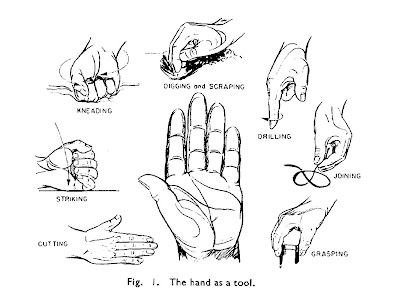
As shown by these drawings from R.J Drillis Folk Norms and Biomechanics, the hands have been the fundamental means through which the world has been shaped, measured, studied and understood. All the actions of machine tools are derived from the motions of the human hand.

In addition, while the metric system is based on relative abstraction, earlier concrete systems, including our system of inches and feet were based on observation of the human hand and other parts of the human body.


The Hands
As schools have attempted to become more efficient in the process of education, children have been confined to desks with hands stilled, essentially blocking their traditional engagement in the process of learning. According to Dr. Frank Wilson, author of The Hand, How its use shapes the brain, language and human culture,
“No one knows precisely when our ancestors started handling textiles and manufacturing thread, but our ability to do this, along with many other tasks, was made possible because of two critical and parallel changes in upper limb and brain structure. Biomechanical changes in the hand permitted a greatly enlarged range of grips and movements of the hand and fingers; the brain provided new control mechanisms for more complex and refined hand movements. These changes took place over millions of years, and because of the mutual interdependence of hand and brain it is appropriate to say that the human hand and brain co-evolved as a behavioral system.

“The entire open-ended repertoire of human manipulative skill rests upon a history of countless interactions between individuals and their environments, natural materials and objects. The hand brain system that came into being over the course of millions of years is responsible for the distinctive life and culture of human society. This same hand-brain partnership exists genetically as a developmental instruction program for every living human. Each of us, beginning at birth, is predisposed to engage our world and to develop our intelligence primarily through the agency of our hands."
Current research in the new field of embodied cognition recognizes that the whole body takes part in the processing of information and human intelligence. The idea that human knowledge is “brain based” no longer provides an accurate view of who we are or how we learn. One of the areas of research involves the use of gesture. Work led by Susan Goldin-Meadow , a psychology professor at the University of Chicago, has found that children given arithmetic problems that normally would be too difficult for them are more likely to get the right answer if they're told to gesture while thinking. In fact, students who can use gesture in the solution of algebraic formulas have been shown to be 4 times more likely to get the right answer. Studies by Helga Noice, a psychologist at Elmhurst College, and her husband Tony Noice, an actor and director, found that actors have an easier time remembering lines their characters utter while gesturing, or simply moving.

There is something extremely powerful about the engagement of the hands. Woodworkers have noted the therapeutic effect of woodworking, calling their time spent in the woodshop, “sawdust therapy.” By and large we feel better when we take the opportunity to immerse ourselves in the process of creating something from wood.

In our nation we have an epidemic of depression and other mental and emotional disorders and use of anti-depressant medications have become common for controlling mood and behavior. I came to my own conclusion that much of the problem has been that we have been out of touch with our own hands, and while being out of touch has disastrous consequences in our lives, it also has profound detrimental effects on the education of our children.

The significance of the hand’s role in learning and the feelings that woodworker’s have about the therapeutic aspects of their time in the woodshop are illustrated by research conducted by Dr. Kelly Lambert at the University of North Carolina. She describes a system of “effort driven rewards” resulting from the creative use of the hands, stimulating an exchange of neuro-hormones in the brain that offsets symptoms of depression and raises overall emotional and intellectual engagement in learning. The idea that the engagement of the hands in learning and making things might come as a surprise to our nations pharmaceutical suppliers, but is no great surprise to those who work with wood. Lambert’s research illustrates how the lack of hands-on engagement leads to emotional disengagement, leading to diminished display of intellectual capacity. This may explain why researcher, Susan Goldin-Meadow suggests, “If you are having trouble thinking clearly, shake your hands.”

So the great educational question we must answer in the first part of the 21st century is very much the same question asked by educational theorists at the beginning of the 20th. “How do we bring the hands to bear on the education of our children?”

The Demonstration at Clear Spring School
The Wisdom of the Hands program is different from conventional school art classes and is different from conventional woodworking programs as well. Each project is planned in cooperation with core classroom teachers to integrate with current studies. By making our own tools at Clear Spring School, we establish a relationship between the materials drawn from our environment, and the student’s growth in confidence by capitalizing on the child’s natural inclinations toward creative activity. We make tools that fit a variety of different categories, each intended to enhance the school’s basic curriculum. Some of the tools enable children to do work, while others are used to expand the children’s understanding of concepts. Some are used for investigation and demonstration of scientific principles, some are used for organizing and collecting data and still others provide additional interest in classroom activities.

•Working tools are those that provide the children opportunity to do other projects, often involving crafts. Examples are looms for weaving, knives for carving, pens for learning cursive, and pencil sharpeners among others.
•Conceptual study tools include geometric solids for the study of geometry, math manipulatives, models of the solar system, puzzle maps for study of geography and plate tectonics. Abacuses for doing math problems and developing numerancy.
•Investigatory tools include windmills for studying meteorology, bug boxes and nets for catching insects, and projectile launchers for the study of trigonometry and physics.
•Organizational tools include divided trays for the collection of rocks and minerals, display boxes for collections of insects and numbered stakes for marking plant species on the school nature trails.

In addition, the children of all ages have a love of making toys and we use toys as tools to expand interest in specific areas of study. As examples, the children have made trains and various animals inspired by their reading. We have made dinosaurs inspired by their study of dinosaurs, as well as boats for the study of the sea, and cars and trucks for the study of economics and transportation. Much of the success of the program is rooted in the close relationship between classroom teachers and the wood shop.

Toy making increases the child’s enthusiasm for learning at all ages. Each project tests new ideas and ends with play. Each child at Clear Spring School has a collection of treasured objects that remind of lessons learned, skills developed.

The Key to our success:
The fact that the classroom teachers are part of the planning process, often suggesting possible projects, leads them to become active wood shop participants, working alongside the students, demonstrating their own engagement in the learning process. Rather than the wood shop being an isolated school activity, it is successfully integrated at all grade levels.

By being deeply immersed in exploring the fundamentals of physical reality, and making his or her own tools for discovery no child is truly left behind, no child is bored, and every child is empowered to engage in creative response to society and environment. The variety of tools that can be made in the school wood shop is without limit. So what is the difference between making an object and making a tool? Tools are intended to have use and impact beyond the time spent in the wood shop. As an example, the simple tray made for the collection of rocks and minerals is not complete until the contents have been collected, organized and labeled. A loom is not complete until it holds a completed cloth. A toy is not complete until it has been played with and enjoyed and learned from. Tools have particular effectiveness in bringing the hands to work in the classroom far beyond note taking and keyboarding. The hands’ profound impact on learning has been widely ignored in American education, but offers the pathway to educational reform and renewal.