Sunday, June 30, 2024

great show and reception for residents

We had a great reception and show of work by participants in our two week woodworking residency at ESSA. I had the honor of observing growth.

Guests had the honor of meeting these fine artists, seeing their work, and buying some to keep. A portion from work sold will support future residencies.

The two week mentored woodworking residency was considered a great success.

There’s a theory in physics called quantum entanglement… that if two particles are introduced to each other, they can be thrust to the furthest corners of the universe and what’s happened with one is known to the other. I believe the same thing happens with people when our creative lives merge. Surely we will have occasions to remember our time together at ESSA and the things we’ve learned in each other’s company.

Make, fix, create and assist others in learning likewise.
 

Saturday, June 29, 2024

Make something with your hands even if it's hideous

 https://www.nytimes.com/2024/06/28/well/mind/hand-crafts-creation-art.html?unlocked_article_code=1.3U0.Ysmx.QmV9TVwr2V2U&smid=url-share

Thursday, June 27, 2024

woodworking resident's show

I'm inviting you to the showing of works by our residents from a two week residency at the Eureka Springs School of the Arts. Woodworkers have been busy finishing works for display and sale.
Among the works are a variety of band sawn boxes, like my own that's shown. 

Make, fix and create...


Wednesday, June 26, 2024

Publication delayed

The release of my new book Designing Boxes has been delayed until October 2024 due to the change in ownership of Taunton Press. 

Earlier in the spring, Taunton Books, which had been sold to magazine publisher Active Interest Media, was then sold to Abrams book publishers, a larger press. It has been a bit confusing and disappointing. 

I'm keeping my fingers crossed that there are no further delays.

Make, fix and create...

Monday, June 24, 2024

A book to share with others

Joe Youcha, founder and director of Building To Teach wrote about my book, Wisdom of Our Hands: Crafting a Life in a review in wooden boat magazine as being a book he would want to share with the mentors from his own life and with his students. Amazon is making sharing just a bit easier with a discount price and an additional discount if you buy two or more copies. You could also, if you like, get a copy from your local library, or buy a single copy and share it with others.

John Ruskin has said that in taking a straight shaving from a plank you'll have learned a thousand things that the word of man cannot express. The Wisdom of Our Hands: Crafting a Life may make those things easier to express.

Make, fix and create....

Saturday, June 22, 2024

Woodworking residency at ESSA

I've finished the first week of my two week residency program for advanced woodworking students at ESSA. Between opportunities to help guide and encourage other woodworkers, I've been busy doing a few things to help the shop. For example I made seven new wooden mallets for student use, new backing boards for the two compound miter saws, and a newly invented hold down for use on sleds. 

In teaching I’ve noticed that not all students have the same hand strength so holding down both pieces while cutting on a sled can be a challenge. For beginners, knowing where to place their hands during the cut can be confusing at first.

The inspiration for this simple device came from Marc Adams school where students are advised to use simple similarly shaped but thin hold downs to keep fingers a safe distance from the blade when using a compound miter saw. For use on the table saw sled as shown, the tunnel underneath provides for passage of the blade without cutting the device. The outside, placed anywhere on the device guarantees that the hands are away from the blade. The extra thickness of this hold down being made from 4 thicknesses of MDF provides pressure over wider, thin stock as would be used in box making. It’s also useful for holding down smaller parts, again keeping the hands a safer distance from the cut.

I've submitted a tip on this device to Fine Woodworking for their consideration.

In the meantime, the August 2024 issue of Popular Woodworking arrived in yesterday's mail. It includes my 6 page article on making a Torsion Table.

Make, fix and create... Assist others in living and learning likewise.

Sunday, June 16, 2024

Box with legs

I like to finish what I start, and so a mitered finger jointed box I started as a demonstration last week now has hinges, a walnut lift tab and surface mounted hinges. An oil finish and lining will come next. I show a simple method for installing a lining on my youtube channel here:  https://youtu.be/qwOGNBmrOjk

Make, fix and create... Assist others in learning lifewise.


Friday, June 14, 2024

mitered finger jointed demonstration box

I've taken a few minutes today to move a demonstration box from my last week's box making class toward completion. This box is assembled with mitered finger joints, a more advanced box making technique. 

Today in the shop I added a floating panel lid. I then cut the lid from the body of the box, and as you can see, I've been shaping feet to give the box a lift. 

After sanding the legs will be glued to the corners of the box. Before the lid is hinged to the body of the box I'll add a walnut lift tab to the front.

Make, fix and create...

Monday, June 10, 2024

demo box

These are photos of a demonstration box, one of two designs made by each of my students before the floodgates were opened for them to spend the next three days working on boxes of their own design. This box is made of white oak and cherry. The unusual color of the white oak is due to a state of decay at the center of the log before milling.

Sunday, June 09, 2024

5 day box making class

I just finished a great 5 day box making class at ESSA. My 7 students made between 3 and 5 boxes of various designs. All claimed that they loved the class. 

In the past I've discussed the difficulties presented by unrestricted economic growth. That's the subject of this article in the New York Times that you can read as my gift.

https://www.nytimes.com/2024/06/08/books/review/shrink-the-economy-save-the-world.html?unlocked_article_code=1.yE0.P4Am.Cx6g__KVMhDp&smid=url-share 

Statistics on economic growth only measure the flow of money from exercises of making and spending. I like to suggest that there are more important things than money that money offers no measure of. The care we offer each other is an example.

One simple way to gradually withdraw from the destructive economy would be to cease buying things made of plastic and to buy hand crafted things from wood instead. 

By doing so, we'll have invested in the learning and character of other human beings, and will acquire useful objects of greater lasting value.

Make, fix and create... 

Tuesday, June 04, 2024

Easy Sharp


Taytools.com has developed an easy way to sharpen chisels and small plane irons. I've tried it. It works. And while I had to make my own jigs to go on the drill press (I made three, one for ESSA, one for Clear Spring School and one for my home shop) Taylor Tool Company now sells the jig and supplies at a reasonable price.

https://lddy.no/1jwo9

Make, fix and create...

Sunday, June 02, 2024

entanglements

 Physicists have noted and proven that if you take two particles, introduce them to each other and then thrust them apart to the furthest reaches of the universe, what is done to one is noted within the behavior of the other. The phenomenon is called quantum entanglement and may someday help us to understand higher levels of human inter-connectedness and inner-connectedness.

Friedrich Froebel had been born the son of a Lutheran minister and his mother had died at a very early age. He was a bright child and cherished by his father's second wife until her own children came along. At that point he was left to fend for himself to obtain the emotional support every child needs. At an early age he was sent to live with an uncle and became apprenticed to a forester, and it was there in the Thuringian forest that Froebel discovered a love of botany and the seeds were planted for what would become Kindergarten, a garden of children. In witnessing the wonders of nature he likely gained a first glimpse of the inter-connectedness of all things.

In college Froebel had planned to become an architect but had an opportunity to work as an assistant to Christian Samuel Weiss, a leading authority on minerals and crystallography. Helping to organize the collection of minerals for Dr. Weiss, Froebel was to witness how things of great beauty grow from patterns inherent within. Should children, given the right circumstances, not grow in the same manner? You see the impact of his work with Dr. Weiss in Froebel's development of his gifts, one through 6 which were designed to lead the child into an exploration of the structure of the universe and through association with other Kindergarten activities, construct their own place within it.

Many of us have seen, even before the internet and before facebook and tik tok, evidence of our inter-connectedness and inner-connectedness. Living in a small town and knowing a few folks, I'll think of someone as I drive through town and then see them coming toward me in the next car. This is not always the case but happens often enough to make me wonder. Under such circumstances, we don't need facebook to remind us that we are a part of one another and that what we do reflects who we are and may be guided by unseen patterns within.

And so, what are we to make of all this? Froebel had suggested three uses for the Froebel gifts. One was to use blocks to create what he called forms of knowledge. Forms of knowledge were used to represent numbers and mathematical constructs important to the growth of the child. Another use was to create forms of beauty. These were to develop the child's design sense through representations of symmetry and rhythm. The third use was to create what Froebel referred to as forms of life, representing the objects to be found in everyday life, thus connecting with the child's natural inclination to serve others by making useful things. So you take these three things, development of intellect, artistic sense, and inclination to serve and you have the formula for growth.

It's ironic that Froebel did not become an architect of buildings, but instead an architect for a system of education that allowed the child to grow from within, as a crystal or flower might grow. In his autobiography Frank Lloyd Wright said about his play with Froebel blocks and their impact, "I can still feel those maple blocks in my hands to this day."

I've become fascinated of late, by the simple realization that when a light shines upon an object, its colors are reflected outward without limit into the whole of the universe. So where do we set the boundaries of self?

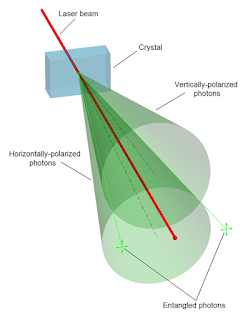
The illustration from wikipedia shows an experiment demonstrating quantum entanglement.

If you are reading this, we are entangled.

Make, fix and create...


Wednesday, May 29, 2024

easy handling

The Nääs style Sloyd chisel handles are very easy to replicate and that might make the design appealing to some. Rather than being turned on the lathe, they are simply shaped using a bandsaw and then sanded. To drill for the tangs to fit, I used my ShopSmith set up as a horizontal borer and used a 3/8 in. drill bit to fit the tangs of the Czech made steel blades. The boring set up and finished set of chisels is shown. 

A distinct advantage of this handle style is that it will not roll off the workbench. The flat sides assure of that.

The Narex set of 6 unhandled chisels is available from Taytools.com

Make, fix and create...

Making Nääs style chisels

Today I've made a set of Nääs style chisels like those featured in Otto Salomon's book, The Teacher's Hand-book of Slöjd:

V. –– Chisels, Gouges, Carving Tools etc.
These terms include a whole group of tools which are used in wood-slöjd for the removal of small pieces of wood, in cases where the knife, the saw, or the plane could not advantageously be used.

They consist of a flat or concave blade made of steel, the cutting end of which is cut straight across and sharpened to an edge, and the other wrought into a four-sided tang, which is set into a wooden handle. The tool in working is driven into the wood either by the pressure of the hand, or by blows from a mallet. In order that the handle may not slip or twist round when grasped, it is generally made with four sides, greater in breadth and in thickness, and with the broader sides rounded. To keep the handle from splitting under violent pressure, the base of the tang is furnished with a shoulder, on which the handle rests.

These tools vary greatly in size both as regards length and breadth. The latter dimensions determined by the dimensions of the edge. The broadest tools are generally also the longest. In order to be able to execute all the different kinds of exercises which occur, it is necessary to have a complete set of each description of tools. There are usually 12 to a set, all of different breadths.
The photo at left shows an original Nääs chisel that a friend of mine gave me in 2016. His dad had found it in a flea market in Sweden and he passed it along to me. I rehandled it in the Nääs style.

Woodworkers often spend a great deal of time honing the beveled side to perfection, but the actual sharpness of the cutting edge will only be as good as the surface developed on both sides of it. Once the face side of an old chisel has been honed to a mirror like finish and if it is stored under proper conditions, keeping the edge sharp will be easy, and accomplished by honing the beveled side with only minor attention to the face.

While the handles are made in my own shop according in the Nääs design, the steel is made by Narex and available as a set from taytools.com.

Make, fix, create, and suggest by your example that others learn likewise.

Friday, May 24, 2024

Links: Making Classic Toys that Teach

BeaverCraft Detail carving knife.
 

AI

Elon Musk is claiming that AI will take all our jobs, thus allowing us to twiddle our thumbs and order up from computers all that we want or need (if anyone can afford it)... this while the world is overrun with meaningless stuff and while social media sucks the lifeblood from our mental health and the lives or our kids.

He also warns that social media is addicting our kids to algorithm supplied dopamines, likely turning them to dopes.

The one remaining occupation that's not a hobby will likely be that of psychological therapist who will be needed for our children as well as for ourselves.

In the meantime, if just one job is lost to AI, perhaps it should be his own.

Yesterday I finished assembly of a third toddler sized rocking chair. I can assure you that it was not made by AI, and the wood used actually grew as a tree. The carving, although simple, was done by hand, with far less perfection than Elon Musk's vision of the world could offer, and with more joy.

My essay on AI, Misinformation and Manual Arts Training can still be found and read free on Front Porch Republic.

Make, fix and create. Our very lives depend upon it.

Wednesday, May 22, 2024

If you haven't done it, how will you know?

An interesting graph from WorkTour.com shows what students consider to be the important factors in choosing a career. You'll note that the two largest factors "I'm good at this" (22%) and "I enjoy doing this"(28%) require  students  to have actually done something. You will not know if you're good at something or that you enjoy doing it, without the reality of having done it. 

I remember an experience in junior high woodshop in which I noticed that I was having difficulty keeping my coping saw cut on the marked like. For just a brief second I looked over at my neighbor's work and realized that perhaps my own work was not so bad after all. His saw cut had wandered far from the line and his work was very much worse.

The very simple graph should illuminate the failure of American education. While it might be focused on students doing real things, it is focused on keeping kids at desks instead.

Make, fix and create.

Sunday, May 19, 2024

The way it works

Everything that can be taught, can be taught to deeper effect if taught hands-on. For instance various aspects of history and culture that are normally taught only through books and lecture can be examined by using various tools from various countries and that tool use can offer insight into human history and cultural development from different nations.

The Japanese woodworking tools can serve as examples. While western handsaws made stiff and heavy through an abundance of steel, Japanese saws were made thin and light because steel was a more precious commodity. Japanese hand saws, because they are made so thin and light are operated in the pull rather than the push stroke. Trying to push  a Japanese saw through a cut will cause the blade to bind and bend, whereas on the pull stroke they work fast and efficiently, so the way of working is shifted by such a simple thing. Even a simple, subtle thing can have broad implications on all aspects of development.

We've used Japanese style saws at the Clear Spring School for many years as they are light enough for kids to use, and still effective as the child grows toward high school age. Working on the pull rather than push gives a different slant to Asian culture and history, and the examination and use of Japanese saws offers a simple way to begin a deeper exploration. Use of real tools and their history and effects provides an opportunity for all students to become more deeply engaged, even those who are choosing to go to college, or may be in college at the present time.  This is just one small example of how crafts can be useful to deepen an understanding of a particular subject.

Taytools.com has excellently crafted Japanese saws on sale right now at 30% off. The dozuki saw is the one I use for cutting dovetails.

Another example of the more sparing use of steel can be found in the typical Japanese rasp. Instead of having a heavy steel body with raised cutting edges, the Japanese rasp is made of much thinner materials, reflecting again the reduced availability of steel. Both the Japanese saws and rasps surprise western users with how easy and effective they are to use. Taytools.com also has these on sale. 

If you teach a subject normally taught by reading or lecture alone, use your imagination. Look for opportunities to bring the hands into learning.

Make, fix and create...

getting real

The greatest problems in modern education can be summarized as the 3 Ds: Disengagement, disinterest and disruption. Schools often fail to engage children's innate capacities for learning. In worst cases, students become disruptive of the educational interests and needs of others. At a very early age, children are instructed, "don't touch!" "Keep your hands to yourself!” 

But the hands and brain comprise an integrated learning/creating system that must be engaged in order to secure the passions and "heart" of our youth. It is the opportunity to be engaged through the hands that brings the seen and known to concrete reality in human experience. Without the opportunity to learn through the hands, the world remains abstract, and distant, and the passions for learning will not be engaged. 

When the passions ARE engaged and supportive systems (teachers, community resources, technology etc) are in place, students find no mountain is too high, and no concept too complex to withstand the assault of their sustained interest and attention. You don’t have to take my word for this. You can see it in action, and while I can describe my own observations, I know that you, the reader of this material can reflect on times when your passions have been engaged in your own lives and your own learning has been at its height. So what is the answer to the challenge of engaging the heart in education? a

Get real. Real life engages the intellect and the imagination. Crafts are an excellent way to bring the real world into the classroom. Real tools, real materials, real work, making real objects with real use. The purpose of the woodshop at Clear Spring is to help all the other subjects become real and engage the hearts and the passions or our students in education. You know what? It really works.

Wednesday, May 15, 2024

When the hands are engaged...

When one's hands are engaged in seemingly repetitive tasks, the mind is neither numbed nor silent. Folks at work with their hands are often engaged in thought and thoughtfulness unapparent to the observer. Just as students in a lecture hall can be surreptitiously engaged in checking their face book pages and the professor will not know whether they're listening, the casual observer of a craftsman at work will know nothing of the inner workings of a craftsman's mind, unless he or she has taken time to make an investment in the development of skill, and knows by extension the depths and complexities of a craftsman's thoughts. Make, fix and create...