Valley is also the home of Valmont Industries, originally Valley Manufacturing, one of the early manufacturers of the circular irrigation systems that are in use throughout the world.
Valmont, with an expanded product line remains a major employer. And so it was with many small towns in America. Small towns would grow from unique ideas that had a significant effect on the world at large. Educational policy makers attempt to standardize education and make all students look at things the same way, and teach all students exactly the same things, and we suffer culturally and economically as a result. We are led to ignore the value of things that grow large from small things. Instead of standardizing education, we'd do better for ourselves and our kids by diversifying. The arts are one of the best ways to do that.
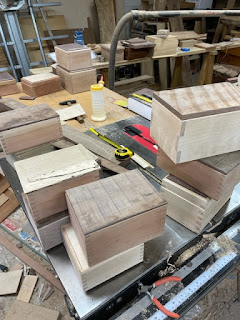
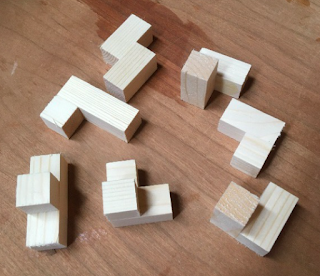
At the Clear Spring School this week with our group studying small business, I mentioned possible sale of woodworking kits, and I provided kits I'd prepared for building Soma Cube Puzzles from wooden blocks for our students to assemble. The students sanded and glued the blocks into the arrangement shown. The Soma puzzle consists of seven pieces, each consisting of 3 or 4 blocks representing the only 7 ways sets of 3 or 4 blocks can be arranged other than being in a straight line.
Concurrently, the core teacher got a 3 D printer for Christmas and is interested in learning its use. I am concerned that 3D printing of things not designed by the students can be a waste of time and talent, and of less educational value so we'll be using Tinkered software for the students to design objects that can be printed, and that reflect their experimenting with objects made of wooden blocks.
The experiment involves some interesting connections with educational sloyd. First start with the interests of the child. The kids love Minecraft, a game that involves pixelate creatures and landscape that appear as through they're made of blocks. In order to go from the easy to the more difficult, and from the concrete to the abstract are two principles from Educational Sloyd. It's easy to build with blocks and thus experiment with pixelated designs. (And it's very easy for me to make lots of uniform wooden blocks).
It can be difficult to learn and used 3D design software, so we'll use Tinkercad on iPads for the students to make designs reflecting their arrangements of blocks. Wooden blocks are concrete in that they have texture, and weight. Tinkercad is abstract. The finished, 3D printed objects will become concrete representations of student thought. And the play with blocks brings Friedrich Froebel back into the 21st century classroom.
Make, fix and create.