Wednesday, October 24, 2007

I had a great day in school today. The 5th and 6th grade students worked to finish their topographical models of Mt. St. Helens, and almost all got satisfactory results. It was an experimental project like most that we do, with the results uncertain. No project should be too easy. This one wasn't. The 7th and 8th graders worked on turned tops and pens turned on the lathe. This was also the day for high school wood club. It is nice when students show extra attention for a subject in the after school hours.

I want to share just a bit more from Ethel J. Apelfels article, The Anthropology and Social Significance of the Human Hand from Artificial Limbs, May 1955.
THE HUMAN HAND IN ART
Through the ages the human hand has appeared in all of the creative arts of every culture. A single line, a schematic portrayal, a simple gesture of the hand, and character and personality stand revealed as clearly as they are seen in the human face. Recently, in the Kefauver investigation of crime in New York City, the television camera focused on the hands of a witness, and millions in the television audience watched while hands expressed feelings that man has taught his face to disguise. In the creative arts, the hand speaks, and one senses the tremendous power of the hand to convey human emotions. The hands are the organs of the body which, except for the face, have been used most often in the various art forms to express human feeling. The hands point or lead or command; the hands cry out in agony or they lie quietly sleeping; the hands have moods, character, and, in a wider sense, their own particular beauty. From prehistoric times to our own day, in every society known to science, the hands symbolize cultural behaviors, values, and beliefs.
The following is from The Anatomy and Mechanics of the Human Hand CRAIG L TAYLOR, Ph.D. & ROBERT J. SCHWARZ, M.D.and is available as part of the .pdf file Artificial Limbs, May 1955..
It is obvious to all that the human hand represents a mechanism of the most intricate fashioning and one of great complexity and utility. But beyond this it is intimately correlated with the brain, both in the evolution of the species and in the development of the individual. Hence, to a degree we "think" and "feel" with our hands, and, in turn, our hands contribute to the mental processes of thought and feeling.
But obviously, what Taylor and Schartz observe, must not be obvious to all. Or someone beyond the few of us would be doing something about it, restoring the traditional role of the hands in learning and helping all our children to understand that their own learning must take place outside the limitations of available texts.
I ran across a wonderful exploration of the hand by Ethel J. Alpenfels D.Sc. 1907-1981 NYU. Called The Anthropology and Social Significance of the Hand nested in a broader discussion of the needs of hand amputees called Artificial Limbs, May 1955. If you click on the title at left, it will begin a 3 meg .pdf download, but I suspect you may find it to be worth it. A bit of Dr. Alpenfels discussion follows:
LANGUAGE ABSTRACTIONS
Because the human hand is an organ of performance, it is not surprising that the hand should "manipulate" ("to lead by the hand") the human vocabulary. The hand receives the "mandate" (from Latin "manus," for "hand," plus "dare," "to give") from the brain, and to "manage" is to govern, direct, or control. Thus, man "commends" (which originally meant "to place in one's hands") and "commands," both words related to "mandate" and, therefore, to the Latin "manus," for "hand." With its basic movements for grasping objects (page 33), the human hand also is "handy" ("dexterous," "to have two right hands") for grasping ideas. To "comprehend" is to "seize" (Latin, "capere," "to seize"), from which we derive such words as "perceive," "conceive," and "receive." Thus, by various shades of meaning, the human hand not only "hands down" information but "picks" it up. The human hand also is an organ of perception and thus lends itself to the most abstract concepts. "Handsome" originally meant "dexterous." "To feel" is connected somehow with the Greek word for hand, "palame." To say in Latin "dicere" means "to point." We touch, feel, handle, finger, thumb, paw, grope, palpate, and stroke objects.
As you can see, the resources are enough that I can go on and on without ever plumbing (c.1300, "lead hung on a string to show the vertical line," from O.Fr. *plombe, plomme "sounding lead," from L.L. *plumba, originally pl. of L. plumbum "lead," the metal, of unknown origin, related to Gk. molybdos "lead" (dial. bolimos), probably from an extinct Mediterranean language, perhaps Iberian. The verb is first recorded c.1380, with sense "to immerse;" meaning "take soundings with a plumb" is first recorded 1568; fig. sense of "to get to the bottom of" is from 1599.) the full depths of the hand. Even the words man and woman are based on these wonderful instruments at the ends of our arms. You might think that those in education (smart people, right?) would know that the hands are significant to everything we do, and that to fail to engage them in education would be the height of their stupidity. The Wisdom of the Hands program at Clear Spring School offers a model for taking education in hand.

Tuesday, October 23, 2007

At left is another chart from the Rudolfs J. Drillis article Folk Norms and Biomechanics illustrating the origins of basic units of measure. (Click on the image to see it in a larger form.) By using measurements based on the body, tools could be made specific to the user, rather than specific to an arbitrary standard. For example if I were to make rakes for my wife and I to do the raking of leaves around the house, hers and mine could each be made using the same "rule of thumb." Her thumb and mine, leading to differing results, with my rake being designed longer to match the proportions and efficiencies of my own body. It is interesting to think of standardization as having the purpose of meeting the needs of the individual rather than the needs of the manufacturers and distributors of objects.
It seems like the whole school is busy making ink pens. The 1st and 2nd graders finished their second pens today so now they can each take one home and still have one at schol for practicing their cursive. The 7th and 8th grade students began making turned pens on the lathe in addition to the hand carved ones they started last week. The 3rd and 4th grade students finished their pioneer lanterns today, but have been practicing their letters using the pens they made last week. Making the pens has helped to renew an interest in penmanship, cursive and greater care in the written presentation of ideas. Who knew that something that happened in the wood shop could do that?
The drawing above is from the Rudolphs J. Drillis article Folk Norms and Biomechanics. All human tools are based on extending the power and efficiency of the normal range of bare hand activities described above.

Monday, October 22, 2007

A moment's reflection on a shameful metaphor... As illustrated by George Lakoff and Mark Johnson in Philosophy of the Flesh and Metaphors We Live By, an examination of our language reveals our core beliefs. Sadly, if you search on the internet for "dirty hands," you find that it is a metaphor for guilt and shame in the perpetration of horrific acts.

How naive I am as a simple craftsman! I thought having dirty hands was a sign of labor and effort in wood, metal, or clay or of the planting and nurture of living things. I guess I've been hanging out with the right people, and maybe not watching enough television to fit in. The historic denigration of labor is pervasive and deeply ingrained at the core of our culture. But the greatest shame is that there are those who know nothing of the true meaning of dirty hands... service, work and creativity.
Joe Barry sent me a paper written by Rudolph J. Drillis called Folk Norms and Biomechanics published in 1963. It presents a wealth of information which I hope to share in the coming weeks. This article can be ordered on-line if you are a subscriber to PubMed.

Yesterday, while my wife and I had a craft day visiting the War eagle Show, my daughter Lucy at Columbia had a craft day of her own. Being in an academically charged environment with lots of homework, she and friends decided to get out their limited amount of crafting supplies and have a craft-play-therapy day of their own. In addition to all the other things the hands do, (if you have been either reading here, or paying attention to your own hands, you know they do a lot) they are quite good at keeping the head on straight. As I've mentioned before, every artist and craftsperson I know confesses to the value of their work in shaping their feelings, helping them to moderate their attitudes and enhance their levels of self-esteem. I have inquired of a number of mental health experts and have yet to find anyone who has done a clinical study of this, but the anecdotal evidence is profound and overwhelming.

Any questions, pick an artist at random and ask. You may learn that making things is safer and more effective than prozac or any other over the counter pharmaceutical. The correct dosage is self-prescribed. But, sorry, as far as I know, no one has found out any ways to make lots of money from it, which may explain why no studies have been done. You need not be a professional artist to receive the full benefits.

Sunday, October 21, 2007

Today I went to the War Eagle Craft Show. I stopped selling my work at that show about 15 years ago, but I found that there were still some old friends around like Skip Cluff, a maker of sand cast jewelry, and pictured at left. Sand casting is a very old metal working technique in which the artist works with a sand medium, making direct impressions to form the mold, which can then be reshaped in making new molds after the metal is cast. It is important that old creative techniques be preserved, and they are largely preserved for future creative use in the hands of a small number of makers like Skip. Some of his work is shown below.

War Eagle is one of the oldest craft fairs in the U.S. and it is amazing to see the amount of energy involved. Personally, I am a craft snob. I prefer useful, highly crafted items which preserve creative tradition to the kinds of things that are quickly made, purely decorative and fill homes with senseless clutter, so with a few notable exceptions War Eagle was a disappointment to me. But shows like War Eagle do illustrate the compulsion that people have to use their hands in association with their intelligence. Unfortunately, the buying public is more interested in buying poorly-made, hand-crafted decorative objects than highly crafted beautiful and useful things. But, seeing old friends, a few craftsmen keeping old traditions alive, the beautiful day in the Ozarks, and time spent in the company of closest friends made a great day.

Saturday, October 20, 2007

It is Saturday in the wood shop and I'm still competing with the Chinese. Danish oil brings the color of the wood to life, protects it from greasy fingerprints, keeps it looking beautiful for decades or longer and highlights every little flaw or sanding mark I may have overlooked yesterday. Oiling boxes is a thing that keeps you on a clear course. You have to be there at the right time to rub things out to attain the perfect look, so you don't wander too far... you could make a mess of things.

I was thinking just a bit more about philosophy, and in particular about "mission." It helps in life to have one... an objective that is in some way greater than yourself. It becomes the focal point of energy as you practice "dual awareness," but it also enlivens you. The energy of mission, identification with higher principles and ideas, shows in your work, and also shows in life by providing greater energy for the persistent application of attention.

My own small boxes are designed to have a mission of their own. Sure they hold things, but they are also designed to help acquaint the user with the beauty and diversity of our native American woods, imparting a sense of understanding and value. It is a very simple thing. I present the woods in their natural colors, at a level of quality that expresses respect for the material, and in signing the work, I identify the species used, and the user gets it. So mission doesn't have to be complicated. You just decide what it is, make certain it is worthy (something more significant than making a buck) and spend a bit of time pushing and refining. You will probably find as I have that there will be those who will lend their shoulders to the work in ways that you might never expect.
It is time to get back to the boxes. Have a great weekend. The photo at left is of boxes drying from their first application of Danish oil.

Friday, October 19, 2007

TGIF …Once again it is Friday and my day to compete with the Chinese. So I have been sanding small boxes (something that could be a near-mindless activity) and reflecting on the unconscious nature of the hands. As I’ve quoted before from Jean Jacques Rousseau, “Put a young man in a wood shop, his hands will work to the benefit of his brain, he will become a philosopher, while thinking himself only a craftsman.” (Don’t look for this quote in English translations of Emile, as you won’t find it exactly as quoted here. It has to go from French to Swedish to English to arrive at this understanding). I want to explain a few things about the hands and how they work, and how they open the mind to exploration of philosophy.

At first, as the hands learn a skill, a great deal of mind and attention are required for their control. There is a constant back and forth feedback loop between the senses and controlling structure in the hands and the processing power in the brain. As the control of the hand activity becomes more clearly established, some of the feedback loop moves from the foreground of thought to an unconscious realm. This liberates the processing power in the brain to engage in mind wandering activity. If you have paid the slightest attention to the workings of your own consciousness you can see the truth in this, and a classic example is driving a car. Once you have mastered steering with your hands your processing power is made available to carefully observe the road, watch for danger, make decisions about your route and your destination, and even allow your mind to wander to things completely unrelated to driving the car (cheeseburgers and cell phones?).

Every act of making, whether in wood, metal, cloth or clay is a moral act, shaped by thought, belief and desire. Decisions are made in making that reflect values, and in the act of making, those values are placed on the line as an expression of the character and quality of the maker that can be read and understood by others by examining the usefulness, beauty and quality of the object made. So what about the processing power of mind that is liberated when the hand’s work is mastered? That is the space in which philosophy is mastered as well… that opening of mind that lies well beyond the idle, detached-from-reality speculations of traditional philosophy.

In that space between the direct attentions that are required to complete the object, and the proficiency that grows to allow the wandering exploration of mind exists the potential for the development and expression of the human spirit.

A friend of mine had called it dual awareness. In the relationship between the hands mind and materials, there is a rhythmic expansion and contraction of required attention in relation to the object. By observing how our attention is balanced between the object being made and the normal tendencies for the mind to wander into other places and scenarios, a sense of our dual nature is attained. The maker is given a choice… either follow the wandering mind until difficulties arise in the making of the object, forcing attention to return, or consciously choose to hold focus directly on the object, instilling a vital force of attention into the psychic structure of the object itself. The maker can take either the easy pathway of escape into fantasy until called back to reality by the materials being crafted, or the maker can apply his or her attention continuously to the making of the thing. The first is the path of least resistance, the second is the path of the peaceful-warrior/maker. The first describes the making of objects of practiced beauty. The second describes the making of objects with inexplicable radiance, and yet, how many do you think can dwell in that perfect state?

And so we come to the philosopher in the wood shop. He becomes a student of his hands and his attentions, and from that foundation explores the very nature of life and perception. When his mind wanders, he pulls it back from circling mundane thoughts of common life, to the task at hand, or failing that, onto the subjects of quality, beauty and mindfulness and to the people with whom he would share his work. Having heard of the peaceful-warrior/maker and having once seen her work, he is reluctant to squander his attentions on the mundane.

So, today, I am sanding boxes. My mind wanders. I try to place it more firmly in the moment, and from what I see and feel in my own hands and from the attentions I apply in the making of these few things, I have a hope that a few things in the world might change in the guidance of my own hands.

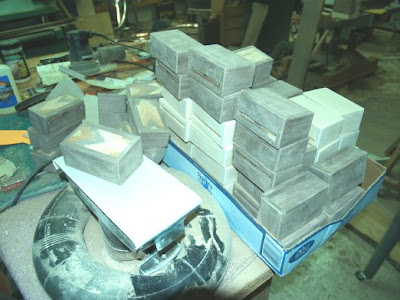
The photo above is of boxes being sanded. Sorry this is so long. With practice, I hope to get the concept down to 29 words or less.
I was thinking this morning about how unusual it is for children to be asked to use knives in school and realizing how unlikely it will be that other schools will follow the example we set. Even in scouting children and adults are no longer trusted. The following is from a recent email from John Grossbohlin:
My sons and I had a conversation about the issue of toys vs. tools and play vs. fun learning Wednesday evening while returning from the wood-turners club. It was evident during the conversation that my sons have noticed how sheltered their peers are from doing anything "real."

I am astounded at how many parents react with horror that I have the Cub Scouts use a real pocket knife and a real piece of wood when I teach the Whittl'n Chip card. Pretty much all the Packs and even the Boy Scout camp staff have the boys use a butter knife, sometimes plastic, and a bar of soap to learn how to use a knife... Ignoring the dull vs. sharp issue for a moment, how, I ask, is someone supposed to learn about stop cuts, splitting cuts, paring cuts, etc. if there is no grain and the medium crumbles????

Even my son's Boy Scout Troop is reluctant to let the boys actually use knives... It's as if they expect the kids to somehow "know" how to use a knife and other tools when they become adults--which judging by what I see adults do is a foolish assumption!

What I found kind of odd is that Jesse used my 3/4 axe to chop down the dead peach tree in our yard and I thought he'd be proud to tell his peers but he never told anyone at school or Scouts. Nor does he mention target shooting with a .22 rifle or 28 gauge shotgun. It seems that doing these things is not socially acceptable any longer... people only see danger and law suits and never stop to think that there are proper ways to use these tools and with proper instruction and following the rules they can be used safely. What has happened in the 40 years since I was my sons' ages... has the populace become so risk averse as to be useless?
I guess if you were to watch TV much at all, you would see knives used time and time again, as instruments of torture and terror. So, in our culture, I can understand the parental desire to shelter children from risk. But television and our own fears are creating a perverse understanding of the tools that have shaped our culture through countless generations. Shame on us. To avoid the small risk of injury, we have created the certainty of undue fear, dark fantasy, and loss of relationship with common instruments of creative potential.

Thursday, October 18, 2007

A quick note on today's lesson in 1st and 2nd grades. The students decided they need pens to take home, but also pens to keep at school, so they have asked that they be allowed to make more pens next week. Of course I told them yes.
This morning in the Clear Spring School wood shop, the 1st and 2nd grade students made their own hand carved pens based on an early Sloyd model. The work and results are shown in the photos at left and below. The students were so excited to be using the pens they had made to practice their letters and learn cursive. Ozric asked, "Where do you buy this ink? I want to get some so I can practice at home!"

On the subject of pencil grips, Joe Barry sent me a Link to a page illustrating functional, immature and inefficient grasp patterns. There are some that work better than others, and the grip will mature with regular use.

Wednesday, October 17, 2007


Richard Bazeley sent me photos and the description as follows:
"My friend Merv, a retired engineer, has kept the projects that he made in year 9 at Technical school over 50 years ago. He is quite proud to show me this and other pieces that he made. The work has his name and grade stamped on it using a metal punch. I admire the accuracy of this work."

Merv is one of many students who have taken pride in their work and kept it for years as examples of their accomplishments. I know that most educators and parents these days think that there are more important things for our children to do in school, like learning the things that will be measured on tests and then quickly forgotten.

Today in the Clear Spring wood shop we continued our project making 3-d elevated models from topographical images. It was difficult for all of the students. They are too easily distracted and struggled to pull their attention from discussion of the latest video games. We had to call the chatter to a halt and ended the class with a discussion of the ineffectiveness of multi-tasking and the importance of giving projects full attention. Not all projects in the wood shop turn out the way we would like, but every thing that arises offers unique opportunity for growth. The photos below show teacher Andrea's model of Mount St. Helens and one of the finished wooden boxes for geometric solids (7th and 8th grades)
Richard Bazeley, wood shop teacher in Australia offers the following comment:
My students have always been interested in the technique of using the hand and pencil as a marking gauge but few are able to copy it. One of the problems they have is the methods they use for holding a pencil to write. Many of them have never learnt how to hold a pencil properly. They hold the pencil with such an uncomfortable looking grip that I wonder how they can write at all. Ask your students to print the alphabet on a piece of paper. Observe how they hold their pencils and shape the letters. If they have been shown how to hold the pencil correctly then this is a simple task but if they haven’t then this simple task is quite a chore. How this affects the rest of their learning is a question I have asked the literacy teachers. I have yet to receive an answer.
Richard, I can remember being corrected as a 1st grader as I sat at my desk forming my letters. It seemed that I didn't have the "proper grip" and that began an early struggle that I finally abandoned. I'm not sure that the right grip is as important as finding ease and familiarity in the use of the pencil. In my first grade teacher's view, my grip has been wrong my whole life.

The thing that I suspect is happening is that simple writing tools are being abandoned as we peck our ways through life on the qwerty. Writing is not something that parents would allow school boards to invest class time towards. We think we have better things to do than provide time for children to become familiar and comfortable with technologies from the past. But today, the 5th and 6th grades class at Clear Spring will spend the morning with scissors and tomorrow the first and second grade students will each carve his or her own fountain pen with a knife. Richard, thank you for sharing your observations. I think your question for the literacy teachers is a good one. We have far too little information about learning and the way the hands grasp learning as we hurl our schools head-long into new technologies and continue to abandon familiarity of common tools and use of the hands.

Tuesday, October 16, 2007

While I'm on the subject of the geometry of the hand and body and how an understanding of the workings of the body can give greater effectiveness to creative work, I want to share these early Sloyd illustrations used to emphasize the importance of posture on the effectiveness and accuracy of work. Conversely, these illustrations also showed the usefulness of Sloyd woodworking in the development of the physical body. These illustrations were commissioned by Otto Salomon at Nääs and distributed throughout the world in the late 1800's. While modern education places little emphasis on proper posture in the learning environment, most teachers can tell in a glance which students are listening, which students care, which students get the material and which students will inevitably fall behind. There is a deep connection between the body and the mind, and learning is best when it engages both.
The photo at left shows another simple hand technique, using the fingers and pencil as a marking gauge.By adjusting the distance between the pencil held by the first finger and thumb and the other fingers as they trail the edge of the wood, precise lines can be marked for carving or other detail work. This technique will also work on curved edges.

In the wood shop at Clear Spring this morning we began making pioneer lanterns with the 3rd and 4th grade students, by piercing patterns in tin cans. Next week we will finish by making wooden bases.

Monday, October 15, 2007

Math and Science teacher, Pete Golden in the photo above contemplates his nearly finished launcher for studying ballistics, and momentum. The first use of it was a disappointment, sending Pete back to the drawing board for modifications. Some of the students were luckier, getting better range with simple launchers. Next week we will have a few minutes to finish up and then a competition of some sort. This has been a fun project with each student challenged to think creatively and practice their problem solving skills, and is a good illustration of how a wood shop can enhance other areas of study.
Here's another simple hand trick. Take a piece of paper and a pencil and draw a straight line across the page from one side to the other. Unless you are practiced at this, you may find it difficult to draw a straight line. Now turn the page 90 degrees and draw the same line in a different manner. Hold the hand still and use the downward rotation of the shoulder with the concurrent bending of the elbow to draw a straight line. You will probably find it easier with less practice and greater efficiency to draw the line with the page turned.

A reader will always look at a page in the same angle in order to understand the information as it is presented. An artist, however, will rotate the page to make use of the geometry of the hand, and in consequence will observe things from a variety of perspectives. So does the use of the hand actually shape our perceptions, and the flexibility of our approach as we examine the world? Would you try it for yourself? Please do. Then, you tell me... Are we missing something by failing to engage the hands in learning? Do they offer anything significant to our intelligence or our perceptions of the universe? If all learning also required hands-on application of knowledge, doing, would what we learned be different in some way?

One way of learning leads us toward obedience and complaisance... the other toward creativity, active participation and leadership. No wonder we don't want the hands engaged in education! It might start a revolution.

Sunday, October 14, 2007

Geometry of the hand and body... at one time, human beings were so deeply involved in the exploration of the world through their hands that there was no need for conscious consideration of what everyone knew instinctively from their own direct experience. Now we have become largely isolated from the development of hand skills. But for those who want to draw or create, and whose use of hands has been limited to brushing teeth and poking the qwerty, a look at hand tricks and the basic geometry of the hands and body may help your hands to act with greater control and intelligence.

The idea in education has been that hand skills are only for dumb people. The consequence is that we have a lot of smart people who aren't actually as smart as they like to think they are, and a few minutes with a pencil or scissors can be devastating to trumped up and inflated egos barely able to cope with unexpected encounters with physical reality.

The illustration above is of a very simple thing, pivoting the hand on the bone of the wrist to create a smoothly drawn arc. It can move from a radius to an ellipse by gradually extending the first finger and thumb during rotation. By changing the pivot point from the wrist to the elbow, the shoulder or a combination of all three, larger simple or complex curves can be drawn. This is something you can try for yourself with paper or directly on wood and with either pencil or pen. It is much better that you experiment and discover things for yourself through your own observations of human geometry and thought. So please don't just take my word for things. Start simple and experiment. There are other tips on tool use and hand consciousness presented earlier in the blog, and I welcome readers to contribute your own tips for increasing hand smarts. In the coming days or months, I will be adding a few more of my own.

Saturday, October 13, 2007

Two distinctly different views of manual labour:

Oscar Wilde:
"And as I have mentioned the word labour, I cannot help saying that a great deal of nonsense is being written and talked nowadays about the dignity of manual labour. There is nothing necessarily dignified about manual labour at all, and most of it is absolutely degrading. It is mentally and morally injurious to man to do anything in which he does not find pleasure, and many forms of labour are quite pleasureless activities, and should be regarded as such. To sweep a slushy crossing for eight hours, on a day when the east wind is blowing is a disgusting occupation. To sweep it with mental, moral, or physical dignity seems to me to be impossible."
On the other hand, Mahatma Basaveshwara
...was a spiritual leader and a practical visionary, who believed work is worship. In one of his hymns, he stresses the significance of labour for attaining perfection in the sphere of spirituality. Rejecting the status ascribed by birth, he believed in the individual worth of every human being and in the dignity of labour.

Much before Mahatma Gandhi made us acknowledge the dignity of manual labour, Basaveshwara underlined its importance and gave respectability to it. He proclaimed that all members of the state are labourers, some may be intellectual labourers and others may be manual labourers. He established numerous committees on different vocations and gave due representation to people pursuing those vocations. It was a novel way of espousing the cause of people engaged in manual labour. His encouragement of manual labour in the 12th Century contributed to the enrichment of crafts and the well being of artisans.
For more about Mahatma Basaveshwara, visit his entry in Wikipedia.org
Otto Salomon, Swedish educator and the international proponent of Educational Sloyd said that while the value of the carpenter's work is in the usefulness of the object, the value of the child's work is in the child.

Many years ago, I was a member of a meditation group, the purpose of which was to lift the understanding of its members to a broader, higher, and more encompassing perspective. The leader of that group offered an exercise in which the students were to look at an orange, first in contemplation of its form, its spherical shape, then in contemplation of its qualities as expressed by surface texture and color, and then move to the question, "who thought it up?"

We are surrounded in our lives by objects, either natural or man-made, and in naming them we feel a sense of relationship and mastery, and yet, the story told by the most simple object is well beyond the human range of perfect understanding. What we might feel as relationship and mastery don't come close to an understanding of complex reality.

The students at Clear Spring School can hardly wait to take home the objects they make in wood shop. "Can I take this home today?" they ask. There is so much excitement in holding and sharing with others the objects we have made. I know, because I see it every day and I feel the same things myself, about my own work.

It is a true challenge in this day and age to look up from our idle naming of things to see their intrinsic qualities, and much harder still to comprehend the incredible stories those objects tell. The best stories are those human ones, of obstacles overcome, of challenge, learning, discovery, and growth. The students at Clear Spring and their parents know that the objects they bring home are much more than just simple things.

Years ago, I sat with the meditation group during the exercise with the orange. A woman gasped audibly at step 3. The orange, she said, "disappeared for a moment in a blaze of light." Perhaps there is more to things than meets the eye. Perhaps there are things that meet the heart as well. There are doors of perception that when closed narrow our vision to the naming of things. Those doors open, reveal wonder, mystery and intense inexplicably profound relationship. And we get to choose.

Friday, October 12, 2007

There was another massive recall of Chinese toys today. So the question, when shopping for your kids, is it safer to buy tools that require careful supervision and attention in their use, or toys that you think are safe but will have long term hidden consequences for the health of your child? Me, I'd choose an original Frost's Sloyd knife, a Vaughan Bear Saw, and a Vaughan 10 oz. Little Pro hammer for my child. Also, a sewing kit with sharp needles, and scissors that come to a point. The point being that individual creativity and empowerment will last a whole life. A toy, on the other hand, will entertain for a short time and go to the land-fill next month where the lead from its toxic paints will leach into our groundwater. Then there is the other matter. Do you buy toys that endanger your child with the probability of growing up to become an undisciplined nit-wit? Or tools that lead to creativity, responsibility and growth?

By the way, when you buy tools, don't buy kiddie toy tools for your children. Don't buy fakes. Give them tools that last and that they will still use and be proud of when they're my age.

I was pleased today with Al Gore's Nobel Peace Prize. Some of his critics will note that he only gets half of it and shares the other half with a United Nations committee. But this award clearly signifies a new recognition of the importance of efforts to stop and reverse global warming. Congratulations Al Gore!
The following is from a book by Elizabeth Gilbert The Last American Man, quoting Eustace Conway:
"The world is ruled by a few basic physical laws--leverage, inertia, momentum, thermodynamics--and if you are out of touch with these fundamental principles, then you can't hammer a nail, carry a bucket or roll a wheel. That means you are out of touch with the natural world. Being out of touch with the natural world means you've lost your humanity and that you live in an environment that you completely do not understand. Can you even begin to imagine my horror at this? Can you begin to comprehend what's been forgotten in just a few generations? It took mankind one million years to learn how to roll a wheel, but it only took us fifty years to forget."

We've forgotten, of course, because of the oldest natural law on the books: Use it or lose it. Kids can't manage the simplest tools because they have no need to learn. It serves no purpose in their comfortable, well appointed lives. Their parents can't teach them this kind of physical dexterity, because they, by and large, don't have it either. Don't need it, never learned it, no call for it anymore. But we know things weren't always this way. Even a century ago, for instance, there wasn't a man in America who didn't carry some kind of knife with him at all times. Whether it was for skinning bears or trimming cigars, a man needed a knife as a basic tool for living, and he knew how to take care of it and sharpen it and handle it. Who needs a knife now?
One of the surest ways to counter the consumer mentality is to stop buying our children the kinds of objects that distract and entertain rather than educate. This year, for Christmas, instead of plastic objects with hazardous lead paints, how about buying them real tools and materials for their education in physical reality? Knives and scissors might be the best way to begin a renewal of American creativity. Give them tools and the opportunity to engage with real materials in the real world. They and you will learn that happiness isn't something that comes in a box... that there is a deeper thing called joy, that is discovered in relation to the natural world when shared with mentors and lived as wisdom.
You may have noticed that American president George W. Bush, who for the first six years in office denied the existence of Global warming and used his office to obfuscate the issue and increase the ignorance of the American people has finally stepped on on-board to acknowledge its reality and ask the world for voluntary action. An important thing that everyone is missing, still, however, is the role of the massive wasteful consumer economy on the creation of global warming, and the potential for change by the American consumer to alleviate its causes. No one ever dares to mention conservation, as that would cut into the huge profits taken by the fossil fuels industries.

What does this have to do with the Wisdom of the Hands? What if we were making things in our own homes and communities instead of shopping? We would cut the huge wasteful traffic to the mall. We would find pleasure in our own creation of beautiful objects from common raw materials. We would discover our identities as makers, transcending the empty and wasteful consumerism that holds our culture and our planet in its choking grasp.

And again, what if we were making things instead of shopping? It might be pretty sad at first. We don't make things as well as machines, but in time with some attention and practice our skills will grow. The things we make have greater feeling and greater effect. We shape material and are shaped as well. In our efforts we become makers, powerfully engaged with tools and the essential realities of the materials of life. In essence, we become wisely woven into the warp and weft of human creative culture, joining the tradition of those who were here before, painting the caves of Lascaux, carving the stone of the great cathedrals, making simple things from wood or fabric that enrich the lives of our families and members of our communities.

But don't hold your breath. Change is not coming soon. This is a revolution that takes place one maker at a time, and the tide currently stands against us all. The forces of mind numbing consumerism are huge and staunchly arrayed in fear lest we discover the hollowness of their offerings. They will not mention the role of the consumer in making change. There is no mention of conservation. They want us to think that we can shop our way out of global warming by buying new light bulbs, refrigerators and carbon credits, so they can keep their hands comfortably in our pockets and gas tanks as we face change. So we grow one maker at a time. It is inevitable. The hand and the physical realities we face call us to be creative. And we will be.

Thursday, October 11, 2007

I started another blog in which to gather and republish my written material related to Saw Zen. A link is also provided at right.
Lessons from a broken cup... from Zen Flesh, Zen Bones, Compiled by Paul Reps.
Ikkyu, the Zen master, was clever even as a boy. His teacher had a precious teacup, a rare antique. Ikkyu happened to break this cup and was greatly perplexed. Hearing the footsteps of his teacher, he held the pieces of the cup behind him. When the master appeared, Ikkyu asked "Why do people have to die?"

"This is natural," explained the older man. "Everything has to die and has just so long to live."

Ikkyu, producing the shattered cup, added: "It was time for your cup to die."
A wise shopper sees the end as well as the beginning. He or she knows that in the acquisition of the object is the responsibility of its disposal. Every large truck arriving at the big box store has its partner, noisy with a gross odor due to the spoiled, infected nature of its contents, that carries away the no-longer-wanted, worn out and wasted stuff for burial in huge mounds or holes from which vile effluent spreads through the groundwaters of our nation to poison our communities.

A wise craftsman sees the end as well as the beginnings of his or her own work. There are lessons from the broken cup. We invest what we can of ourselves in the object, to insure its strength and ability to serve. We design things to be useful so they may serve and strong so that they may last. We make things beautiful so that others will care for them and know what is in our hearts. We know the things we make will not last forever. Some things we make will join the objects from the big box store, hauled away in stinky trucks. Some, however, may last and inspire others to make and to care. The wise craftsman knows that his or her time is short. Even the most nimble and creative fingers will grow tired and inept. At that time we will visit young friends in their homes, find the things we have made displayed as treasures, and when the time comes to join the broken cup, we will go in peace.

Wednesday, October 10, 2007

This morning the 5th and 6th grade students began working on topographical models of Mt. St. Helens volcano by using scissors to cut the topographical lines and by making scaled paper "z's" for attaching the various layers. You will understand this better when you see the finished models next week. Cutting exactly on the lines involves some development of skill, but also the application of attention and care. Making the small attachment pieces to hold the various levels in relation to each other involved a review of math, fractions and careful measuring, cutting and folding. Anything done with the hands is an expression either of care or hurry, either craftsmanship or carelessness, and the results are clear.

People for years have been advocating that values be taught in school. Those who speak the loudest in the US proclaim that schools without clearly delineated "Christian" values as expressed through organized prayer have become a moral wasteland, and that organized prayer offers the solution. But the real decline in our values has little to do with our choice of religions but with a more fundamental cause. The denigration of manual labor and ignorance of the values expressed directly through the creations of our human hands, concurrent with the promotion of entertainment, consumption and idle distraction as our primary values, leave our nation, our people and our schools at a tremendous loss. What we do, and whether or not we express care in how we do it is the fundamental choice in the expression of human values. We can profess in words-- belief in one thing or another, but in what we do with our hands as they express creativity, beauty and service, the real qualities of the human soul are revealed.

Tuesday, October 09, 2007

From Dr. Felix Adler, Moral Instruction of Children, 1912:
...there are influences in manual training... which are favorable to a virtuous disposition. Squareness in things is not without relation to squareness in action and in thinking. A child that has learned to be exact--that is, truthful--in his work will be predisposed to be scrupulous and truthful in his speech, in his thought, in his acts.
And from Charles H. Hamm, Mind and Hand:
It is thus that the trained hand comes at last to foresee as it were that a false proposition is surely destined to be exploded. The habit of rectitude gives it prescience. It invariably discovers, sooner or later, that a false proposition, when embodied in wood or iron, becomes a conspicuous abortion, involving in disgrace both the designer and the maker. A false proposition in the abstract may be rendered very alluring; a false proposition in the concrete is always hideous. One of the chief effects of manual training is, then, the discovery and development of truth; and truth, in its broadest signification is merely another name for justice; and justice is the synonym of morality.
Today in the wood shop at Clear Spring, the 1st and 2nd grade students made vehicles based on ones they see in use in Eureka Springs. The 3rd and 4th grade students made their own ink pens based on early Sloyd models, but also related to their study of westward migration and the Pony Express. If we're very lucky the pens may help them to take an interest in the potential beauty that can be expressed as hand writing... an area of craftsmanship that is suffering severely now that people think computers should do everything for them.

Here is a bit more from Charles H. Hamm's Mind and Hand:
A purely mental acquirement is a theorem--something to be proved. As to whether the theorem is susceptible of proof is always a question until the doubt is solved by the act of doing. Hence Comenius's definition of education--"Let those things that have to be done be learned by doing them."--is profoundly philosophical, since nothing can be fully learned without the final act of doing, owing to the fact of the incompleteness of all theoretical knowledge.

The mind and hand are natural allies. The mind speculates; the hand test the speculations of the mind by the law of practical application. The hand explodes the errors of the mind, for it inquires, so to speak, by the act of doing, whether or not a given theorem is demonstratable in the form of a problem. The hand is, therefore, not only constantly searching after the truth, but is constantly finding it. It is possible for the mind to indulge in false logic, to make the worse appear the better reason without instant exposure. But for the hand to work falsely is to produce a misshapen thing--tool or machine--which in its construction gives the lie to its maker. Thus the hand that is false to truth, in the very act publishes the verdict of its own guilt, exposes itself to contempt and derision, convicts itself of unskilfulness or of dishonesty.

There is no escaping the logical conclusion of an investigation into the relations existing between the mind and the hand. The hand is scarcely less the guide than the agent of the mind. It steadies the mind. It is the mind's moral rudder, its balance-wheel. It is the mind's monitor. It is constantly appealing to the mind, by its acts, to "hew to the line, let the chips fly where they may"
The photos below are of sample pens(not student work), and the first and 2nd grade students with their vehicles.
From Mind and Hand, 1886, quoting Dr. George Wilson:
"In many respects the organ of touch, as embodied in the hand, is the most wonderful of the senses. The organs of the other sense are passive; the organ alone of touch is active... The hand selects what it shall touch, and touches what it pleases. It puts away from it the things which it hates, and beckons towards it the things which it desires... Moreover, the hand cares not only for its own wants, but when the other organs of the senses are rendered useless takes their duties upon it... The blind man reads with his hand, the dumb man speaks with it; it plucks the flower for the nostril, and supplies the tongue with objects of taste. Not less amply does it give expression to the wit, the genius, the will, the power of man. Put a sword into it and it will fight, a plough and it will till, a harp and it will play, a pencil and it will paint, a pen and it will speak. What moreover, is a ship, a railway, a light-house, or a palace--what indeed is a whole city, a whole continent of cities, all the cities of the globe, nay the very globe itself, so far as man has changed it, but the work of that giant hand with which the human race, acting as one mighty man, has executed his will."
And we, choosing to leave the hands of our children untrained in skill and sensitivity, place ourselves and our planet at risk.

Today in the Clear Spring wood shop, the 3rd and 4th grade students will be making their own writing pens based on an early Sloyd model, but also to allow them to write letters home from their journey by wagon train across our nation. The first and 2nd grade students will be making delivery trucks as part of their study of our community. Photos will come later.

Monday, October 08, 2007

From Mr. James MacAlister, Superintendent of the Schools of Philadelphia, 1882:
"The hand is the most marvelous instrument in the world; it is the necessary complement of the mind in dealing with matter in all its varied forms. It is the hand that 'rounded Peter's dome;' it is the hand that carved those statues in marble and bronze, that painted those pictures in palace and church, which we travel into distant lands to admire; it is the hand that builds the ships which sail the sea, laden with the commerce of the world; it is the hand that constructs the machinery which moves the busy industries of this age of steam; it is the hand that enables the mind to realize in a thousand ways its highest imaginings, its profoundest reasonings, and its most practical inventions."
From Charles H. Hamm, Mind and Hand, 1886:
It is the most astounding fact of history that education has been confined to abstractions. The schools have taught history, mathematics, language and literature and the sciences to the utter exclusion of the arts, not withstanding the obvious fact that it is through the arts alone that other branches of learning touch human life... In a word, public education stops at the exact point where it should begin to apply the theories it has imparted... At this point the school of mental and manual training combined--the Ideal School--begins; not only books but tools are put in to the hands of the pupil, with this injunction of Comenius; "Let those things that have to be done be learned by doing them."
Also, from Charles H. Hamm:
When it shall have been demonstrated that the highest degree of education results from combining manual with intellectual training, the laborer will feel the pride of a genuine triumph; for the consciousness that every thought-impelled blow educates him, and so raises him in the scale of manhood, will nerve his arm, and fire his brain with hope and courage.
This theory is the antithesis of Plato, from Divine Dialogs:
"...the simplest and purest way of examining things, is to pursue every particular by thought alone, without offering to support our meditation by seeing or backing our reasonings by any other corporal sense."
So much for objective reality!
Over the weekend, I offered conclusive evidence of the wrongful, destructive, persistent and malicious denigration of manual labor over thousands of years of civilization, and to those who normally come here to be uplifted in your thoughts of workmanship and encouraged by our activities at Clear Spring School, I apologize for the length of the text and the amount of effort and forbearance that it may have taken to break through.

When Columbia University President Lee Bollinger "welcomed" the president of Iran to the Columbia University campus, he was careful to inoculate his students and the press against the the man's ideas.

Are we as careful in our universities to inoculate against the ideas of Aristotle? Can you see the destructiveness of his ideas as they have played out through thousands of years to marginalize the manual labors of craftsmen and women, even to this day?

There is a need in America to address the issue of craftsmanship, to restore through affirmative action, the dignity and worth of the maker in society. The best inoculation against the disease of denigration is for all to have direct personal experience learning and making through the agency of our human hands. The importance of that experience is greatest for the hearts and minds of those given the power, opportunity and authority to shape the future of our planet.

We live in a culture in which the consumer is celebrated and exalted while we shatter the balance of nature, threaten with extinction the planet's diverse species, and lay the Earth to waste in our senseless hunger to devour its resources. In the interest of reversing that, welcome to the wisdom of the hands. The photo above is of Arlo and Wyatt at work making a bird house.

Sunday, October 07, 2007

From the "Right to be Lazy" by Paul Lafargue, son-in-law of Karl Marx:
“I could not affirm,” says the father of history, Herodotus, “whether the Greeks derived from the Egyptians the contempt which they have for work, because I find the same contempt established among the Thracians, the Cythians, the Persians, the Lydians; in a word, because among most barbarians, those who learn mechanical arts and even their children are regarded as the meanest of their citizens. All the Greeks have been nurtured in this principle, particularly the Lacedaemonians.”
“At Athens the citizens were veritable nobles who had to concern themselves but with the defense and the administration of the community, like the savage warriors from whom they descended. Since they must thus have all their time free to watch over the interests of the republic, with their mental and bodily strength, they laid all labor upon the slaves. Likewise at Lacedaemon, even the women were not allowed to spin or weave that they might not detract from their nobility.”
The Romans recognized but two noble and free professions, agriculture and arms. All the citizens by right lived at the expense of the treasury without being constrained to provide for their living by any of the sordid arts (thus, they designated the trades), which rightfully belonged to slaves. The elder Brutus to arouse the people, accused Tarquin, the tyrant, of the special outrage of having converted free citizens into artisans and masons.

The ancient philosophers had their disputes upon the origin of ideas but they agreed when it came to the abhorrence of work. “Nature,” said Plato in his social utopia, his model republic, “Nature has made no shoemaker nor smith. Such occupations degrade the people who exercise them. Vile mercenaries, nameless wretches, who are by their very condition excluded from political rights. As for the merchants accustomed to lying and deceiving, they will be allowed in the city only as a necessary evil. The citizen who shall have degraded himself by the commerce of the shop shall be prosecuted for this offense. If he is convicted, he shall be condemned to a year in prison; the punishment shall be doubled for each repeated offense.”

In his Economics, Xenophon writes, “The people who give themselves up to manual labor are never promoted to public offices, and with good reason. The greater part of them, condemned to be seated the whole day long, some even to endure the heat of the fire continually, cannot fail to be changed in body, and it is almost inevitable that the mind be affected.” “What honorable thing can come out of a shop?” asks Cicero. “What can commerce produce in the way of honor? Everything called shop is unworthy an honorable man. Merchants can gain no profit without lying, and what is more shameful than falsehood? Again, we must regard as something base and vile the trade of those who sell their toil and industry, for whoever gives his labor for money sells himself and puts himself in the rank of slaves.”
Notes on the origins of this information are available here, and I present this not as an endorsement of Marxist theory, but as further explanation of our historic and continued denigration of labor and the ridiculous widespread perceptions of disconnection between the hands and intellect. It may help to explain why we as a nation are devoted to fantasy and entertainment rather than service and reality.
In exploring the systematic denigration of labor, the following is from Ali Khan, The Dignity of Manual Labor:
Aristotle considers leisure an indispensable precondition to living a life of virtue. However, leisure cannot be achieved without shunning physical labor altogether. Thus a life of virtue is neither recommended to, nor is it possible for, the slave child who, according to Aristotle, the gods create for no other purpose but to provide manual labor. This dialectical logic drives a wedge between leisure and labor, as well as between the elite and the manual child.

In the 19th century educational reformer, Horace Mann said,
The labor of the world has been performed by ignorant men, by classes doomed to ignorance from sire to son; by the bondmen and bondwomen of the Jews, by the helots of Sparta, by the captives who passed under the Roman yoke the villeins and serfs and slaves of more modern times.
In this statement, Horace Mann attempted to describe the sources of society's denigration of the work of the human hand.

One can see quite clearly that the divide between manual activity and the workings of the mind alone are clearly drawn in western culture, denying some the encouragement to discover the fulfillment of their own hands-on creativity and denying others the dignity that ought to be the just reward for the skills, wisdom and intelligence expressed through their hands. The divide is not one that arose as an accident, but was one of human intent as a means of deliberate subjugation.

It has been a couple days on the blog with no photos of kids at work, so I've added one below as remedy for the distorted view of Aristotle in which learning through the hands was to be carefully suppressed.

Saturday, October 06, 2007

Ali Khan inThe Dignity of Manual Labor observes the following about our current state:
… science and technology developed in post-industrial societies further sharpen the binary dichotomy between the manual and intellectual markets. In the pre-industrial era, the farmer, the artisan, and the craftsman used both their knowledge and physical labor to cultivate crops, make shoes, and manufacture sickles and hammers, respectively. Even the industrial revolution created a new breed of skilled workers who combined manual labor with knowledge of the machine. Gradually, however, science and technology have unlinked knowledge from manual labor. Aronowitz and DiFazio observe that, "The skilled worker, who performs both the manual and mental aspects of work, is systematically separated from his special knowledge of the labor process." As the microscopic division of labor becomes the organizational principle of new corporate management, manual work is increasingly becoming mindless. In information-driven industrial production, for example, engineers and scientists appropriate the design work, accountants keep the books, and corporate managers control the production processes. In this microscopic shuffle, the worker is reduced to a semiskilled or unskilled laborer, forced to perform the machine-coordinated, repetitive, boring, and monotonous manual work. This "de-skilling," as Harry Braverman demonstrates in his seminal and provocative book, Labor and Monopoly Capitalism, denies the worker the power he once enjoyed over his craft, creativity, as well as freedom and autonomy. If manual labor cannot be eliminated, and if it has indeed become more mindless than before, the questions of how and to whom the market will allocate manual labor remain.
Now, dear readers, take a moment and rub you hands together to warm them up. Maybe even spit in one, the other or both. This is going to take some work.

Friday, October 05, 2007

The Dignity of Manual Labor
ALI KHAN

Washburn University - School of Law
Abstract:
The denigration of manual labor is a long, sad, captivating story of human civilization. No community can survive, let alone prosper, without the manual labor of farmers, industrial employees, construction workers, miners, and innumerable other men and women who toil to make everyone's day-to-day life possible. Yet a deeply entrenched prejudice against manual labor persists. Cultures and communities across the globe and throughout history have interwoven complex social, religious, and legal webs to create, maintain, and perpetuate a manual class that performs menial, difficult, and hazardous work. Weavers of these webs, including intellectual, political, and legal elites, personally benefit from the fruits of labor. These elites, however, also undervalue manual labor, nurturing a prejudice often made manifest in visible social realities. It is no mere coincidence that the manual class, providing socially indispensable physical labor, frequently ends up deprived of income, status, social respect, and even human dignity.
The above document is available for download.
More of interest from Charles A. Hamm, Mind and Hand:
It is easy to juggle with words, to argue in a circle, to make the worse appear the better reason, and to reach false conclusions which wear a plausible aspect. But it is not so with things. If the cylinder is not tight the steam engine is a lifeless mass of iron of no value whatever. A flaw in the wheel of the locomotive wrecks the train. Through a defective flue in the chimney the house is set on fire. A lie in the concrete is always hideous; like murder, it will out. Hence it is that the mind is liable to fall into grave errors until it is fortified by the wise counsel of the practical hand.
In yesterday's post, I shared some of stone carver Chris Pellettieri's philosophy regarding the value of hand-work over machines. I want to add just a bit having to do with the hands' dual role in both sensing and forming the craftsman's material. In considering Chris' driving or walking analogy, think of driving a bus. Does your hand on the wheel have a "feel" for the road? As a point of comparison, what if you were driving a sports car, or what if a computer is driving the bus and you are a passenger at the back, riding along in pretense of craftsmanship? Machines isolate the hands from sensitivity to the material. You feel more the vibration and rotation of the tool and less of the qualities inherent in the material. Does this lead to work of greater quality and sensitivity? Does it lead to greater quality in the relationship between the craftsman and the material? Beginning craftsman are challenged to understand both the tools and the materials. Increase the isolation of the student's hands from those materials by the introduction of power tools and you directly limit the student's understanding of the material's essential qualities. The results are two fold. First, quality dependent on sensitivity to difficult or unusual materials suffers. Secondly, the student is deprived of the tremendous sensory experience that arises through direct engagement with the material. That sensory engagement is what calls the heart to the aid of the will in the development of skill.

On a slight change of tack, I offer the following from Charles A. Hamm, Mind and Hand, 1886.
Francis Bacon: “The end of man is an action, not a thought." This is the philosophy, the rationale, of Manual Training; it is the union of thought and action, and it therefore demands the elimination from educational methods of the abstract philosophy of the Greeks. In his declaration, "All the useful arts are degrading," Plato defined the character of the revival of learning which was to occur hundreds of years afterwards; it was a revival of Greek methods, which exalted abstractions, and debased things...

Bacon discovered, and did not hesitate to declare, that "the understanding is more prone to error than the senses"; and this fact constitutes the basis of his philosophy of “things". "For if we would look into and dissect the nature of this real world," he says, "we must consult only things themselves." If we would find the cornerstone of education, we must consult labor. Nothing great is accomplished without a due mingling of drudgery and humility; for of all the virtues humility is the most excellent. The Greeks failed to comprehend the true educational idea because of their pride. They associated use with slavery, because in Greece all labor was performed by slaves; and, scorning labor, they scorned use, and, by consequence, service, the greatest of the moralities.
In my personal view, I wouldn't go so far as Charles A. Ham in his call for an end for education in the classics, but I do call for a renewal in education at all levels that includes an understanding of the dignity and value of the hands. We are at the back of the bus. The driver is asleep or drunk (hemlock or power, your guess). We have no feel for the road. Look up from your entertainment and listen to the scientists who study our climate and the impact of our insensitivity to the materiality of our existence. You will see that it is time for the call "all hands on deck."

Thursday, October 04, 2007

The following is from Chris Pellettieri, Stone Carver in New York City. He is one of many stone carvers trained at St. John the Divine Cathedral on Manhattan near Columbia University. The apprenticeship program at St. John the Divine closed in 1991.
A friend once summed up the reason for his preference for machine tools over hand tools by saying, "Why walk when you can drive?". I find this to be a perfect analogy because if you take it literally, there are many reasons why I would rather walk than drive. If I am going through a beautiful place, it would probably be nicer to walk. If I was searching for something, and had to pay close attention, it would be better to walk. If I was trying to do something healthy for my body, it would be better to walk. I choose to do the majority of my stonecarving work with hand tools not because I feel I have anything to prove (although I may have felt that way years ago), but rather for the same reasons I often choose to walk: it is often a more pleasant way to work, it is healthier, it is more fun, and in most cases, the work comes out looking better. However, in many instances I do choose to use power tools because there are some jobs they can do much better than hand tools. Other times, I need to work quickly so I use the fastest techniques, often involving power tools. One thing I hope I will never want to do is to use machines that shape stone without any human guidance, such as robotic computer-controlled saws and routers that you can set up and walk away from while they do the work for you. I'm very thankful for the training I got at the Cathedral where hand tool skills were considered essential. I appreciate the fact that the values and techniques I was taught were in total opposition to the dominant trend in the modern stone industry if not in all areas of the modern world.

Wednesday, October 03, 2007


Today was the start of the Clear Spring School fall camp out, and it looks like the campers may get by without rain. In the meantime, rain or not, there is a great deal to be learned. This afternoon among many other areas of activity some of the students went fishing for the first time in their lives and others like Sam in the photo below practiced a bit of Sloyd woodcarving.

Tuesday, October 02, 2007

There is a thing that happens in the naming and identification of things. You observe a bird in the back yard, and you say to yourself, "tufted-titmouse," and you gain a sense of satisfaction in your own knowledge and mastery of information. But the ability to name the bird differs from the ability to fly. There is a great deal more going on in the bird than is revealed by the identification and naming of its external form. The naming and identification is either a stopping point, or the point from which greater and deeper analysis and understanding can ensue. For most, the naming is the end of knowledge rather than its beginning.

Many art history courses in universities are designed to impart a sense of intellectual mastery of the arts, so that from an academic perspective the student can feel a sense of ownership of the subject without ever being required to handle a tool or a brush. Too often education stops at the neck. You see it, you hear it, you process it in the brain, and you recite the common concepts, and the discussions of those who have devoted their lives to the critique, classification and analysis of great works allowing you to participate confidently in discussions while expressing a sense of mastery and superiority.

Anyone wanting to look more deeply at the origins of academic dominance over the arts might want to read Barbara Maria Stafford's book, Artful Science.

A sincere look at the hands, and serious examination of what they can impart to learning at all levels could awaken us to much more. It would be very easy to read all this and assume that I have an anti-academic bias. The truth is that I have profound respect for academics, but I also know that they are enriched and brought to greater life when the hands take their place as full partners with the head and heart. Any questions? My arguments won't be enough. Pick up a knife and a stick. Invest your time and attention. A steady hand, sharp steel, and slender shavings express an understanding beyond words. See if something occurs to you. You might feel silly (and awkward) at first. Learning something new or reengaging something near forgotten can do that to you. It means you have stepped beyond your comfort zone. Those feelings are the sign of the heart breaking its common boundaries as learning begins to take flight.
Today in the Clear Spring School wood shop, the 1st and 2nd grade students finished their trains, and the 3rd and 4th grade students made book holders for their read-in. Photos follow:

Monday, October 01, 2007

Designing new things is one of the best parts of being a woodworker, and working with kids is a great way to encourage new designs. I started working on a prototype for the 3rd and 4th grades to make tomorrow and ended up making a more refined version that will become a magazine article. I took step-by-step photos as this one was made, so my work is almost complete. This would be a great cookbook stand, holding it on just the right page and clearly visible as you work, but it would also be great for craft books as it would allow you to take books (or magazines) into the wood shop to guide your next project. The book stand shown above is made of quarter-sawn white oak.

Another thing to note, my student Paige whose box won Grand Champion in Woodworking at the Carroll County Fair also won Best of Show, Woodworking in the Regional competition. Now her work goes on to the State Fair. Congratulations! Paige! And good luck!
This morning on NPR, they had an interview with Pulitzer Prize winning novelist Richard Russo about his new novel Bridge of Sighs. Russo frequently writes about the blue collar class, and in his interview, he mentioned the loss of things in which the lower classes are able to take significant pride. We, as a society tend to place such a strong stigma on the activities of the blue collar working man (and woman) that we fail to note the pride they take in their work. The shame isn't their's for the dirt under the fingernails, but lies in the hearts of those who fail to see or understand and thereby diminish the significance of their contributions. Richard told of working with his father on a highway crew, and that every time his father would pick him up at the airport he would point out the highway entrance ramp they worked on together. "We did that!" he would state. Classism is a serious disease that we must overcome in our efforts to build a nation that makes full use of the diverse talents of our people. As long as hands-on learning is disconnected from the education of the academic elite, there will be little recognition in society of the contributions of our nation's craftsmen.

In the wood shop this afternoon we used one of our object launchers to produce a ballistics problem for the physics class to study. It was much more meaningful than working from a purely hypothetical model. From the angle of launch, and the distance the object flew, the physics class was able to determine velocity, height, and time of flight.