This afternoon, I have been once again competing with the Chinese, but it is a friendly competition. Those of us who make rather than merely consume are brothers and sisters in hand, beauty and creativity.
I have been worried about the global economy, but when I am busy making things, my heart is at rest. I work unconcerned.
My uncle Ron used to visit, and he would ask, "Are you making anything big?" "No." I would reply. "Just more boxes." (thousands of them over time.) Making boxes has been my therapy, solace and strategy for hard times. When I had gone months without furniture commissions to work on, I applied myself in making boxes. The inventory might build for a time, and then the dam would burst. The orders would come, and the time some might have thought I was wasting enabled me to survive as a craftsman and maker of larger things.
You can find a few of my boxes on Etsy. Visit, order from my shop. You too can be one who proves the value of great faith.
Friday, February 27, 2009


Making spoon carving knives
A few years ago I had made knives with my students and one that I had made turned out to be particularly good for carving the bowls for spoons. I had tried to interest a tool manufacturer in making some, but that came to naught, so I am making my own for use in teaching. You will see the simple steps in the photos below:


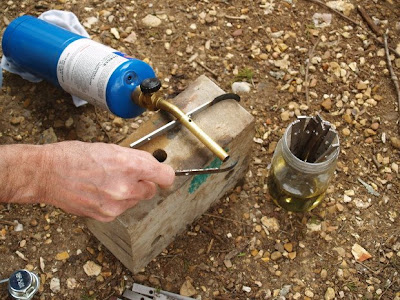 Now they are in the oven being tempered. Four hundred degrees for 25 minutes, then cooled to room temperature. After that, walnut handles will be added. My thanks to Larry Williams, Clark and Williams Planemakers. Larry gave me hints on hardening and tempering steel and provided scrap steel from making plane irons for use in making these knives.


 Now they are in the oven being tempered. Four hundred degrees for 25 minutes, then cooled to room temperature. After that, walnut handles will be added. My thanks to Larry Williams, Clark and Williams Planemakers. Larry gave me hints on hardening and tempering steel and provided scrap steel from making plane irons for use in making these knives.
New technique in the dovetail arsenal
 Those who make dovetail joints in woodworking may be interested in this new technique, particularly if you are making a set of dovetails as large as these. You cut the pins using the table saw, then reassemble the parts, slightly offset to form the pins. The loss of grain continuity is minimal. And the glued joint, if done well, is as strong as the wood. The wood must be clamped in all directions to keep the pins from sliding up as clamping pressure is applied to the sides. Wooden strips are clamped on both sides at the ends to hold the parts in alignment and wax paper is used to prevent the strips from sticking to the workpiece.
recess eliminated
Here in the city of Eureka Springs recess has been eliminated from public middle school.
Here is what the Alliance for Childhood says:
When our actions are in direct conflict with what we know to be true, we descend from rationality to chaos.
Here is what the Alliance for Childhood says:
Most Americans from all cultural backgrounds are more familiar with “direct instruction” teaching methods based on teaching discrete skills isolated from children's interests and activities. But research shows that the exploratory and creative activity that young children initiate themselves (play) is the primary way they develop concepts and understanding about the world. Play helps children develop the skills necessary for critical thinking and leadership. Play is how children learn to solve problems and to feel good about their ability to learn.I'm sure the school has its reasons. Perhaps more time is required to prepare for government mandated standardized test. Teachers want the children to do well at those so they will be rewarded with incentives and bonus income. Or perhaps children, being unschooled in problem solving are mean to each other when unsupervised, and therefore not to be trusted on the playground. Either case spells decline for our nation and for our children.
When our actions are in direct conflict with what we know to be true, we descend from rationality to chaos.
Thursday, February 26, 2009
simple but measurable progress


 The photos above and below show some of what has been going on at Clear Spring School. The 3rd and 4th grade students have been finishing their models of the solar system. The Chemistry students have been assembling the various elements for their periodic table, and today we began assembling the framework in which it will be displayed. Pet Golden, our math and science teacher is excited about this project. And one of the things that is often forgotten in public education is that teaching is best when the teachers are creatively engaged in the subject material and the teaching process.
And finally, we are making great progress on the bench for Crystal Bridges. The rough shape of the bench has been determined and the boards are being sanded by my high school intern Luke. I have a new technique which I am applying in making dovetails, and though I won't explain it all now, you can see a hint in the last photo.


making a wren house in pre-school


 These photos are of making a wren house with the Clear Spring School Pre-school students. I had pre-cut the parts, but the kids were very proud of their hammering. Nathan says he has his own tool belt and thinks the birds will find the box in four days and begin building their nest. Aleena says the birds will build their nest in the spring.
Building outside the box
 Fine Woodworking has a contest online, Building outside the box. Some of you may recognize my boxes in the contest introduction page.
Small town recession
I live in a relatively small town in Arkansas and it seems the recession is gradually growing our way. First many in our local retired community were hit by the steep decline in the stock market. That in itself brought a serious decline in available local resources. Then those of us whose incomes are drawn from outside the community have watched as our incomes have declined. Artists who travel to shows report business being down. Galleries in the cities that sell their work have had declining sales. As a tourist community, it seems people are still coming but spending less. That means the restaurant business is slow and the gift stores and galleries have declining sales and are selling inventory at a loss.
I have noticed the recession in my own business. An article has been postponed and a book put on hold. I no longer have customers inquiring about custom furniture, and the sales of my boxes to galleries has slowed nearly to a halt.
So, like nearly everyone in America I am looking at my options, considering new opportunities and income strategies. Of equal importance is the process of reexamining our current use of financial resources. National Geographic this month has an excellent article on the waste of resources that takes place in the common American home. The article offers changes that come at almost no cost. Our past profligacy is the result of our misperceptions of abundance and we are currently coming to terms with reality. My hope is that this will lead to better and more responsible use of the earth's resources.
One of the things you learn in the process of woodworking. You have a board. There is only one that shows the qualities desired in the finished work. You are frugal and caring in its use.
Today I go to the preschool to make a bird house, and this afternoon I work on the bench for Crystal Bridges and the table of elements for high school Chemistry.
I have noticed the recession in my own business. An article has been postponed and a book put on hold. I no longer have customers inquiring about custom furniture, and the sales of my boxes to galleries has slowed nearly to a halt.
So, like nearly everyone in America I am looking at my options, considering new opportunities and income strategies. Of equal importance is the process of reexamining our current use of financial resources. National Geographic this month has an excellent article on the waste of resources that takes place in the common American home. The article offers changes that come at almost no cost. Our past profligacy is the result of our misperceptions of abundance and we are currently coming to terms with reality. My hope is that this will lead to better and more responsible use of the earth's resources.
One of the things you learn in the process of woodworking. You have a board. There is only one that shows the qualities desired in the finished work. You are frugal and caring in its use.
Today I go to the preschool to make a bird house, and this afternoon I work on the bench for Crystal Bridges and the table of elements for high school Chemistry.
Wednesday, February 25, 2009
puppets
 The fifth and 6th grade students finished their puppets today and the 7th through 10th students are almost done with their book holders. The photo above shows puppets.
Evidently a great deal of interesting research is linking internal rhythm, even inside the brain with external symptoms of disease and stress. Alter the fundamental processes and rhythms, and what do you get? Life itself is experimental and we are finding out.
I have had this suspicion that video gaming, television and even some forms of music can detract from internal balance and ability to learn and engage with others in cooperative activities. At this point, for me at least, I have simple observations as a craftsman about these things. And I am pleased that others in the Scientific community are investigating.
the expression of rhythm
I am grappling with the interconnected concepts of rhythm and pattern, inspired by a conversation with an anthropologist. In the conventional explorations of self, we tend to regard ourselves and others as physical specimens. We examine the structure and form, and yet, by ignoring rhythm and pattern we overlook the essence of our humanity.
When you make something from wood, you engage the rhythms of the body... sawing, planing, sanding and hammering are timed in conformity with rhythms, internal and unseen.
Unfortunately, in schools, we expect children to conform to structure that inhibits the natural expressions of rhythm. When constrained, those expressions take the form of clicking ball point pens, scratching on coarse textures, or drumming on desks.
And what are the physiological and cultural consequences? As I say, I am grappling with this. Perhaps my anthropologist friend will help. And I invite you to share your own thoughts.
When Kahlia is a horse, I look up in the woods and recognize her by her gait. Tyler is flying, a ninja, forked stick at his side. Where will he land and what evil will he slay? There are important rhythms we must explore in order to understand, teach and learn and they are most often expressed through the hands.
Today the 5th and 6th grade students will finish their anatomical puppets. the 7th through 10th grade students will work on book holders.
When you make something from wood, you engage the rhythms of the body... sawing, planing, sanding and hammering are timed in conformity with rhythms, internal and unseen.
Unfortunately, in schools, we expect children to conform to structure that inhibits the natural expressions of rhythm. When constrained, those expressions take the form of clicking ball point pens, scratching on coarse textures, or drumming on desks.
And what are the physiological and cultural consequences? As I say, I am grappling with this. Perhaps my anthropologist friend will help. And I invite you to share your own thoughts.
When Kahlia is a horse, I look up in the woods and recognize her by her gait. Tyler is flying, a ninja, forked stick at his side. Where will he land and what evil will he slay? There are important rhythms we must explore in order to understand, teach and learn and they are most often expressed through the hands.
Today the 5th and 6th grade students will finish their anatomical puppets. the 7th through 10th grade students will work on book holders.
Tuesday, February 24, 2009
solar system models
 The third and 4th grade students finished their solar system models today as shown in the photo above. The first and second grade students began making small hinged boxes to use as "friendship boxes." It is interesting listening to children in the woodshop... what they reveal of their personal lives and thoughts of themselves as they explore their abilities and test their limits. The following quote is from Albert Einstein's book, Ideas and Opinions, shared with me by local essayist, Dan Krotz:
 “It isn’t enough to teach a man a specialty. Through it he may become a kind of useful machine, but he will not be a harmoniously developed personality. The scientist, undertaker, bricklayer, banker are trained to perform a certain function, but the valuable question is, do they have a vivid sense of the beautiful and of the morally good?”The vivid sense of the morally good and beautiful are things you can learn through skilled craftsmanship, and are the Wisdom of the Hands.
two views
Charles Darwin's theories have been characterized as survival of the fittest, but if you take an honest view of life, you see that that those who survive are those best suited to fit a cooperative framework, each part in some way sustaining and nourishing the others. Human beings have grown in an ever expanding circle of cooperation, or at least did so until recently. Throughout millions of years of "primitive" existence men recognized relationship with the other living things as being sacred. We grew from family to tribe to nation state and now to internet global economy, each part in some level of sustained but sometimes strained cooperation. It is now time to remember what was forgotten... Our sacred relationship with all species of the planet, and our responsibilities as guardians of all life. That sounds like a daunting task. To move from the selfishness of the me first Reagan era to a new level of world-wide sensitivity and cooperation. But remember that we have the full thrust of evolution on our side, a billion year momentum toward ever widening spheres of cooperation. In that we have the power and potential to awaken to greater consciousness.
What we face at this moment has been called a convergence of crises. Economic collapse and global warming. Things may not look good. But we are at our best when the most is required of us.
Today in the woodshop at Clear Spring School, the first and second grade students will make friendship boxes and the 3rd and 4th will finish their models of the solar system and do projects from paper sloyd.
What we face at this moment has been called a convergence of crises. Economic collapse and global warming. Things may not look good. But we are at our best when the most is required of us.
Today in the woodshop at Clear Spring School, the first and second grade students will make friendship boxes and the 3rd and 4th will finish their models of the solar system and do projects from paper sloyd.
Monday, February 23, 2009
Origin of Art- Robert Keable Row, 1909
 Robin Wood shows the results of his weekend carving class on his blog today and the spoon shown here is shows one of his student's decorative efforts. Robert Keable Row, an associate of John Dewey wrote in the "Educational Meaning of Manual Arts and Industries", 1909:
A study of the art of primitive peoples shows us that one form of art invariably begins with an attempt to decorate an article that has been constructed for some practical purpose. This seems to be a natural sequence. When one gets control of a practical activity the aesthetic impulse seeks its opportunity, its medium, for expression as an accompaniment of the practical. The utilitarian product expresses the purpose of the worker; the decorative element expresses the emotional attitude. This feeling may be pride in the result of the labor, or in ownership of the product, or a sense of joy in contemplation of what seems beautiful in decoration itself.Nice work.
No real surprises... but plenty of amazement
I finished Malcolm Gladwell's book Outliers, The Story of Success. My wife and I are deeply engaged parents, supporting our daughter's interests and education. There are many of us in the world, though perhaps not enough. As outlined clearly in Gladwell's book, success is built on two factors, timing and commitment, not only in the individual, but in his family, community and culture. There is not much a person can to about timing. There are lucky things that happen to lay paths toward success, and I won't spoil the book. But why is it that the bulk of parents are so disengaged in their children's success? That is the subject of my amazement.
Today I am preparing for tomorrow's classes and working on the walnut bench.
Today I am preparing for tomorrow's classes and working on the walnut bench.
Sunday, February 22, 2009
Fine Woodworking Jigs surprise
 I was reading the current issue of Fine Woodworking and was surprised to find myself on the cover of a new publication. Essential Shopmade Jigs will be available on March 31 through Taunton Press. Click on the image at left and it will become large enough to read for ordering your copy. Free shipping is offered for copies ordered before March 4.
Saturday, February 21, 2009
success and joy?
I was talking to my mother last night, and those of you who have read deeply into the blog would know that she is a retired kindergarten teacher. She thinks that working with children is the most joyous and honorable of professions. So when I mentioned that my daughter Lucy is working with kindergarten students in the Columbia University day school as her on-campus employment, my mother was excited. "Do you think she will change her major?" She asked eagerly.
As I mentioned, I am reading Malcolm Gladwell's book, Outliers, the Story of Success. The book is about the factors contributing to success and focuses on the big names, like Bill Gates and the Beatles. But what is success anyway? Is there a single point at which one can be considered a "success?" Or is it best measured in smaller increments and met moment by moment in our own lives? And what about joy?
 I have been engaged in a struggle with design and materials. I am making a bench (with children's help) for the new museum in Bentonville, Arkansas, Crystal Bridges. The walnut was supplied from the site, and when I got into the pile of it, I found much of it to be splintered and cracked. I am having to be very frugal and specific in the use of each piece. So I have been awake nights thinking about it and have a deadline of March 27. In the making of real things success or failure is measured in very small increments. The photo above is of the walnut and a model of the intended design. The photo below is of the current high school chemistry/woodworking project, making a periodic table of elements using wood and baby food containers to hold the elements.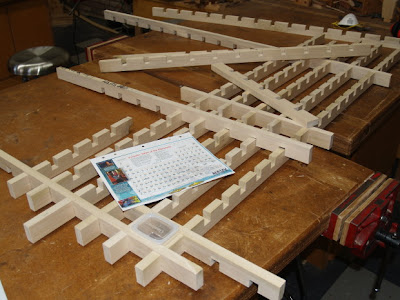
As I mentioned, I am reading Malcolm Gladwell's book, Outliers, the Story of Success. The book is about the factors contributing to success and focuses on the big names, like Bill Gates and the Beatles. But what is success anyway? Is there a single point at which one can be considered a "success?" Or is it best measured in smaller increments and met moment by moment in our own lives? And what about joy?
 I have been engaged in a struggle with design and materials. I am making a bench (with children's help) for the new museum in Bentonville, Arkansas, Crystal Bridges. The walnut was supplied from the site, and when I got into the pile of it, I found much of it to be splintered and cracked. I am having to be very frugal and specific in the use of each piece. So I have been awake nights thinking about it and have a deadline of March 27. In the making of real things success or failure is measured in very small increments. The photo above is of the walnut and a model of the intended design. The photo below is of the current high school chemistry/woodworking project, making a periodic table of elements using wood and baby food containers to hold the elements.
Friday, February 20, 2009
Wisdom of the Hands featured online
 Brad Walseth from Custom Woodworking Business magazine wrote an article about my work for the February 2009 Issue. The article can be found online here. The entertainment center is the lead photo in the article.
Thursday, February 19, 2009
The Outliers
I am currently reading Malcolm Gladwell's latest book, Outliers, The Story of Success and even the first chapter is a doozy. I was one of those November children who started kindergarten as the youngest in the class, and Outliers starts out by illustrating the age based advantages given to those who are larger and more mature whether in athletics or in school. It helps me to understand why I didn't make the little league team, but it also helps me to better understand why school can be a crippling experience for some. It illustrates how even the very simple things like date of birth can have profound implications. We run grave risks of debilitating some even as we lift others.
How do we change that? I think schools like Clear Spring School are the answer. Smaller class sizes, more personal child centered learning, schools that allow for variation and individuality in child development.
How do we change that? I think schools like Clear Spring School are the answer. Smaller class sizes, more personal child centered learning, schools that allow for variation and individuality in child development.
Is a drawing worth a thousand words?
 This simple drawing of miter joints is from William W. Klenke's 1925 book, Joints and How They Are Made. If you want to know how something looks, "a picture is worth a thousand words." If you want to know how something is made, a drawing can be worth even more, being beautiful as well.
It is one more thing not taught in schools today.
Subscribe to:
Posts (Atom)


