Good things come to those who show up. I couldn't resist showing this as a work in progress, so blog readers get first glimpse, a preview of what will come in a finished form next week.
For a long time, I've felt that I needed to produce a short video of my kids at work. This is a first draft with the final version to be published next week after the kids have finished their projects. Let me know what you think. I also plan to do a short video of my small children working with knives. No doubt it will terrify some, make some parents have conniption fits. But knives can be safely used with first, second and third graders, and it would be better that they understand the safe use of tools than for us to allow them to be captivated by the dark culture of knives and weaponry that has emerged from television and video game violence.
So, stay tuned or at least come back next week for for the finished video.
Tuesday, October 20, 2009


Monday, October 19, 2009
way back when
Years ago, most people in America had at least some understanding of the whole process of production. Even if you were a rich kid, you at least walked past the blacksmith shop on your way to school and may have been drawn close enough by your own curiosity and the ring of hammer on steel to see the muscles and sweat. You would have seen the farmer bringing his produce to town, and you would have taken outings in which you might have seen your next meals being raised on the farm.
We, as a nation have become so divorced from any semblance of understanding of how things are made, how things are grown or how we might take part in the making and growing, or how we might encourage things to be made. And that is not just a problem for the poor. While the children of the rich may have the security of trust fund, they often know little but investment on speculation. They know quite well about investing dollars. What they don't know and seem to have no hopes of knowing is the process through which human beings invest in each other's lives and growth. It is that particularly difficult challenge of secondary ignorance. They don't know they don't know, and thus have no intrinsic motivation for discovery.
Independent Vermont Senator Bernie Sanders warns that the middle class in America is collapsing. The banks, and bankers have gone back to playing the same old slots, investing in their same old ways and in the same old things. But what could we reasonably expect? We have a nation in which nearly all have been sequestered from understanding. You can know the formulas for making your monetary investments and be completely sequestered from your own human cultural implications.
In the days of Educational Sloyd, one of its objectives was to nurture democracy by fostering a sense of the dignity of all labor. In order to accomplish this goal, all students in schools were exposed to wood shop. There they discovered the creative capacities of their own hands, and witnessed the contributions of others at all levels of society to sustain a meaningful culture. The rich from exposure to such an education, might in respect, use their resources to build businesses in which all might learn and grow. Instead, we have Wall St. where their dollars go into speculation according to formulas having no relationship to human growth or growth of community.
So we are in a mess. Unemployment continues to rise. Corporate CEOs continue to make 400 times the amount earned by a common employee. Wall Street is returning to big bonuses. The DOW is back up with record profits for the year. Banks, thanks to the bailout are thriving and some are reaching record profits, while people are losing their homes and jobs.
Wall St. bankers are not completely to blame nor are they aware of their ignorance, so it may not be reasonable to expect much help from their direction. Ditto the Gov. It is full of people hired from Wall Street. Besides, revolutions take place from the ground up, when citizens take matters into their own hands. Make, create, plant, nourish, tend, fix, grow. While economists are watching bottom lines, you can see real progress when it takes place in your own hands.
We, as a nation have become so divorced from any semblance of understanding of how things are made, how things are grown or how we might take part in the making and growing, or how we might encourage things to be made. And that is not just a problem for the poor. While the children of the rich may have the security of trust fund, they often know little but investment on speculation. They know quite well about investing dollars. What they don't know and seem to have no hopes of knowing is the process through which human beings invest in each other's lives and growth. It is that particularly difficult challenge of secondary ignorance. They don't know they don't know, and thus have no intrinsic motivation for discovery.
Independent Vermont Senator Bernie Sanders warns that the middle class in America is collapsing. The banks, and bankers have gone back to playing the same old slots, investing in their same old ways and in the same old things. But what could we reasonably expect? We have a nation in which nearly all have been sequestered from understanding. You can know the formulas for making your monetary investments and be completely sequestered from your own human cultural implications.
In the days of Educational Sloyd, one of its objectives was to nurture democracy by fostering a sense of the dignity of all labor. In order to accomplish this goal, all students in schools were exposed to wood shop. There they discovered the creative capacities of their own hands, and witnessed the contributions of others at all levels of society to sustain a meaningful culture. The rich from exposure to such an education, might in respect, use their resources to build businesses in which all might learn and grow. Instead, we have Wall St. where their dollars go into speculation according to formulas having no relationship to human growth or growth of community.
So we are in a mess. Unemployment continues to rise. Corporate CEOs continue to make 400 times the amount earned by a common employee. Wall Street is returning to big bonuses. The DOW is back up with record profits for the year. Banks, thanks to the bailout are thriving and some are reaching record profits, while people are losing their homes and jobs.
Wall St. bankers are not completely to blame nor are they aware of their ignorance, so it may not be reasonable to expect much help from their direction. Ditto the Gov. It is full of people hired from Wall Street. Besides, revolutions take place from the ground up, when citizens take matters into their own hands. Make, create, plant, nourish, tend, fix, grow. While economists are watching bottom lines, you can see real progress when it takes place in your own hands.
Sunday, October 18, 2009
Today in my own shop, catch 22
Today in my own wood shop, I am continuing my friendly competition with the Chinese. I am making wooden boxes to supply the few small craft galleries that continue to sell my work. I say it is a friendly competition, even though in price and quality I am losing "bigtime."
I call it friendly because I believe that those trying to produce goods and services in the "information" age are swimming against the tide, and the Chinese have earned my profound respect. I also call if friendly because in my own shop, it is such a joy to work with tools, to see beautiful and useful objects developed within my own hands. I know that there are many in this world that don't have the slightest idea what I am talking about. They may find their joy in other ways... ordering others into action or spending the money that has become the focal point of their lives. And yet, the joy one finds through the direct activities of one's own hands cannot be adequately described.
Elliot Eisner distinguished between primary and secondary ignorance. And it is awkward to talk about such things without sounding accusatory. But there is such a thing as ignorance none the less. Primary ignorance is easy to fix because it is something you know is missing, an answer you want, and may be willing to seek in order to feel complete. Secondary ignorance is a bit harder to resolve. It is about things you don't know are missing from your own life. You have no idea how to find what you don't know is missing in the first place. You have no intrinsic motivation toward discovery. Unless you suddenly take a fall and you discover that things are not quite as you imagined them to be.
The body-mind knows things the conscious mind may not comprehend. There is joy in making things. There is a wholeness that arises in the relationship between man (or woman), materials and tools in the making of beautiful and useful objects. The joy is not just there in the finished goods, but in the process, the engagement, as one watches one's own hands give new shape and meaning to materials. Where these opportunities are not perceived and are not acted upon, we suffer in ways we may not be able to readily comprehend. Depression, Anxiety? To quote my least favorite politician, "you betcha!"
Today in the wood shop, I am taking long boards, cutting them into short sections, resawing them into thin stock, planing the thin stock to a uniform dimension, jointing edges straight, then sawing into uniform widths, and cutting small parts to exact dimension. Each small step is a matter of fulfillment, completing a feedback loop from which one draws assurance. And there are those, whom I take the gross liberty of calling out for secondary ignorance. They may never understand the burden of their loss. They may never feel directly encumbered by their own stupidity. Much of their direct suffering can be alleviated with pills. But there is a price our children pay for what they will never know they might have learned in the first place.
There. Enough words for today. I'm headed back to the wood shop and my friendly competition with the Chinese. If you are one of those who are not aware of the transformative value of work of your own hands, please do not be offended. I offer my own view as a kindness.
I call it friendly because I believe that those trying to produce goods and services in the "information" age are swimming against the tide, and the Chinese have earned my profound respect. I also call if friendly because in my own shop, it is such a joy to work with tools, to see beautiful and useful objects developed within my own hands. I know that there are many in this world that don't have the slightest idea what I am talking about. They may find their joy in other ways... ordering others into action or spending the money that has become the focal point of their lives. And yet, the joy one finds through the direct activities of one's own hands cannot be adequately described.
Elliot Eisner distinguished between primary and secondary ignorance. And it is awkward to talk about such things without sounding accusatory. But there is such a thing as ignorance none the less. Primary ignorance is easy to fix because it is something you know is missing, an answer you want, and may be willing to seek in order to feel complete. Secondary ignorance is a bit harder to resolve. It is about things you don't know are missing from your own life. You have no idea how to find what you don't know is missing in the first place. You have no intrinsic motivation toward discovery. Unless you suddenly take a fall and you discover that things are not quite as you imagined them to be.
The body-mind knows things the conscious mind may not comprehend. There is joy in making things. There is a wholeness that arises in the relationship between man (or woman), materials and tools in the making of beautiful and useful objects. The joy is not just there in the finished goods, but in the process, the engagement, as one watches one's own hands give new shape and meaning to materials. Where these opportunities are not perceived and are not acted upon, we suffer in ways we may not be able to readily comprehend. Depression, Anxiety? To quote my least favorite politician, "you betcha!"
Today in the wood shop, I am taking long boards, cutting them into short sections, resawing them into thin stock, planing the thin stock to a uniform dimension, jointing edges straight, then sawing into uniform widths, and cutting small parts to exact dimension. Each small step is a matter of fulfillment, completing a feedback loop from which one draws assurance. And there are those, whom I take the gross liberty of calling out for secondary ignorance. They may never understand the burden of their loss. They may never feel directly encumbered by their own stupidity. Much of their direct suffering can be alleviated with pills. But there is a price our children pay for what they will never know they might have learned in the first place.
There. Enough words for today. I'm headed back to the wood shop and my friendly competition with the Chinese. If you are one of those who are not aware of the transformative value of work of your own hands, please do not be offended. I offer my own view as a kindness.
Saturday, October 17, 2009
Second Sloyd Training School in Boston
View Larger Map
Gustaf Larsson's Sloyd School in Boston shared the location at 37 No. Bennet St. with the North Bennet St. Industrial School until 1908 when it moved to a new building built by Mrs. Pauline Agassiz Shaw at 7 Harcourt St. in Boston. The 37 No. Bennet St. Location had become too small for both to share and the North Bennet St. School continues in that location. Mrs. Pauline Agassiz Shaw was the philanthropist founder of both schools. You can find the location of the Sloyd School using the address 7 Harcourt St. Boston, MA either using Google or Google Earth. The street view above will show you how the building looks today. If you compare the building above with the floor plan below, you can see that while the building may have a more modern brick facade, the structure is the same. The 7 Harcourt location is currently occupied by a real estate development corporation. Don't be confused by the 22 Bolton address shown on the street view. Boston streets are funny and confusing.

North Bennet St. School
My friend Miguel Gómez-Ibáñez, director of North Bennet St. School produced the video above. Nice job explaining the difference between sloyd and vocational education. The use of the hands is crucial to the expansion of intelligence for all children. Seeing this short video reminds me that I need to produce my own.
In reference to my earlier post, this is from Froebel:
...(Intelligence) begins in the working and application at the moment when the child perceives outward impressions decidedly, that is, discriminates between light and darkness. The mother must already have taught the child to observe everything, to separate everything which comes within the circle of his life, before the peculiar moment of time when the development of language begins.Now we know that even before children make their first uttered sounds they have been preparing the foundation for discourse. The intelligent use of the hands gives them something to talk about, and for the parents to discuss with them.
no place like home
In Newsweek Magazine there is an article about the "new localism", No Place Like Home. People, in the face of recession are settling in, in ways that were not anticipated. (Provided of course, that they are lucky enough to still have their homes). It could be a very good thing if people were not just to settle in, but to begin making things and sharing hands-on creativity and learning with their kids. Keep your fingers crossed.
Mother-Play and "How Gertrude Teaches Her Children"
In Disrupting Class, How Disruptive Innovation Will Change the Way the World Learns the authors state that if the research is correct in identifying language use in the earliest days of the child's life as being the primary contributing factor in their performance in schools, "it becomes quite clear that some public policy and legislative initiatives are well intentioned but wrong-minded." In essence, intervention at the preschool level, headstart and kindergarten is not near early enough. Young mothers and fathers must be taught their roles in preparing their children for school success.
 The following is from my blog post of January 14, 2007:
In the not-too distant past, courses like home economics, auto repair, and wood and metalworking were offered in most high schools to prepare young people at least for some of the mechanics of adulthood. Quite possibly, high school might be the place to teach courses that conveyed the methods of early cognitive development to tomorrow's parents. The benefits might be broadly felt. Young, single, inner-city mothers who otherwise would be trapped with their children in the multigenerational cycle of educational underachievement and poverty certainly would benefit from knowing how to shape their early interactions with their children to help them succeed in school.Certainly makes me wonder why educators haven't paid more attention to Froebel and Pestalozzi. Pestalozzi wrote the landmark book, "How Gertrude Teaches Her Children," 1801, as a guide to mothers interested in teaching their own children and in it he laid out the principles that guided his own exploration of scientific education. Froebel followed in the same vein with "Mother-Play and Nursery Songs," or Songs for Endearment by Mothers, 1844 and education today would be different if we had continued to listen to their wisdom rather than allowing ourselves to become distracted by the bells and whistles of technology. The following is from Unesco:
In his Songs of Endearment for Mothers, Fröbel comes very close to the everyday living world that he represents in scenes (pictorial illustrations), finger games and nursery rhymes. Experiences of the child’s everyday life are acted out through the perceived physical medium of finger games or in illustrations. The mother plays the finger game and the child is asked to imitate it. This book is a sequel to Pestalozzi’s Book for Mothers, but moves beyond that author’s cognitive and schematic method. Fröbel’s principle is motherly love. The mother shows loving care for her child through play. Initially, the infant is a being at one with himself/herself. As its own forces then begin to develop, i.e. its motor system, senses and intelligence, the child begins to become familiar with its surroundings and is able to differentiate and structure them. The true self gradually becomes structured and differentiated through this experience of the outside world.The method Froebel describes is not just verbal, but involves the use of the hands to create a foundation for intellectual growth and in doing so goes far beyond what Christensen, Horn and Johnson describe in Disrupting Class.
 The following is from my blog post of January 14, 2007:
Too often now, parents are distracted by other things rather than being engaged with their full attention on play. With your child in your lap, its head on your knees and feet on your chest, start by moving your hands into and out of visual range. Weave your fingers together and then pull them apart. Repeat and then vary your motions. Your child will watch and in a short time will engage your hands with hers or his. My daughter Lucy and I could spend what seemed like hours in contemplation of our hands. As she became a couple months older, toys and rattles joined with the hands, and we never tired of the play. We don't have any way to measure the profound impact such simple things can have except to observe the results. I could spend days as I suspect many parents might, proclaiming the wonders of my daughter. I won't. But I will invite you to play with your child in the manner I describe. Hold him or her as shown in the position above.What often seems like idle play fulfills extremely important purposes in human development.
Friedrich Froebel, inventor of Kindergarten realized the incredible opportunity young mothers were missing in the development of their childrens' capacities for learning. Much of his early work was in developing songs, hand activities and games for mothers to play with their children. We hope that schools will do enough to educate our children, but don't count on it. They can't make up for the opportunities lost in the earliest days. But take your child in your lap and with your hands make a start.
Friday, October 16, 2009
language dancing
Still reading Disrupting Class, How Disruptive Innovation Will Change the Way the World Learns and I've gotten to the good part. First we know that putting computers in classrooms, and attempting to layer them over the responsibilities teachers have in the first place hasn't worked to expectations. And as described by the authors, the greatest promise of computers in education will come as they sneak in from the edges, not by displacing concerned teachers in the classroom, but by meeting needs yet to be imagined.
Now, chapter 6, the authors, Christensen, Horn and Johnson are discussing a thing they have termed "language dancing." It seems that research has shown that children in the ghetto are spoken to as infants, a rate on average of 600 words per hour. Children in upper class households are spoken to at a rate of from 1,500 to 2100 words per hour, and much of the exchange isn't in the form of "business language," as in "Put that down," or "what do you want?" but in exchange at an adult level related to evaluation of things, hopes, desires and reflection on events, that the authors call "language dancing".
Now, chapter 6, the authors, Christensen, Horn and Johnson are discussing a thing they have termed "language dancing." It seems that research has shown that children in the ghetto are spoken to as infants, a rate on average of 600 words per hour. Children in upper class households are spoken to at a rate of from 1,500 to 2100 words per hour, and much of the exchange isn't in the form of "business language," as in "Put that down," or "what do you want?" but in exchange at an adult level related to evaluation of things, hopes, desires and reflection on events, that the authors call "language dancing".
Interestingly, the most powerful of these words, in terms of subsequent cognitive achievements, seemed to be those that were spoken in the first year of life--when there was no visible evidence that the child could understand what the parents were saying. The children whose parents did not begin speaking seriously to their children until their children could speak, at roughly age 12 months, suffered a persistent deficit in *intellectual capacity*, compared to those whose parents were talkative from the beginning.(*intellectual capacity as understood in the narrow definition, based on standardized testing of linguistic intelligence.*)So we have a system in place which evaluates, measures and thus determines children's success based on their linguistic comprehension, while those currently in poverty are caught in a cultural chasm from which emergence is based on energizing the linguistic exchange rate at the most basic household level. Let me assure you that hands-on creativity and capacity are also encouraged or discouraged at the youngest age... by activities present in the household. It would certainly be best if children were talked to enough to develop their vocabularies and literal comprehension and engagement, and it would make sense for their creative capacities to be encouraged as well. You wonder how to do that? Throw out the TV. Engage with your child in making things. The linguistic exchange that takes place during the exercise will push your child's linguistic capacities over the top. Cook, make, create, plant, sew, fix. It will give you and your infant a lot to dance about.
Thursday, October 15, 2009
Elliot Eisner, non-linguistic intelligence
I realize that when I, a craftsman, challenge academia for failure to acknowledge the intelligence expressed through the hands, some might be offended. After all, who am I, a simple teacher and craftsman to challenge modern education? But my purpose is not to offend, but to simply assert the value, the intelligence, and dignity of hands-on work and hands-on learning. To that end, I quote the following from Elliot Eisner's the Arts and the Creation of Mind:
...a lesson that the arts can teach education is that literal language and quantification are not the only means through which human understanding is secured or represented. So much of schooling privileges discursive language and the use of number that types of intelligence and forms of understanding not represented in these forms are given marginal status. It must be acknowledged, of course, that the abilities to read, to write, and to compute are of crucial importance. Students who cannot read, write, or compute are in deep trouble. But important though these skills are, they do not encompass all of what people know or the ways in which what they know is given public status. We appeal to poetry to say what cannot be expressed in literal language. We secure from images ideas and other forms of experience that elude discursive description. We experience through music qualities of lived experience that cannot be rendered in quantitative form. In short, our sensibilities and the forms of representation associated with them make distinctive contributions to what we notice, grasp and understand. As Pascal said, "The heart has its reasons that the head knows not."The current plan in Texas to eliminate wood shop programs from the state approved curriculum is evidence of the failure of academia to grasp the value of hands-on learning and hands-expressed intelligence. According to Eisner, "The long term result of such deprivation is a diminution of the varieties of life that students are able to lead."
the assumption
I have been reading the Clayton Christensen book Disrupting Class, How Disruptive Innovation Will Change the Way the World Learns, and discover that the premise is that computers will reshape education, not by being integrated at the center as has been the incredibly costly and wasteful attempt, but by chipping away at the edges. The idea is based on Christensen's concept of "disruptive innovation" through which technological change takes place by creating fringe consumption and use. Personal computers became dominant, not by competing directly with main frames, which they couldn't do at the time, but by adopting a recreational role in the lives of an at first small set of consumers. It is noted in the book that billions of dollars have been invested placing computers in schools with little real effect on outcomes, but the real effect will undoubtedly come from computers sneaking in from the edges. It is kind of like the way the Apple IIe led to the ultimate demise of Digital Equipment... a sneak attack. I am not done with the book yet, but am growing weary of its direction.
The assumption at this point in the book is that computers can fulfill the entire range of multiple intelligences. Body smart? you want Wii. Art smart? you might want illustrator or photoshop. Word smart? you may want a Kindle. Of course I'm being silly. The concept they present is not as simple as that, but as someone who takes pleasure working with my hands, tools and real materials I question whether technology will solve all our problems. What about the simple matter of the heart?
I question whether we do our children's education full justice by presenting them with made up models of physical reality. Are our children to take seriously the "chem lab" where they just click to mix, and the bunsen burner is a flame on screen? Safer perhaps, but does it not also inform our children that A. we don't trust them with the real thing, B. we don't value them enough to provide something real, and C. what we are teaching is little more than a game and thus not to be taken seriously? If they haven't stood in white coat amidst an array of tubes, open flames, and possible danger of real things happening, will they feel inclined toward becoming real chemists?
The assumption is that computer knowledge is transcendent of all multiple human intelligences and not merely another narrowly defined intelligence field that isolates it practitioners with its own jargon, exclusive culture and sense of entitlement. (anyone know an IT?)
I am reminded of an experiment in which they tested to see whether industrial arts could be taught as efficiently with lectures as with real tools. Wishful thinking no doubt that the school budget could be shaved in half. Can you guess what the outcome was? I believe computers have already offered a revolution in learning. Now, the question becomes will computer technology also offer a revolution in schools, allowing us to overcome the challenges illustrated by a 30% high school drop out rate? No doubt computers will play their part, but revolution? I believe it will take the hands for that.
The assumption at this point in the book is that computers can fulfill the entire range of multiple intelligences. Body smart? you want Wii. Art smart? you might want illustrator or photoshop. Word smart? you may want a Kindle. Of course I'm being silly. The concept they present is not as simple as that, but as someone who takes pleasure working with my hands, tools and real materials I question whether technology will solve all our problems. What about the simple matter of the heart?
I question whether we do our children's education full justice by presenting them with made up models of physical reality. Are our children to take seriously the "chem lab" where they just click to mix, and the bunsen burner is a flame on screen? Safer perhaps, but does it not also inform our children that A. we don't trust them with the real thing, B. we don't value them enough to provide something real, and C. what we are teaching is little more than a game and thus not to be taken seriously? If they haven't stood in white coat amidst an array of tubes, open flames, and possible danger of real things happening, will they feel inclined toward becoming real chemists?
The assumption is that computer knowledge is transcendent of all multiple human intelligences and not merely another narrowly defined intelligence field that isolates it practitioners with its own jargon, exclusive culture and sense of entitlement. (anyone know an IT?)
I am reminded of an experiment in which they tested to see whether industrial arts could be taught as efficiently with lectures as with real tools. Wishful thinking no doubt that the school budget could be shaved in half. Can you guess what the outcome was? I believe computers have already offered a revolution in learning. Now, the question becomes will computer technology also offer a revolution in schools, allowing us to overcome the challenges illustrated by a 30% high school drop out rate? No doubt computers will play their part, but revolution? I believe it will take the hands for that.
Wednesday, October 14, 2009
Today in my own shop
Today I have the luxury of working in my own shop. Elementary School is off today to allow students and staff to recover from camping.
I was reading Disrupting Class before bed last night and reflecting on the continuous minor sound disruptions that occur when you teach in an object rich learning environment. In the wood shop, I have lots of tools and each makes a noise. Kids are drawn to things that can be tapped or waved, a stick of wood will do, and even at the high school level, I need to remind kids to put things down while I am attempting to give instruction. For those who are particularly susceptible to the effects of disruption, even the clicking of a ball point pen can become the last straw. But I question the need for children to sit quietly all the time. First, we know from testing that children's brains are not equipped for sitting quietly while the teacher lectures for more than just a few minutes, and our incessant use of hand-held tech devices has made sitting quietly even more difficult for most children, and even difficult for some adults.
So my vision last night was that of a symphony... Acknowledging the musical intelligence involved in working with wood. And so I am wondering how to use that vision and that intelligence in my classroom management. With the younger children, I may do some form of choral reading to bring them into a sense of the noises we make and attune them to listening to each other's voices and tools. It may sound wacky. What am I, nuts?
Years ago, scientists testing for the effects of instrumental music on learning found a high correlation with success in math... but of course the question not explored was whether it was the music that provided the effect, or the involvement of the hands in playing the music, and I suspect it was both. So perhaps I shall make a conductor's wand for myself and become a conductor of a symphony of tools.
On a more depressing subject, I received word this morning that the Texas School Board has decided to "virtually eliminate" wood shops from Texas schools, substituting "metal fabrication" in its place. My last blog post, the vicious cycle in classroom learning may help to explain why some, particularly at the highest levels of education just don't get it and may never understand why hands-on learning is important for all our children. If you haven't done it you won't get it, and you may persist in living in a self-sustained delusion that you are one of the smartest people in the world despite mounting evidence to the contrary. And the evidence is mounting. For example, look at the numbers of drop-outs in America, and look at international rankings. We spend much more for education and performance is in the ditch.
I was reading Disrupting Class before bed last night and reflecting on the continuous minor sound disruptions that occur when you teach in an object rich learning environment. In the wood shop, I have lots of tools and each makes a noise. Kids are drawn to things that can be tapped or waved, a stick of wood will do, and even at the high school level, I need to remind kids to put things down while I am attempting to give instruction. For those who are particularly susceptible to the effects of disruption, even the clicking of a ball point pen can become the last straw. But I question the need for children to sit quietly all the time. First, we know from testing that children's brains are not equipped for sitting quietly while the teacher lectures for more than just a few minutes, and our incessant use of hand-held tech devices has made sitting quietly even more difficult for most children, and even difficult for some adults.
So my vision last night was that of a symphony... Acknowledging the musical intelligence involved in working with wood. And so I am wondering how to use that vision and that intelligence in my classroom management. With the younger children, I may do some form of choral reading to bring them into a sense of the noises we make and attune them to listening to each other's voices and tools. It may sound wacky. What am I, nuts?
Years ago, scientists testing for the effects of instrumental music on learning found a high correlation with success in math... but of course the question not explored was whether it was the music that provided the effect, or the involvement of the hands in playing the music, and I suspect it was both. So perhaps I shall make a conductor's wand for myself and become a conductor of a symphony of tools.
On a more depressing subject, I received word this morning that the Texas School Board has decided to "virtually eliminate" wood shops from Texas schools, substituting "metal fabrication" in its place. My last blog post, the vicious cycle in classroom learning may help to explain why some, particularly at the highest levels of education just don't get it and may never understand why hands-on learning is important for all our children. If you haven't done it you won't get it, and you may persist in living in a self-sustained delusion that you are one of the smartest people in the world despite mounting evidence to the contrary. And the evidence is mounting. For example, look at the numbers of drop-outs in America, and look at international rankings. We spend much more for education and performance is in the ditch.
Tuesday, October 13, 2009
the vicious cycle in classroom learning
The following is something I have described before in the blog, but the book Disrupting Class, How Disruptive Innovation Will Change the Way the World Learns by Christensen, Horn and Johnson, puts it rather well, and from a position of presumed greater authority (there are three of them), as they describe "a vicious cycle:"
...the subject material in a high school language arts class relates in obvious ways to linguistic intelligence. Students with that intelligence type naturally comprise most of the ones who excel in language arts. They're the ones who choose to major in that subject in college and then choose teaching careers in that field. Specific subject matter tends to be linked to specific intelligences through the way textbooks are written--by experts strong in that specific intelligence type. As a result, what has emerged in every domain are "intellectual cliques," composed of curriculum developers, teachers, and the best students in that subject area. Their brains are all wired consistently with each other. Just as members of a social clique often are unaware of the degree to which they easily understand and communicate with each other to the exclusion of those outside the group, members of these intellectual cliques are often unaware of the extent to which their shared patterns of thinking exclude those with strengths in other kinds of intelligences.The authors suggest that the same patterns repeat themselves generation after generation with teachers only being effective with those students who match their own learning styles. The result is that some may have the impression that they alone are smart. The evidence, at least to them is clear. And so I have mentioned before that given the complete disregard for the hands by those who have no knowledge of the intelligent use of the hands, we are called to create an affirmative action program for the hands through which all students have the opportunity to learn more about themselves and each other. What we have now in schools is a structural pattern that exists from primary education through grad school, and because it is a self-replicating, self-sustaining structure, it will be difficult to overcome. Work on it with me. Cook, make, sew, plant, harvest, create, fix, nurture, care, and when you run into idiots, don't be shy about the display of your own intelligence.
the culture of learning, campus disruptus

 Last night, the Clear Spring elementary students were camping in the rain. It is not the first time, nor will it be the last. In fact, when I was a Clear Spring School parent, I went many times along with my daughter Lucy on the school camp outs as a parent volunteer and school camping trips are not always in the best of weather. Parents don't go just to hang out but only to become part of the teaching force.
I have begun reading Clayton Christensen's book Disrupting Class, How Disruptive Innovation Will Change the Way the World Learns. I will have more to report on that later. But what comes to mind at the moment, reflecting on the camping experience and Christensen's book is that teaching is structural, learning is cultural. Teachers become teachers having passed through a system, and having adopted its means. A carpenter will teach his apprentice by putting a hammer in his hands, and by giving occasional demonstrations with some verbal instruction. A common teacher (and this is not to imply any are not uncommon) will teach utilizing the models presented to him or her through their own education. They become teachers within a structural form due to their affinity with that form. And it is difficult to stand aside from that form when its teaching style is lacking in effectiveness for the learning styles of the children involved.
Disrupting class is an essential activity for those students whose needs are not being met. It usually doesn't work, however. Teachers and administrations are taught to have zero tolerance for the slippery slope of disruption.
The Clear Spring School campout is not an easy thing. It is not easy for students or staff. It brings kids out of the classroom into real life. And real life isn't restricted to meeting the needs of particular types of learners. And that is what I mean when I say that learning is cultural. It pulls in and reflects the full diversity of human learning styles.
This morning the students and staff awakened to heavy rain, and the balance of the camping trip was canceled. It meant a breakfast prepared under sad circumstances and then the hauling of wet gear back to school and wet clothing home. As one student proclaimed, "This the best worst time I have ever had." So while the camping trip was disrupted, the kids are tested in spirit and resilience.
Today in wood shop my 7th, 8th and 9th grade students worked on the recycling box for the school campus which is shown in the photos above, adding trim to cover errors from hand-sawn cuts and adding rustic handles inspired by the coat rack they made earlier in the year.
Monday, October 12, 2009
camping grades 1-6
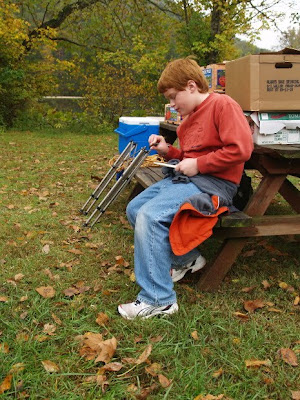
Today the Clear Spring School students are on their fall camp out. I helped set up tents and got a few of the kids started on their whittling. This is the first test of the new sloyd knives I made to replace the set that was stolen from my school wood shop last year. I spent a few minutes today making sure they were very sharp and ready for use. John Deal referred me to an incident today in which a 6 year old was suspended and sentenced to 45 days in reform school for taking his knife/fork/spoon cub scout tool to school. It was called a "weapon" in a school with zero-tolerance for "weapons." It is a tragic situation that basic tools for cutting wood and feeding yourself could only be viewed through the darkest lens, and if the hands are, as I believe, responsible for the development of intellect, we need to re-examine our relationship with tools. I attribute our current situation to the dark fantasies portrayed in film, on TV and in computer gaming. In the days before all that, boys used their knives to go to the woods and whittle on sticks, and the greatest fear was that they might nick themselves.
The Center for Disease Control notes a shocking 50 percent increase over the last two years in the number of children diagnosed with autism. The increase may be in part because of greater attention given to screening for the disease, but may also reflect what some see as a growing epidemic affecting the emotional health and social adjustment of millions of children. Two years ago the rate was 1 in 150 and now 1 in 100 children is diagnosed as autistic.
If you study primate behavior, you can see a bit of what human beings might have been like before the modern age. There is an incredible amount of grooming going on in primate behavior directed toward their young. But today, in modern households, families may be involved in other things. The constant holding and physical attention may not happen when mother is holding a book instead, or when father is engaged with the keyboard and computer screen. What happens when the television or computer are used to babysit children? Or what happens when families are so involved in television programs, that they are in separate rooms, watching their own televisions? How much traditional primate behavior is taking place in households today? Am I the only one who wonders about this?
The photos below show setting up camp, a bit of whittling and lunch.



The Center for Disease Control notes a shocking 50 percent increase over the last two years in the number of children diagnosed with autism. The increase may be in part because of greater attention given to screening for the disease, but may also reflect what some see as a growing epidemic affecting the emotional health and social adjustment of millions of children. Two years ago the rate was 1 in 150 and now 1 in 100 children is diagnosed as autistic.
If you study primate behavior, you can see a bit of what human beings might have been like before the modern age. There is an incredible amount of grooming going on in primate behavior directed toward their young. But today, in modern households, families may be involved in other things. The constant holding and physical attention may not happen when mother is holding a book instead, or when father is engaged with the keyboard and computer screen. What happens when the television or computer are used to babysit children? Or what happens when families are so involved in television programs, that they are in separate rooms, watching their own televisions? How much traditional primate behavior is taking place in households today? Am I the only one who wonders about this?
The photos below show setting up camp, a bit of whittling and lunch.


Sunday, October 11, 2009
Making sulpture from the Half Model
 I have made my article Making Sculpture from the Half Model available as a PDF file for use by educators as I prepare to introduce my Wisdom of the Hands project to Michigan educators. This article explores ancient boat design techniques for use in high school sculptural design.
on the value of showing up
Last night my wife and I went for a walk in town and as always we had a few things to pick up and drop off at the library on the way home. Jean is digging through 100 years of records so that the history of our library can be written in celebration of its centennial year. Thirty percent of those years were her own, notes and records gathered from her own watch, written or typed in her hand and reflecting some of her own thoughts and aspirations.
There are those who shake up history in dramatic action and those who shape culture through their day to day relentless vision and effort. On the internet today, human consciousness is reduced to utter brevity. Today's news is yesterday's recycled electrons and what comes up on your screen in this moment is but a click away from oblivion. It is interesting to visit the library today. Years ago, while it was just a building with dusty books, it was a quiet place. But under Jean's 30 year watch, our Carnegie Library has blossomed. And while she would be the first to credit others, her effects are profound.
We have been relentlessly driven by the media toward short range thinking and short range goals, and I have been told that kids attention spans have been severely shrunk. Actually scientists have measured over the years and the evidence is clear. And so, I want to celebrate what has been called the "Cal Ripkin Effect", named after the baseball player who played years without missing a game. It is the value of showing up and it is actually the major player in the construction of human culture.
And so, I show up here each day to write, and some faithful readers show up each day to share my journey... but what are my goals? One is plastered on the banner at top... to put hands-on learning within reach of every child. But I have a broader goal as well that stems from the belief that I share with Anaxagoras, that the hands are the source of all human wisdom. It will be though our hands-on engagement that our culture will become more humane, compassionate, responsible. Cook, clean, make, plant, harvest, create, nurture, care, respond, teach, love. Pick something worthy. Show up. Relentlessly. In 30 years you will have left an important mark and you (and others) will be very glad you did.
There are those who shake up history in dramatic action and those who shape culture through their day to day relentless vision and effort. On the internet today, human consciousness is reduced to utter brevity. Today's news is yesterday's recycled electrons and what comes up on your screen in this moment is but a click away from oblivion. It is interesting to visit the library today. Years ago, while it was just a building with dusty books, it was a quiet place. But under Jean's 30 year watch, our Carnegie Library has blossomed. And while she would be the first to credit others, her effects are profound.
We have been relentlessly driven by the media toward short range thinking and short range goals, and I have been told that kids attention spans have been severely shrunk. Actually scientists have measured over the years and the evidence is clear. And so, I want to celebrate what has been called the "Cal Ripkin Effect", named after the baseball player who played years without missing a game. It is the value of showing up and it is actually the major player in the construction of human culture.
And so, I show up here each day to write, and some faithful readers show up each day to share my journey... but what are my goals? One is plastered on the banner at top... to put hands-on learning within reach of every child. But I have a broader goal as well that stems from the belief that I share with Anaxagoras, that the hands are the source of all human wisdom. It will be though our hands-on engagement that our culture will become more humane, compassionate, responsible. Cook, clean, make, plant, harvest, create, nurture, care, respond, teach, love. Pick something worthy. Show up. Relentlessly. In 30 years you will have left an important mark and you (and others) will be very glad you did.
Saturday, October 10, 2009
use of "log cabin jig"

 One of my very useful inventions, that you can have for free is my "log cabin jig" which allows you to duplicate again and again, a perfect recess to fit square, rectangular or other shapes in wood. This can be used for fitting butt hinges as will be demonstrated in my upcoming Fine Woodworking article or even for fitting inlay in the tops of boxes.
In the photos above, I am using it as a guide to rout the back sides of drawer facings so that hammered brass inserts can be installed. The router bit used has a top mounted bearing of the same diameter as the cutter so that it exactly replicates the open space in the jig. The jig is simply made by overlapping log cabin corners. Again, you will see the finished effect later when the drawers are finished and installed, but as a teaser, you can see the first assembled drawer below. The pull is made of cocobolo, a departure from my usual reliance on Arkansas woods. The cocobolo has extremely high oil content, making it the perfect wood to resist the occasional greasy fingers as drawers are opened and closed and as meals are being prepared.

failing schools in Arkansas
Of the 1081 public schools in Arkansas this year 407 have failed to meet prescribed "yearly progress standards." That is a 37.6 percent failure rate following 7 years of "No Child Left Behind" legislation. Could it possibly be that the missing link in our children's education could be something as simple as the human hand?
"...the human hand and brain co-evolved as a behavioral system." --Frank Wilson, author of The Hand: How Its Use Shapes the Brain, Language, and Human Culture.We neglect the education of our children's hands only to put their minds at risk.
Anaxagoras
Anaxagoras was the pre-Socratic Greek philosopher who proposed the concept nous or mind as the controlling force of the universe, and yet he also believed that the hands were the source of all human wisdom. And thus arose within the split view of Anaxagoras the conflict that is with us still today.
In schools we have this idea that the mind is something separate from the rest of the body, and that having children sit at desks while we stimulate their minds is the most cost effective means of providing for their growth. At this time, we have a significant body of scientific evidence gathered through centuries of examination of real human beings to tell us otherwise. And yet, we do very little to make necessary changes to improve education. Make, fix, cook, plant, nurse, care, sew, create, tend, repair, become powerful, self-reliant, gather with others to teach and learn, and be smart.
Engagement of children in the arts avoids the oversimplification of right and wrong answers, thereby coaching children toward intelligent understanding of nuance and subtleties of relationship and form. I continue to digest Elliot Eisner's book, the Arts and the Creation of Mind. Abandonment of the arts in schools is the dumbing of our children and our culture.
Today, in the wood shop, I will continue to finish boxes, start some new ones from scratch for the next order, and work on drawer facings.
In schools we have this idea that the mind is something separate from the rest of the body, and that having children sit at desks while we stimulate their minds is the most cost effective means of providing for their growth. At this time, we have a significant body of scientific evidence gathered through centuries of examination of real human beings to tell us otherwise. And yet, we do very little to make necessary changes to improve education. Make, fix, cook, plant, nurse, care, sew, create, tend, repair, become powerful, self-reliant, gather with others to teach and learn, and be smart.
Engagement of children in the arts avoids the oversimplification of right and wrong answers, thereby coaching children toward intelligent understanding of nuance and subtleties of relationship and form. I continue to digest Elliot Eisner's book, the Arts and the Creation of Mind. Abandonment of the arts in schools is the dumbing of our children and our culture.
Today, in the wood shop, I will continue to finish boxes, start some new ones from scratch for the next order, and work on drawer facings.
Friday, October 09, 2009
swords or plowshares, weaponry, the environment and education
 I congratulate President Obama and the Nobel Peace Prize committee. It was a complete shock to me this morning to learn of Obama's award. And I hope that it offers even greater awards to the American people.
We have long faced a choice, more difficult for some and easier for others, whether we would lead by the sword of conquest, or the plowshare that serves the cause of social justice. If we were to contemplate for a moment the amount of money we spend each year on the development and production of advanced weaponry, and what it would mean if we turned those productive resources toward energy independence, sustainable development and education we would begin to recognize the opportunity that some in the world see more clearly than the American people.
What can you you imagine? I'll start the list... more teachers, smaller classes, a solar collector on each rooftop, medical care that doesn't leave families economically bankrupt while facing by personal tragedy, an end to global warming, peaceful resolution of international conflicts, an end to fear based partisan bickering... You are welcome to add to my list.
There is lost opportunity in rigid adherence to the status quo, and we have to accept the Nobel Committee's conclusion. President Obama brings qualities to the world stage that many in the US are unwilling to recognize... And I offer my deepest heartfelt congratulations.
In the photo above you can see my next step in making drawer fronts. The routed groove is for a hardwood bar forming a drawer pull in a unique design. You will be able to see the finished design in a later post.
Northern Woodlands
My review of Shop Class as Soulcraft for Northern Woodlands magazine has been edited and approved for the next issue. Northern Woodlands is an informative regional publication that has great articles about nature and the outdoors with a particular emphasis on forest and stream ecology and sustainable forestry practices. It also offers an interesting email newsletter that might be of special interest and entertainment to my regular readers.
Shop Class as Soulcraft, An Inquiry Into the Value of Work
By Matthew Crawford
Penguin Press, 2009
One morning I followed a link sent to me by a friend and found that I had been quoted in The New York Times. That’s not a thing that happens often to woodshop teachers.
The article cited my blog in its discussion of Matthew Crawford’s best selling book, Shop Class as Soulcraft, An Inquiry Into the Value of Work. Crawford’s book opens by quoting me:
“In schools we create artificial learning environments for our children that they know to be contrived and undeserving of their full attention and engagement… Without the opportunity to learn through the hands, the world remains abstract, and distant, and the passions for learning will not be engaged.”
Such a statement could have been made by any of the remaining woodshop teachers in America. We all know in our hearts, through our own soulcraft, that our students learn best when their hands are engaged in real problem solving.
Certainly, Crawford’s book isn’t the first to look at the values of work and the absurdities of the blue collar/white collar divide, though all of us hand-guys and shop teachers revel in its success. As a woodshop teacher and hands-on learning enthusiast, I welcome all the help I can get in explaining the value of my program. Crawford’s well-written exploration is a much-valued addition to others on the subject. Mike Rose’s Mind at Work and Richard Sennett’s The Craftsman are recent books that come to mind that inquire intelligently about the values of work.
Soulcraft’s great appeal is that it is an engaging story well told from personal experience by someone measured successful on both sides of the white collar/blue collar divide, someone who chose the blue and provides eloquent defense of his decision. It illuminates our misperceptions of the values of each and presents a strong case for rethinking the educational goals we might reasonably demand of our children. I was one of those whose parental aspirations were that I might become a lawyer before my own hands and heart got in the way of their ambitions for me. So I am particularly pleased to see anyone make the case that a craftsman or tradesman can find in his work not only pleasure but also success and meaning.
Crawford is a Ph.D. philosopher turned motorcycle mechanic. His tale shows that our ideal of university education for all may for some be a waste of time and for some a great disservice. Many reluctant students might find greater pleasure and deeper meaning in the direct hands-on problem solving that a life in the trades can provide. As suggested by another book, The Millionaire Next Door, by Thomas J. Stanley and William D. Danko, a life in the trades might even end up making more money.
Perhaps most pleasing is that Crawford demonstrates his chops as both a mechanic and philosopher, through thoughtful and coherent discourse. Motorcycle mechanics and philosophy? That is not necessarily a surprise, since years ago we had Robert Pirsig’s Zen and the Art of Motorcycle Maintenance, and readers may sense a connection. But long before that Jean Jacques Rousseau had said in Emelius and Sophia, 1763: “If instead of making a child stick to his books I employ him in a workshop, his hands labor to the profit of his mind, he becomes a philosopher but fancies he is only a workman.”
Doug Stowe
rules, production, ignorance and competing with the Chinese
This morning I am sanding some boxes to fill an order with one of the few galleries continuing to handle my work. The order is smaller than usual for this time of year. Its the economy. But I am grateful that as my attentions have been turned to teaching and writing, there are still a few galleries that care about what I make and that they have customers who care about what I make.
The boxes that I make when I teach are never exactly the same, but when I make boxes for selling through small craft galleries, I follow very specific rules. The types of wood and sizes and types of inlay are set, as are the various steps followed to get consistent results, so that when the gallery places the order, they know exactly what they will receive. It is never a mindless enterprise, as I am always paying careful attention to make certain that my standards are met. Being tight with the rules is part of what it takes to build a business. If I were to ship my materials to China and teach someone my set-ups, rules, and standards, they could produce what I make for a fraction of the cost... Provided there was a large enough demand for the product for them to justify making gadzillions.
In actual fact, I'm not really competing with the Chinese in the most direct sense... The value of my work is in its relationships to our beautiful forests and to the notion that the work is made by a real human being. Its qualities are not simply the result of tooling and precision machinery, but also arise from care and human attention to detail. I do compete with the Chinese in a less direct sense, in that the value of Chinese made goods impacts the perceived value of other things, and so many people do not really know what goes into the making of a human crafted object, and thus we have been taught to place little value in things.
I was reading in Elliot Eisner's book the Arts and the Creation of Mind about primary and secondary ignorance. Primary ignorance is what you know you don't know. Secondary ignorance is a far more difficult challenge in that it is what we don't know we don't know. For example most of the people in the US don't really know how little they know about how things are made, and consequently, they have little sense of the values invested in their making. Joe Barry told me that in the PBS broadcast of Craft in America, "a college weaving teacher noted that all his American students came to him not only never having made anything themselves but, not having seen anyone else make something!" People in America know very little about making things, and also don't even know how little they know about making things, so we have a striking example of secondary ignorance.
But there is a simple fix. Return crafts to the center of primary and secondary education. Make, fix, cook, sew, plant, create. Renew education.
The boxes that I make when I teach are never exactly the same, but when I make boxes for selling through small craft galleries, I follow very specific rules. The types of wood and sizes and types of inlay are set, as are the various steps followed to get consistent results, so that when the gallery places the order, they know exactly what they will receive. It is never a mindless enterprise, as I am always paying careful attention to make certain that my standards are met. Being tight with the rules is part of what it takes to build a business. If I were to ship my materials to China and teach someone my set-ups, rules, and standards, they could produce what I make for a fraction of the cost... Provided there was a large enough demand for the product for them to justify making gadzillions.
In actual fact, I'm not really competing with the Chinese in the most direct sense... The value of my work is in its relationships to our beautiful forests and to the notion that the work is made by a real human being. Its qualities are not simply the result of tooling and precision machinery, but also arise from care and human attention to detail. I do compete with the Chinese in a less direct sense, in that the value of Chinese made goods impacts the perceived value of other things, and so many people do not really know what goes into the making of a human crafted object, and thus we have been taught to place little value in things.
I was reading in Elliot Eisner's book the Arts and the Creation of Mind about primary and secondary ignorance. Primary ignorance is what you know you don't know. Secondary ignorance is a far more difficult challenge in that it is what we don't know we don't know. For example most of the people in the US don't really know how little they know about how things are made, and consequently, they have little sense of the values invested in their making. Joe Barry told me that in the PBS broadcast of Craft in America, "a college weaving teacher noted that all his American students came to him not only never having made anything themselves but, not having seen anyone else make something!" People in America know very little about making things, and also don't even know how little they know about making things, so we have a striking example of secondary ignorance.
But there is a simple fix. Return crafts to the center of primary and secondary education. Make, fix, cook, sew, plant, create. Renew education.
Thursday, October 08, 2009
rules based learning and behavior vs. the arts
I have continued my reading of Elliot Eisner's book The Arts and the Creation of Mind, and it has stimulated my thoughts on rules based vs. artistic thinking and problem solving.
The idea of science is that you or I could do the same things exactly the same way and come to exactly the same results, and from that, rules can be established, that when followed, any place in the world, regardless of setting or the individual characteristics of the person involved will lead to the same predictable desired results. As an example, last night our the satellite dish receiver went haywire. My wife called customer service and got an automated help desk that led us by voice prompts through a series of troubleshooting steps to a successful result. Years ago that kind of thing would have been handled with an on-site service visit by a real person, but now is automated, so that the computer is following the same set of rules that used to require a live agent. For an interim period, such things were handled by call centers in India or some other country in which cheaper labor could follow the same rules. With rules based problem solving there is a potential savings of millions or even billions of dollars and the outcomes (when they are successful) are a lot better than waiting days for someone to come to your door.
It may seem surprising to you, as it always has to me, that so many people like the idea of everything being set in rules. Rules are comforting in a way. They produce a sense of order and reliability. And the future is often not so reliable. With rules, you do this, and that happens. Whew! What a relief. If only our schools and the education of our children could be handled with such ease! But then, as stated by my then teenaged daughter as she was explaining to me why she should go to Columbia University instead of the school that offered a complete scholarship, "If everything were rational, there would be no poetry." And I can add, nor would we have the arts.
When teaching box making to adults, I demonstrate specific rules, that when applied to wood through the use of specific jigs for precise cutting and though specific steps for assembly will lead my students to successful boxes. Teaching the rules is part of why they pay me to teach and part (but only part) of why my students are willing to devote a week of their time to the effort. Breaking the rules is the other part, encountering and creating the unexpected, and that tends to be the part most usually forgotten in school.... once we know the rules, what do we do next? The rules can become the foundation for growth and exploration, as students are encouraged to push beyond perceived limits and expand both the capabilities of the child, and the dimensions of physical and aesthetic reality. But, too often they are not.
So that leads to another set of "rules" in my box making classes, much more subjective and from which creative potential is expanded, the "principles and elements of design." These bring the student to question and explore their own aesthetics and aesthetic values. But unlike the rules of making, these require the participant to develop their own sensitivity to form and meaning and make decisions based on what they find. The students love both parts of the box making class. The first set of rules form the foundation for the second and it is through both that they find greater confidence of personal expression. And it is here that the arts depart, leaving science in dust, and the truth of our humanity is revealed.
I know all this is poorly delivered, and I will reflect on and refine my thoughts over the course of days. But this is a "blog," a place through which things can be discussed, mulled over and left hanging. There are no precise rules, or standards in a blog but I do have criteria... that of moving my thoughts forward in consideration of education and sharing them with you.
It seems that many in politics and administration would like teaching to become a completely rules based behavior, though we know of course that it can be performed as an art, in which there are actually no limits to its potential. The effects of teaching when it is performed as art, may never be fully measured.
So what are the things that would enable more teachers to raise what they do as an "art form"? A reduction in class size so that teachers can actually get to know their students might be a good place to start. Then remove the over-the-top emphasis on standardized testing and put in place other criteria for student, teacher, and school assessment. One question regarding criteria we might ask in schools, "Are they having fun yet?" And in this case, having fun isn't goofing off. It can be as simple as making things in woodshop.
The idea of science is that you or I could do the same things exactly the same way and come to exactly the same results, and from that, rules can be established, that when followed, any place in the world, regardless of setting or the individual characteristics of the person involved will lead to the same predictable desired results. As an example, last night our the satellite dish receiver went haywire. My wife called customer service and got an automated help desk that led us by voice prompts through a series of troubleshooting steps to a successful result. Years ago that kind of thing would have been handled with an on-site service visit by a real person, but now is automated, so that the computer is following the same set of rules that used to require a live agent. For an interim period, such things were handled by call centers in India or some other country in which cheaper labor could follow the same rules. With rules based problem solving there is a potential savings of millions or even billions of dollars and the outcomes (when they are successful) are a lot better than waiting days for someone to come to your door.
It may seem surprising to you, as it always has to me, that so many people like the idea of everything being set in rules. Rules are comforting in a way. They produce a sense of order and reliability. And the future is often not so reliable. With rules, you do this, and that happens. Whew! What a relief. If only our schools and the education of our children could be handled with such ease! But then, as stated by my then teenaged daughter as she was explaining to me why she should go to Columbia University instead of the school that offered a complete scholarship, "If everything were rational, there would be no poetry." And I can add, nor would we have the arts.
When teaching box making to adults, I demonstrate specific rules, that when applied to wood through the use of specific jigs for precise cutting and though specific steps for assembly will lead my students to successful boxes. Teaching the rules is part of why they pay me to teach and part (but only part) of why my students are willing to devote a week of their time to the effort. Breaking the rules is the other part, encountering and creating the unexpected, and that tends to be the part most usually forgotten in school.... once we know the rules, what do we do next? The rules can become the foundation for growth and exploration, as students are encouraged to push beyond perceived limits and expand both the capabilities of the child, and the dimensions of physical and aesthetic reality. But, too often they are not.
So that leads to another set of "rules" in my box making classes, much more subjective and from which creative potential is expanded, the "principles and elements of design." These bring the student to question and explore their own aesthetics and aesthetic values. But unlike the rules of making, these require the participant to develop their own sensitivity to form and meaning and make decisions based on what they find. The students love both parts of the box making class. The first set of rules form the foundation for the second and it is through both that they find greater confidence of personal expression. And it is here that the arts depart, leaving science in dust, and the truth of our humanity is revealed.
I know all this is poorly delivered, and I will reflect on and refine my thoughts over the course of days. But this is a "blog," a place through which things can be discussed, mulled over and left hanging. There are no precise rules, or standards in a blog but I do have criteria... that of moving my thoughts forward in consideration of education and sharing them with you.
It seems that many in politics and administration would like teaching to become a completely rules based behavior, though we know of course that it can be performed as an art, in which there are actually no limits to its potential. The effects of teaching when it is performed as art, may never be fully measured.
So what are the things that would enable more teachers to raise what they do as an "art form"? A reduction in class size so that teachers can actually get to know their students might be a good place to start. Then remove the over-the-top emphasis on standardized testing and put in place other criteria for student, teacher, and school assessment. One question regarding criteria we might ask in schools, "Are they having fun yet?" And in this case, having fun isn't goofing off. It can be as simple as making things in woodshop.
Wednesday, October 07, 2009
Ed Tech Specialists Introduction
I have been invited to present a webinar with Ed Tech Specialists to teachers and school administrators in Michigan and am using this blog post to briefly introduce myself and provide the opportunity for those who are interested to read some of my material in advance. For those who are regular readers, I am one of several educators selected to present ideas in the current round of webinars on educational reform. I believe that the view of the craftsman has become unusual in today's culture, and that my unique experience offers a view that may be useful to others. This particular post may be useful to my regular readers as it provides links to articles that could be hard to find in print. And the two videos embedded below will give a brief glimpse of what we do in the woodshop.
Although my training is not that of an educator, I teach woodworking at Clear Spring School in Northwest Arkansas grades 1-12 with occasional projects at the preschool and kindergarten levels. Clear Spring School is 35 years old, has been called by some “a miracle in the woods” for its unlikely location in a very small town in Arkansas. It is accredited through ISACS and the NAIS, and has been called by some one of the few truly progressive schools in America. While some independent schools are set up to provide an alternative for students in particular communities, Clear Spring School originated as a laboratory to explore new ideas in education that might have impact in time on the nation at large.
I have been a professional woodworker since 1976, have written over 50 articles for various woodworking magazines and 6 woodworking books and 2 DVDs available on Amazon.com and through book stores.
My interest in education began when my mother returned to teaching kindergarten when I was in junior high school. She invested so much of herself in her job that I knew her work to be daunting, and as a young man I never imagined I would become a teacher.
I graduated from a Hastings College, a small Nebraska Presbyterian liberal arts college in 1970 and then after employment with a children’s center in Memphis, Tennessee, and studying pottery at Memphis State University, I moved to Arkansas in 1975 and began my crafts career first as a potter and then woodworker. Much earlier, my parents had ambitions that I might become a lawyer, but when I was restoring an antique Ford during high school and college, a friend had observed, “Doug, I don’t know why you would plan to be a lawyer. Your brains are in your hands.” This comment caused me to examine my goals, and ultimately led me to pursue the life of a professional craftsman and to begin raising fundamental questions based on my own personal observations about how we learn.
Throughout my work as a craftsman I observed the integral role of my own hands in the process of design and the ways hands-on learning gave richness and depth to my career. I also observed that woodworking was not an isolated or isolating enterprise, as I routinely depended upon a knowledge of science, math, economics, history and business in association with the design and execution of my work. My association with Clear Spring School actually began in 1975 when students would visit my pottery studio for arts activities. In 1992 my daughter Lucy began preschool at Clear Spring. In 2000 as the school was planning the addition of a high school, I had been engaged in conversations with wood working teachers, had realized that wood working was seen as no longer relevant in American education, and I proposed to the head of school that we start a woodworking program in association with the new high school. We applied for funding from an Arkansas foundation and started the Wisdom of the Hands program in September 2001.
In late October 2001, in order to establish connections with other like minded woodworking teachers, I attended the first meeting of the New England Association of Woodworking Teacher, and was one of the founding members of that organization. While visiting the North Bennet St. School in Boston, one of the staff members, hearing of my school program asked if I had ever heard of Sloyd, which had played a role in North Bennet St. School’s early history. That conversation set off my curiosity and I began researching Educational Sloyd, learned that its principles involving hands-on learning very closely mirrored my own. I began writing articles about Educational Sloyd for Woodwork magazine, reintroducing this near forgotten method to the American public. My own Wisdom of the Hands Program at Clear Spring School became the means through which I began testing and illustrating the principles of Educational Sloyd.
Over the past years, my Wisdom of the Hands Program, guided by Educational Sloyd transitioned from a high school only program to its current form, using woodworking as an integrated activity in support of the full K-12 school curriculum at Clear Spring School. Here are some download document resources that I am making available for your review:
CV/Resume condensed
Wisdom of the Hands article in Independent School Magazine Published by NAIS, National Association of Independent Schools.
Article in Encounter: Education for Meaning and Social Justice, Department of Psychology, City University of New York.
The following are my articles about Educational Sloyd:
Educational Sloyd, Woodwork magazine
Paper Sloyd, Woodwork Magazine
The Sloyd Knife, Woodwork magazine
Making a Child’s Benchhook Woodwork Magazine
Beginning Sloyd, Woodwork Magazine
Nääs: Placing the hands at the center of education, Woodwork Magazine
Nääs: Looking Back, Sloyd Models, Woodwork Magazine
Sloyd article in "Furniture Matters," newsletter of the Furniture Society.
My general school wood shop articles:
Woodcraft article on Clears Spring School Woodworking
American Woodworker article on Clear Spring School
Article in Woodcraft magazine, Back to School
Making Sculpture from the Half Model describes using an ancient boat building technique as a means of creating sculptural forms at Clear Spring School.
Making a crooked knife page one
Making a crooked knife page two
Community and family in the woodshop.
Page 2
Page 3
Page 4
This document was produced by Doug Stowe and Jack Grube for distribution to schools throughout New England: 21 Reasons for School Woodshops
In May, 2006, I presented the following paper, a 21st century personal journey to the heart of Educational Sloyd, at a Sloyd conference at Umeå University in Sweden, and in September, 2008 I presented the paper, Hands, Tools and the Expansion of Intellect at the Crafticulation and Education Conference at the University of Helsinki.These papers in their full view have photos which have been omitted due to file size. You can see photos of regular school activities here on the blog.
Additional documents will be placed online for your use. And other articles and editorials have been featured in Cabinet Maker Magazine and Northern Woodlands. I am currently on the Fulbright Senior Specialists Roster making me available for overseas teaching at the university level.
Although my training is not that of an educator, I teach woodworking at Clear Spring School in Northwest Arkansas grades 1-12 with occasional projects at the preschool and kindergarten levels. Clear Spring School is 35 years old, has been called by some “a miracle in the woods” for its unlikely location in a very small town in Arkansas. It is accredited through ISACS and the NAIS, and has been called by some one of the few truly progressive schools in America. While some independent schools are set up to provide an alternative for students in particular communities, Clear Spring School originated as a laboratory to explore new ideas in education that might have impact in time on the nation at large.
I have been a professional woodworker since 1976, have written over 50 articles for various woodworking magazines and 6 woodworking books and 2 DVDs available on Amazon.com and through book stores.
My interest in education began when my mother returned to teaching kindergarten when I was in junior high school. She invested so much of herself in her job that I knew her work to be daunting, and as a young man I never imagined I would become a teacher.
I graduated from a Hastings College, a small Nebraska Presbyterian liberal arts college in 1970 and then after employment with a children’s center in Memphis, Tennessee, and studying pottery at Memphis State University, I moved to Arkansas in 1975 and began my crafts career first as a potter and then woodworker. Much earlier, my parents had ambitions that I might become a lawyer, but when I was restoring an antique Ford during high school and college, a friend had observed, “Doug, I don’t know why you would plan to be a lawyer. Your brains are in your hands.” This comment caused me to examine my goals, and ultimately led me to pursue the life of a professional craftsman and to begin raising fundamental questions based on my own personal observations about how we learn.
Throughout my work as a craftsman I observed the integral role of my own hands in the process of design and the ways hands-on learning gave richness and depth to my career. I also observed that woodworking was not an isolated or isolating enterprise, as I routinely depended upon a knowledge of science, math, economics, history and business in association with the design and execution of my work. My association with Clear Spring School actually began in 1975 when students would visit my pottery studio for arts activities. In 1992 my daughter Lucy began preschool at Clear Spring. In 2000 as the school was planning the addition of a high school, I had been engaged in conversations with wood working teachers, had realized that wood working was seen as no longer relevant in American education, and I proposed to the head of school that we start a woodworking program in association with the new high school. We applied for funding from an Arkansas foundation and started the Wisdom of the Hands program in September 2001.
In late October 2001, in order to establish connections with other like minded woodworking teachers, I attended the first meeting of the New England Association of Woodworking Teacher, and was one of the founding members of that organization. While visiting the North Bennet St. School in Boston, one of the staff members, hearing of my school program asked if I had ever heard of Sloyd, which had played a role in North Bennet St. School’s early history. That conversation set off my curiosity and I began researching Educational Sloyd, learned that its principles involving hands-on learning very closely mirrored my own. I began writing articles about Educational Sloyd for Woodwork magazine, reintroducing this near forgotten method to the American public. My own Wisdom of the Hands Program at Clear Spring School became the means through which I began testing and illustrating the principles of Educational Sloyd.
Over the past years, my Wisdom of the Hands Program, guided by Educational Sloyd transitioned from a high school only program to its current form, using woodworking as an integrated activity in support of the full K-12 school curriculum at Clear Spring School. Here are some download document resources that I am making available for your review:
CV/Resume condensed
Wisdom of the Hands article in Independent School Magazine Published by NAIS, National Association of Independent Schools.
Article in Encounter: Education for Meaning and Social Justice, Department of Psychology, City University of New York.
The following are my articles about Educational Sloyd:
Educational Sloyd, Woodwork magazine
Paper Sloyd, Woodwork Magazine
The Sloyd Knife, Woodwork magazine
Making a Child’s Benchhook Woodwork Magazine
Beginning Sloyd, Woodwork Magazine
Nääs: Placing the hands at the center of education, Woodwork Magazine
Nääs: Looking Back, Sloyd Models, Woodwork Magazine
Sloyd article in "Furniture Matters," newsletter of the Furniture Society.
My general school wood shop articles:
Woodcraft article on Clears Spring School Woodworking
American Woodworker article on Clear Spring School
Article in Woodcraft magazine, Back to School
Making Sculpture from the Half Model describes using an ancient boat building technique as a means of creating sculptural forms at Clear Spring School.
Making a crooked knife page one
Making a crooked knife page two
Community and family in the woodshop.
Page 2
Page 3
Page 4
This document was produced by Doug Stowe and Jack Grube for distribution to schools throughout New England: 21 Reasons for School Woodshops
In May, 2006, I presented the following paper, a 21st century personal journey to the heart of Educational Sloyd, at a Sloyd conference at Umeå University in Sweden, and in September, 2008 I presented the paper, Hands, Tools and the Expansion of Intellect at the Crafticulation and Education Conference at the University of Helsinki.These papers in their full view have photos which have been omitted due to file size. You can see photos of regular school activities here on the blog.
Additional documents will be placed online for your use. And other articles and editorials have been featured in Cabinet Maker Magazine and Northern Woodlands. I am currently on the Fulbright Senior Specialists Roster making me available for overseas teaching at the university level.
beginning sloyd
 Today the 1st grade students at Clear Spring School made pencil sharpeners. It was a great introduction to the use of saws, planes, marking gauges, squares and sanding blocks. The project is the first one from Gustaf Larsson's Elementary Sloyd and Whittling. and a perfect way to begin building skills in woodworking. The pencil sharpeners will be useful when the kids go on their first overnight school camping trip tomorrow. The plans from Gustaf Larsson's book are shown below.
The word sloyd in Swedish means skilled or handy, so we stared today's lesson with a discussion of what "skill" means, and how we get it. One student offered, "by paying attention." That and a bit of practice and care and you're there.


This afternoon, the 2nd and 3rd grade students began working on friendship boxes with leather hinges. We use a special bench hook to hold the saw square to the stock so that the box parts can be more easily assembled into a finished box.

Tuesday, October 06, 2009
witness to learning
My 10th, 11th and 12 grade students are working with some spalted maple boards that I supplied for them to make furniture. I give a demonstration of a furniture making technique. They go after their boards with enthusiasm. They may or may not end up with anything notable from their efforts. Usually at the senior high level, woodworking students would work from plans and preset materials lists. In this case, they are learning from their own efforts. Plans are adjusted as reality sets in. Bradley wanted to turn a part on the lathe, and Meghan had drawn a sketch of a dog on her board and wondered if she could carve. So Luke inspired by Bradley and Asia inspired by Meghan also began turning and carving.
In the class I witness a variety of things going on. One fits a Dewey term, "flexible purposing" which Elliot Eisner describes thus: "... flexible purposing pertains to the improvisational side of intelligences as it is employed in the arts. The intelligence I speak of its the ability to shift direction, even to redefine one's aims when better options emerge in the course of one's work."
Another thing I've observed is the kids are learning from their own direct experience, but also learning from each other. That sets up a dynamic in which they encourage each other's experimentation and growth.
I am intrigued by another of Elliot Eisner's observations particularly because it aligns with observations by Otto Salomon and early sloyd practitioners.
In the class I witness a variety of things going on. One fits a Dewey term, "flexible purposing" which Elliot Eisner describes thus: "... flexible purposing pertains to the improvisational side of intelligences as it is employed in the arts. The intelligence I speak of its the ability to shift direction, even to redefine one's aims when better options emerge in the course of one's work."
Another thing I've observed is the kids are learning from their own direct experience, but also learning from each other. That sets up a dynamic in which they encourage each other's experimentation and growth.
I am intrigued by another of Elliot Eisner's observations particularly because it aligns with observations by Otto Salomon and early sloyd practitioners.
"... learning is seldom significant when it is limited to a onetime affair. The teacher who gives students clay one week, watercolors the next, wire for sculpture the third week, and linoleum printmaking the next, all in the name of providing a rich art curriculum, does those students no favor. What are needed are sequential opportunities to work on problems with one material, time to get a feel for that material, and time to learn how to cope with problems engendered by the materials so that mastery is secured."This project will be put aside for a time following next week so that students can work on projectile launchers for study of physics and then will be picked up as time allows through the course of the year. You can be assured we will return again and again to working with wood.
Monday, October 05, 2009
rock hounds!

Today at Clear Spring School, the 4th 5th and 6th grade students finished their kits for rock and mineral exploration as shown in the photo above. Later in the year, and as part of their study of earth science, they will travel to the diamond mine at Murfeesboro, Arkansas and also to the quartz crystal mines near Hot Springs. The mallets and chisels will enable the children to dig crystals out of crevices in rock. The sieves will be useful for diamond mining, and the collection trays will be used for the collection of rocks and minerals that will provide tangible evidence of learning. These four tools extend the engagement of the hands in learning, and extend the useful range of the school wood shop into classroom learning. Besides that, it is kind of cool to make your own tools.
Sunday, October 04, 2009
design day
 Today I have been working on a new design for a customer who wants a table with some shelves to go at the back of a sofa. I often wake up in the middle of the night and visualize such projects when the mind has been in a near sleep state and I sometimes awaken later with a clear view of what is to be made. I think this is actually less spooky than it sounds as most of us are driven as much by the unconscious mind as the rational one. Just look around at how people are in the world if you have any doubts. People's behavior in this summer's town hall meetings reminded me of zombies in the movies. Using the unconscious mind for creative exploration is certainly better than to immerse ourselves in fear based delusions. And many would have had more productive summers if they had arranged for themselves something real and creative to do. Even knifes and whittle sticks would have been better than what I saw on TV.
Readers will notice a similarity to the torii tables I recently finished in that this one is is to be made with exposed mortise and tenon joints. It will have my trademark meander down the middle of the waney edged board forming the top, which will be secured to the base using sliding dovetails. It can be made with more than one shelf if needed.
I downloaded sketchup software but ended up using my old graphics design program. The new tools were just a bit more than I can grasp at a single sit down at that screen. Maybe I'll make more progress another time.
Saturday, October 03, 2009
The mountain of parts
 I am making progress on the fitting of tongue and grooved parts to fill the bridle jointed frame of the Greene and Greene inspired kitchen. What you see in the photo are the tongue and grooved parts held together with tape, and ready to fit inside the frames at the time of assembly. This is complicated and precise work with many pieces to organize. The tape is a blessing as it holds the necessary parts in order. Next I will rout and sand the frames to prepare them for assembly.
I make therefore I am
From A theory of craft: function and aesthetic expression By Howard Anthony Risatti
In the meantime, the effort to compose meaningful text to justify and explain the act of making to that part of the world, which has never been inspired to create and has no clue to its significance goes on. And on. While some, already outside the academic realm and already aware of man's unique predisposition to discover fulfillment in the creative act simply grab clay and squish it through fingers, or take knife and stick or choose from a myriad of other tools and materials for the manipulation of physical reality and rediscover themselves for the first time. In other words, in simpler text, no knowledge of Greek required, just do it.
For until such time as you have engaged in making beautiful and useful objects no amount of explaining will suffice. When you have discovered yourself through your own creative act, no amount of explaining will be necessary, except that you may be in the position of feeling compelled to explain what is essentially beyond explanation so that others might be lured to discover themselves through the act of making. It is best to dispense with words altogether. We are best led by the quiet hand. Grab one. A child's perhaps. Cook, garden, make, sew, fix, clean, create, make new. It is the creation of self about which words alone are insufficient.
The philosophical concept of intentionality is instructive for fine craft and fine art when one realizes that just as the intentional “object” is the bearer of the thinker’s thought, so too the thing the maker makes must be the bearer of the maker’s thought. Thus Descartes’s “cogito ergo sum” can be applied to homo faber, to man-the maker, and be transposed in to “facio ergo sum” (“I make” or “I am making, therefore I am”). However, it is not enough to understand ”I make, therefore I am” as simply a Cartesian declaration of conscious existence; it must be understood in the expanded sense of a conscious, intentional act in which “to be a maker” means “I am making something.” And just like the act of thinking, the act of making can never be empty; always it must be directed beyond itself to an intentional object; and more important for our discussion, when this act also is creative, it becomes an act that transforms its object.It transforms the maker as well, for in the act of making, man fulfills essential being.
In the meantime, the effort to compose meaningful text to justify and explain the act of making to that part of the world, which has never been inspired to create and has no clue to its significance goes on. And on. While some, already outside the academic realm and already aware of man's unique predisposition to discover fulfillment in the creative act simply grab clay and squish it through fingers, or take knife and stick or choose from a myriad of other tools and materials for the manipulation of physical reality and rediscover themselves for the first time. In other words, in simpler text, no knowledge of Greek required, just do it.
For until such time as you have engaged in making beautiful and useful objects no amount of explaining will suffice. When you have discovered yourself through your own creative act, no amount of explaining will be necessary, except that you may be in the position of feeling compelled to explain what is essentially beyond explanation so that others might be lured to discover themselves through the act of making. It is best to dispense with words altogether. We are best led by the quiet hand. Grab one. A child's perhaps. Cook, garden, make, sew, fix, clean, create, make new. It is the creation of self about which words alone are insufficient.
Friday, October 02, 2009
woodworking on economic upswing
According to the Craft and Hobby Industry Association, woodworking sales grew from $1.13 billion to 1.39 billion for a 20.2% sales increase while general crafts declined by 3.2%. This is associated with an 11.5% increase in the number of households doing woodworking. Hopefully, some of that woodworking will rub off on kids.
This all means that good things are happening in the woodworking world. People are doing more of it. And that means very good things for the American culture.

Today in the wood shop, I am working on parts for drawer facings for a friend's kitchen. The drawer fronts are made with tongue and grooved cherry parts set in frames made with bridle joints in a Greene and Greene inspired design. I have been working on a veritable mountain of parts, fitting and sanding and organizing. You can see a bit of the project in the photo above.
Chapter 2 of Eisner's book is about seeing as not seeing, which you will see illustrated in the photo below. When we examine an object exclusive of its surroundings, its making, its history and cultural significance, we only see a bit of it. We choose or someone has chosen for us, what is to be included or excluded from what we see and what we examine. When we look at a framed image, it is at the exclusion of the surrounding reality. When we frame student performance through multiple choice test scores, we see very little of the whole child. When we teach through the frame of standardized curriculum we present our children with a narrowly contrived world view. Get the picture? There's a real world out there and it is best if it includes the arts.
On another weird subject, I have started posting on twitter. Most twitter posts are kind senseless to me, but I wonder, if restricting posts to 140 characters isn't a good thing. Certainly most of the great quotes composed in the English language are 140 characters or less, and I will try my best to tweet sweet. You need not subscribe to twitter, as my "tweets" will be shown in the gadget box at right. But if you are all a twitter, you can subscribe at right and forward my short tweets to friends and help me expand the following of this blog.
This all means that good things are happening in the woodworking world. People are doing more of it. And that means very good things for the American culture.

Today in the wood shop, I am working on parts for drawer facings for a friend's kitchen. The drawer fronts are made with tongue and grooved cherry parts set in frames made with bridle joints in a Greene and Greene inspired design. I have been working on a veritable mountain of parts, fitting and sanding and organizing. You can see a bit of the project in the photo above.
Chapter 2 of Eisner's book is about seeing as not seeing, which you will see illustrated in the photo below. When we examine an object exclusive of its surroundings, its making, its history and cultural significance, we only see a bit of it. We choose or someone has chosen for us, what is to be included or excluded from what we see and what we examine. When we look at a framed image, it is at the exclusion of the surrounding reality. When we frame student performance through multiple choice test scores, we see very little of the whole child. When we teach through the frame of standardized curriculum we present our children with a narrowly contrived world view. Get the picture? There's a real world out there and it is best if it includes the arts.

On another weird subject, I have started posting on twitter. Most twitter posts are kind senseless to me, but I wonder, if restricting posts to 140 characters isn't a good thing. Certainly most of the great quotes composed in the English language are 140 characters or less, and I will try my best to tweet sweet. You need not subscribe to twitter, as my "tweets" will be shown in the gadget box at right. But if you are all a twitter, you can subscribe at right and forward my short tweets to friends and help me expand the following of this blog.
Arts and the Creation of Mind
I am reading a book by Elliot Eisner, Arts and the Creation of Mind. Most books go preaching to the choir, and perhaps you and I are the very small choir. But finding others who reinforce our positions is important in finding the language necessary to build strength for educational reform. And so I quote from Eisner's introduction to this important text:
One aim of the Arts and the Creation of mind is to dispel the idea that the arts are somehow intellectually undemanding, emotive rather than reflective operations done with the hand somehow unattached to the head. In the following pages I advance quite a different view. I argue that many of the most complex and subtle forms of thinking take place when students have an opportunity either to work meaningfully on the creation of images -- whether visual, choreographic, musical, literary, or poetic -- or to scrutinize them appreciatively. To be able to create a form of experience that can be regarded as aesthetic requires a mind that animates our imaginative capacities and that promotes our ability to undergo emotionally pervaded experience. Perception is, in the end, a cognitive event. What we see is not simply a function of what we take from the world, but what we make of it.Fair use, copyright laws would make me hesitant to quote more, though the richness of thought in this book presents a temptation. The following is Eisner's more widely published list of "Ten lessons the arts teach":
The arts teach children to make good judgments about qualitative relationships. Unlike much of the curriculum in which correct answers and rules prevail, in the arts, it is judgment rather than rules that prevail.And so, it may come as know surprise to some that the arts have been abandoned in many schools. The arts empower children to think in new ways, to recognize that there are no absolute right and wrong answers, and to see the value of diversity. And the arts make kids smarter, leading kids to think for themselves and become more expressive and more dangerous to the status quo. Pretty scary, don't you think? (sarcasm intended)
The arts teach children that problems can have more than one solution and that questions can have more than one answer.
The arts celebrate multiple perspectives. One of their large lessons is that there are many ways to see and interpret the world.
The arts teach children that in complex forms of problem solving purposes are seldom fixed, but change with circumstance and opportunity. Learning in the arts requires the ability and a willingness to surrender to the unanticipated possibilities of the work as it unfolds.
The arts make vivid the fact that neither words in their literal form nor number exhaust what we can know. The limits of our language do not define the limits of our cognition.
The arts teach students that small differences can have large effects. The arts traffic in subtleties.
The arts teach students to think through and within a material. All art forms employ some means through which images become real.
The arts help children learn to say what cannot be said. When children are invited to disclose what a work of art helps them feel, they must reach into their poetic capacities to find the words that will do the job.
The arts enable us to have experience we can have from no other source and through such experience to discover the range and variety of what we are capable of feeling.
The arts’ position in the school curriculum symbolizes to the young what adults believe is important.
Thursday, October 01, 2009
Truth is most clearly expressed...
Truth is most clearly expressed when through trained hand, eye and heart a beautiful and useful object is created.
John Dewey on intellectualism
Any idea that ignores the necessary role of intelligence in the production of works of art is based upon identification of thinking with use of one special kind of material, verbal signs and words. To think effectively in terms of relations of qualities is as severe a demand upon thought as to think in terms of symbols, verbal and mathematical. Indeed, since words are easily manipulated in mechanical ways, the production of a work of genuine art probably demands more intelligence than does most of the so-called thinking that goes on among those who pride themselves on being 'intellectuals.'
-- John Dewey, Art and Experience
often the hands...
"Often the hands will solve a mystery that the intellect has struggled with in vain." Carl Gustav Jung
Death, violence and conflict resolution
I was watching CNN last night and they were discussing the recent outside-the-school violence in Chicago which resulted in the killing of an honor student, Derrion Albert. The video tape of the brutal event is horrifying. The police sergeant interviewed on CNN suggested that among the proposed solutions was a greater emphasis on conflict resolution in schools. One could only hope. What good are standards if kids end up killing each other?
We have had conflict resolution at Clear Spring School from the time before my daughter Lucy (now a third year at Columbia University) started at pre-school at age two. I remember one night when Saddam Hussein was in the news during the Iraqi occupation of Kuwait and American forces were gathering for the first Gulf War invasion of Iraq. Lucy, at age 3, being aware of the pending conflict asked, "Daddy, why can't they just use their words?"
American politicians and business leaders have been so concerned about international competition (which we are losing) that they have attempted to impose student and teacher testing as means to force improvements in school performance, and have thus overlooked all the important things that kids really do need to learn in school. Like how to get along with each other and care for each other, and nourish each other's growth. And thus, as I have mentioned before, we have become a nation of idiots.
Some may remember Robert Fulghum's book, All I really Need to Know I learned in Kindergarten. It was at one time a best seller. And Friedrich Froebel, inventor of Kindergarten must be spinning in his grave as kindergartens have become hollow shells of what they once were, and as learning through play is forgotten and Kindergarten testing of the 3 R's begins in earnest.
There is a simple alternate model that we could look to for inspiration. Finland leads the world in PISA testing, while the US ranks 25th and below in various categories. In Finland, students don't start reading until they are 8 years old. Here in the US, we force reading at age 5. That means that in school performance, the Finns do better in 5 years of reading instruction than our American schools do in 8. Are you starting to see the pattern here? If we were to return to primary education as taught by Friedrich Froebel. We could teach students how to get along with each other and build effective democratic communities and still have plenty of time to catch up with the rest of the world in reading and math, which after all are not related to total time spent in the classroom but to maturity and readiness.
When I was in Helsinki in 2008, I visited the University of Helsinki wood shop where future Kindergarten teachers were learning their woodworking. It was a wonderful class with young soon-to-be teachers learning the qualities of the materials and the use of basic woodworking tools, so they would be able to supervise students doing real work.
We can do something about all this beyond mourning the tragic death of an honor student in Chicago. Take steps. Begin discussions. Tell people about this blog. Read Robert Fulgham's book. Take time with your own kids (or grandkids). And best of all, do some wood working. The values we learn from making things with our own hands align us with the creative force of the universe. From a place of such alignment, kids are busy making things, not hurting each other.
We have had conflict resolution at Clear Spring School from the time before my daughter Lucy (now a third year at Columbia University) started at pre-school at age two. I remember one night when Saddam Hussein was in the news during the Iraqi occupation of Kuwait and American forces were gathering for the first Gulf War invasion of Iraq. Lucy, at age 3, being aware of the pending conflict asked, "Daddy, why can't they just use their words?"
American politicians and business leaders have been so concerned about international competition (which we are losing) that they have attempted to impose student and teacher testing as means to force improvements in school performance, and have thus overlooked all the important things that kids really do need to learn in school. Like how to get along with each other and care for each other, and nourish each other's growth. And thus, as I have mentioned before, we have become a nation of idiots.
Some may remember Robert Fulghum's book, All I really Need to Know I learned in Kindergarten. It was at one time a best seller. And Friedrich Froebel, inventor of Kindergarten must be spinning in his grave as kindergartens have become hollow shells of what they once were, and as learning through play is forgotten and Kindergarten testing of the 3 R's begins in earnest.
There is a simple alternate model that we could look to for inspiration. Finland leads the world in PISA testing, while the US ranks 25th and below in various categories. In Finland, students don't start reading until they are 8 years old. Here in the US, we force reading at age 5. That means that in school performance, the Finns do better in 5 years of reading instruction than our American schools do in 8. Are you starting to see the pattern here? If we were to return to primary education as taught by Friedrich Froebel. We could teach students how to get along with each other and build effective democratic communities and still have plenty of time to catch up with the rest of the world in reading and math, which after all are not related to total time spent in the classroom but to maturity and readiness.
When I was in Helsinki in 2008, I visited the University of Helsinki wood shop where future Kindergarten teachers were learning their woodworking. It was a wonderful class with young soon-to-be teachers learning the qualities of the materials and the use of basic woodworking tools, so they would be able to supervise students doing real work.
We can do something about all this beyond mourning the tragic death of an honor student in Chicago. Take steps. Begin discussions. Tell people about this blog. Read Robert Fulgham's book. Take time with your own kids (or grandkids). And best of all, do some wood working. The values we learn from making things with our own hands align us with the creative force of the universe. From a place of such alignment, kids are busy making things, not hurting each other.
Subscribe to:
Posts (Atom)


