Sunday, October 07, 2007

From the "Right to be Lazy" by Paul Lafargue, son-in-law of Karl Marx:
“I could not affirm,” says the father of history, Herodotus, “whether the Greeks derived from the Egyptians the contempt which they have for work, because I find the same contempt established among the Thracians, the Cythians, the Persians, the Lydians; in a word, because among most barbarians, those who learn mechanical arts and even their children are regarded as the meanest of their citizens. All the Greeks have been nurtured in this principle, particularly the Lacedaemonians.”
“At Athens the citizens were veritable nobles who had to concern themselves but with the defense and the administration of the community, like the savage warriors from whom they descended. Since they must thus have all their time free to watch over the interests of the republic, with their mental and bodily strength, they laid all labor upon the slaves. Likewise at Lacedaemon, even the women were not allowed to spin or weave that they might not detract from their nobility.”
The Romans recognized but two noble and free professions, agriculture and arms. All the citizens by right lived at the expense of the treasury without being constrained to provide for their living by any of the sordid arts (thus, they designated the trades), which rightfully belonged to slaves. The elder Brutus to arouse the people, accused Tarquin, the tyrant, of the special outrage of having converted free citizens into artisans and masons.

The ancient philosophers had their disputes upon the origin of ideas but they agreed when it came to the abhorrence of work. “Nature,” said Plato in his social utopia, his model republic, “Nature has made no shoemaker nor smith. Such occupations degrade the people who exercise them. Vile mercenaries, nameless wretches, who are by their very condition excluded from political rights. As for the merchants accustomed to lying and deceiving, they will be allowed in the city only as a necessary evil. The citizen who shall have degraded himself by the commerce of the shop shall be prosecuted for this offense. If he is convicted, he shall be condemned to a year in prison; the punishment shall be doubled for each repeated offense.”

In his Economics, Xenophon writes, “The people who give themselves up to manual labor are never promoted to public offices, and with good reason. The greater part of them, condemned to be seated the whole day long, some even to endure the heat of the fire continually, cannot fail to be changed in body, and it is almost inevitable that the mind be affected.” “What honorable thing can come out of a shop?” asks Cicero. “What can commerce produce in the way of honor? Everything called shop is unworthy an honorable man. Merchants can gain no profit without lying, and what is more shameful than falsehood? Again, we must regard as something base and vile the trade of those who sell their toil and industry, for whoever gives his labor for money sells himself and puts himself in the rank of slaves.”
Notes on the origins of this information are available here, and I present this not as an endorsement of Marxist theory, but as further explanation of our historic and continued denigration of labor and the ridiculous widespread perceptions of disconnection between the hands and intellect. It may help to explain why we as a nation are devoted to fantasy and entertainment rather than service and reality.
In exploring the systematic denigration of labor, the following is from Ali Khan, The Dignity of Manual Labor:
Aristotle considers leisure an indispensable precondition to living a life of virtue. However, leisure cannot be achieved without shunning physical labor altogether. Thus a life of virtue is neither recommended to, nor is it possible for, the slave child who, according to Aristotle, the gods create for no other purpose but to provide manual labor. This dialectical logic drives a wedge between leisure and labor, as well as between the elite and the manual child.

In the 19th century educational reformer, Horace Mann said,
The labor of the world has been performed by ignorant men, by classes doomed to ignorance from sire to son; by the bondmen and bondwomen of the Jews, by the helots of Sparta, by the captives who passed under the Roman yoke the villeins and serfs and slaves of more modern times.
In this statement, Horace Mann attempted to describe the sources of society's denigration of the work of the human hand.

One can see quite clearly that the divide between manual activity and the workings of the mind alone are clearly drawn in western culture, denying some the encouragement to discover the fulfillment of their own hands-on creativity and denying others the dignity that ought to be the just reward for the skills, wisdom and intelligence expressed through their hands. The divide is not one that arose as an accident, but was one of human intent as a means of deliberate subjugation.

It has been a couple days on the blog with no photos of kids at work, so I've added one below as remedy for the distorted view of Aristotle in which learning through the hands was to be carefully suppressed.

Saturday, October 06, 2007

Ali Khan inThe Dignity of Manual Labor observes the following about our current state:
… science and technology developed in post-industrial societies further sharpen the binary dichotomy between the manual and intellectual markets. In the pre-industrial era, the farmer, the artisan, and the craftsman used both their knowledge and physical labor to cultivate crops, make shoes, and manufacture sickles and hammers, respectively. Even the industrial revolution created a new breed of skilled workers who combined manual labor with knowledge of the machine. Gradually, however, science and technology have unlinked knowledge from manual labor. Aronowitz and DiFazio observe that, "The skilled worker, who performs both the manual and mental aspects of work, is systematically separated from his special knowledge of the labor process." As the microscopic division of labor becomes the organizational principle of new corporate management, manual work is increasingly becoming mindless. In information-driven industrial production, for example, engineers and scientists appropriate the design work, accountants keep the books, and corporate managers control the production processes. In this microscopic shuffle, the worker is reduced to a semiskilled or unskilled laborer, forced to perform the machine-coordinated, repetitive, boring, and monotonous manual work. This "de-skilling," as Harry Braverman demonstrates in his seminal and provocative book, Labor and Monopoly Capitalism, denies the worker the power he once enjoyed over his craft, creativity, as well as freedom and autonomy. If manual labor cannot be eliminated, and if it has indeed become more mindless than before, the questions of how and to whom the market will allocate manual labor remain.
Now, dear readers, take a moment and rub you hands together to warm them up. Maybe even spit in one, the other or both. This is going to take some work.

Friday, October 05, 2007

The Dignity of Manual Labor
ALI KHAN

Washburn University - School of Law
Abstract:
The denigration of manual labor is a long, sad, captivating story of human civilization. No community can survive, let alone prosper, without the manual labor of farmers, industrial employees, construction workers, miners, and innumerable other men and women who toil to make everyone's day-to-day life possible. Yet a deeply entrenched prejudice against manual labor persists. Cultures and communities across the globe and throughout history have interwoven complex social, religious, and legal webs to create, maintain, and perpetuate a manual class that performs menial, difficult, and hazardous work. Weavers of these webs, including intellectual, political, and legal elites, personally benefit from the fruits of labor. These elites, however, also undervalue manual labor, nurturing a prejudice often made manifest in visible social realities. It is no mere coincidence that the manual class, providing socially indispensable physical labor, frequently ends up deprived of income, status, social respect, and even human dignity.
The above document is available for download.
More of interest from Charles A. Hamm, Mind and Hand:
It is easy to juggle with words, to argue in a circle, to make the worse appear the better reason, and to reach false conclusions which wear a plausible aspect. But it is not so with things. If the cylinder is not tight the steam engine is a lifeless mass of iron of no value whatever. A flaw in the wheel of the locomotive wrecks the train. Through a defective flue in the chimney the house is set on fire. A lie in the concrete is always hideous; like murder, it will out. Hence it is that the mind is liable to fall into grave errors until it is fortified by the wise counsel of the practical hand.
In yesterday's post, I shared some of stone carver Chris Pellettieri's philosophy regarding the value of hand-work over machines. I want to add just a bit having to do with the hands' dual role in both sensing and forming the craftsman's material. In considering Chris' driving or walking analogy, think of driving a bus. Does your hand on the wheel have a "feel" for the road? As a point of comparison, what if you were driving a sports car, or what if a computer is driving the bus and you are a passenger at the back, riding along in pretense of craftsmanship? Machines isolate the hands from sensitivity to the material. You feel more the vibration and rotation of the tool and less of the qualities inherent in the material. Does this lead to work of greater quality and sensitivity? Does it lead to greater quality in the relationship between the craftsman and the material? Beginning craftsman are challenged to understand both the tools and the materials. Increase the isolation of the student's hands from those materials by the introduction of power tools and you directly limit the student's understanding of the material's essential qualities. The results are two fold. First, quality dependent on sensitivity to difficult or unusual materials suffers. Secondly, the student is deprived of the tremendous sensory experience that arises through direct engagement with the material. That sensory engagement is what calls the heart to the aid of the will in the development of skill.

On a slight change of tack, I offer the following from Charles A. Hamm, Mind and Hand, 1886.
Francis Bacon: “The end of man is an action, not a thought." This is the philosophy, the rationale, of Manual Training; it is the union of thought and action, and it therefore demands the elimination from educational methods of the abstract philosophy of the Greeks. In his declaration, "All the useful arts are degrading," Plato defined the character of the revival of learning which was to occur hundreds of years afterwards; it was a revival of Greek methods, which exalted abstractions, and debased things...

Bacon discovered, and did not hesitate to declare, that "the understanding is more prone to error than the senses"; and this fact constitutes the basis of his philosophy of “things". "For if we would look into and dissect the nature of this real world," he says, "we must consult only things themselves." If we would find the cornerstone of education, we must consult labor. Nothing great is accomplished without a due mingling of drudgery and humility; for of all the virtues humility is the most excellent. The Greeks failed to comprehend the true educational idea because of their pride. They associated use with slavery, because in Greece all labor was performed by slaves; and, scorning labor, they scorned use, and, by consequence, service, the greatest of the moralities.
In my personal view, I wouldn't go so far as Charles A. Ham in his call for an end for education in the classics, but I do call for a renewal in education at all levels that includes an understanding of the dignity and value of the hands. We are at the back of the bus. The driver is asleep or drunk (hemlock or power, your guess). We have no feel for the road. Look up from your entertainment and listen to the scientists who study our climate and the impact of our insensitivity to the materiality of our existence. You will see that it is time for the call "all hands on deck."

Thursday, October 04, 2007

The following is from Chris Pellettieri, Stone Carver in New York City. He is one of many stone carvers trained at St. John the Divine Cathedral on Manhattan near Columbia University. The apprenticeship program at St. John the Divine closed in 1991.
A friend once summed up the reason for his preference for machine tools over hand tools by saying, "Why walk when you can drive?". I find this to be a perfect analogy because if you take it literally, there are many reasons why I would rather walk than drive. If I am going through a beautiful place, it would probably be nicer to walk. If I was searching for something, and had to pay close attention, it would be better to walk. If I was trying to do something healthy for my body, it would be better to walk. I choose to do the majority of my stonecarving work with hand tools not because I feel I have anything to prove (although I may have felt that way years ago), but rather for the same reasons I often choose to walk: it is often a more pleasant way to work, it is healthier, it is more fun, and in most cases, the work comes out looking better. However, in many instances I do choose to use power tools because there are some jobs they can do much better than hand tools. Other times, I need to work quickly so I use the fastest techniques, often involving power tools. One thing I hope I will never want to do is to use machines that shape stone without any human guidance, such as robotic computer-controlled saws and routers that you can set up and walk away from while they do the work for you. I'm very thankful for the training I got at the Cathedral where hand tool skills were considered essential. I appreciate the fact that the values and techniques I was taught were in total opposition to the dominant trend in the modern stone industry if not in all areas of the modern world.

Wednesday, October 03, 2007


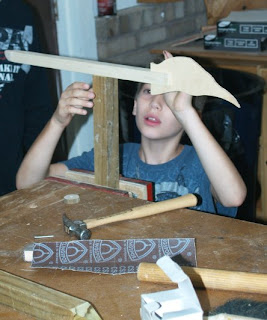
Today was the start of the Clear Spring School fall camp out, and it looks like the campers may get by without rain. In the meantime, rain or not, there is a great deal to be learned. This afternoon among many other areas of activity some of the students went fishing for the first time in their lives and others like Sam in the photo below practiced a bit of Sloyd woodcarving.

Tuesday, October 02, 2007

There is a thing that happens in the naming and identification of things. You observe a bird in the back yard, and you say to yourself, "tufted-titmouse," and you gain a sense of satisfaction in your own knowledge and mastery of information. But the ability to name the bird differs from the ability to fly. There is a great deal more going on in the bird than is revealed by the identification and naming of its external form. The naming and identification is either a stopping point, or the point from which greater and deeper analysis and understanding can ensue. For most, the naming is the end of knowledge rather than its beginning.

Many art history courses in universities are designed to impart a sense of intellectual mastery of the arts, so that from an academic perspective the student can feel a sense of ownership of the subject without ever being required to handle a tool or a brush. Too often education stops at the neck. You see it, you hear it, you process it in the brain, and you recite the common concepts, and the discussions of those who have devoted their lives to the critique, classification and analysis of great works allowing you to participate confidently in discussions while expressing a sense of mastery and superiority.

Anyone wanting to look more deeply at the origins of academic dominance over the arts might want to read Barbara Maria Stafford's book, Artful Science.

A sincere look at the hands, and serious examination of what they can impart to learning at all levels could awaken us to much more. It would be very easy to read all this and assume that I have an anti-academic bias. The truth is that I have profound respect for academics, but I also know that they are enriched and brought to greater life when the hands take their place as full partners with the head and heart. Any questions? My arguments won't be enough. Pick up a knife and a stick. Invest your time and attention. A steady hand, sharp steel, and slender shavings express an understanding beyond words. See if something occurs to you. You might feel silly (and awkward) at first. Learning something new or reengaging something near forgotten can do that to you. It means you have stepped beyond your comfort zone. Those feelings are the sign of the heart breaking its common boundaries as learning begins to take flight.
Today in the Clear Spring School wood shop, the 1st and 2nd grade students finished their trains, and the 3rd and 4th grade students made book holders for their read-in. Photos follow:

Monday, October 01, 2007

Designing new things is one of the best parts of being a woodworker, and working with kids is a great way to encourage new designs. I started working on a prototype for the 3rd and 4th grades to make tomorrow and ended up making a more refined version that will become a magazine article. I took step-by-step photos as this one was made, so my work is almost complete. This would be a great cookbook stand, holding it on just the right page and clearly visible as you work, but it would also be great for craft books as it would allow you to take books (or magazines) into the wood shop to guide your next project. The book stand shown above is made of quarter-sawn white oak.

Another thing to note, my student Paige whose box won Grand Champion in Woodworking at the Carroll County Fair also won Best of Show, Woodworking in the Regional competition. Now her work goes on to the State Fair. Congratulations! Paige! And good luck!
This morning on NPR, they had an interview with Pulitzer Prize winning novelist Richard Russo about his new novel Bridge of Sighs. Russo frequently writes about the blue collar class, and in his interview, he mentioned the loss of things in which the lower classes are able to take significant pride. We, as a society tend to place such a strong stigma on the activities of the blue collar working man (and woman) that we fail to note the pride they take in their work. The shame isn't their's for the dirt under the fingernails, but lies in the hearts of those who fail to see or understand and thereby diminish the significance of their contributions. Richard told of working with his father on a highway crew, and that every time his father would pick him up at the airport he would point out the highway entrance ramp they worked on together. "We did that!" he would state. Classism is a serious disease that we must overcome in our efforts to build a nation that makes full use of the diverse talents of our people. As long as hands-on learning is disconnected from the education of the academic elite, there will be little recognition in society of the contributions of our nation's craftsmen.

In the wood shop this afternoon we used one of our object launchers to produce a ballistics problem for the physics class to study. It was much more meaningful than working from a purely hypothetical model. From the angle of launch, and the distance the object flew, the physics class was able to determine velocity, height, and time of flight.

Sunday, September 30, 2007

These days, being a boy isn't quite what it once was, and if you would like a glimpse of what it was and what it again could be (at least for some), check out Ernest Thompson Seton's book Two Little Savages It may remind you of some aspects of your own childhood, or it may fill you with longing for the childhood you never had. Ernest Thompson Seton was a well known author and one of the founders of the Boy Scouts of America. The illustration above is from the dedication of his book and I think it will explain the deep attraction I feel for his work.

This morning I was in the Clear Spring Wood shop to work out details of a prototype for a book holder. Tuesday the 3rd and 4th grades are having a "read-in", a day dedicated to reading, which will be interrupted only by the hour or so making book holders in the Clear Spring wood shop. Tune in on Tuesday for a glimpse of a new design, and children at work.

Saturday, September 29, 2007

Things men have made

Things men have made with wakened hands, and put soft life into
are awake through years with transferred touch, and go on glowing
for long years.

And for this reason, some old things are lovely,
warm still with the life of forgotten men who made them.

Things made by Iron

Things made by iron and handled by steel
are born dead, they are shrouds, they soak life out of us.

Til after a long time, they are old and have steeped in our life,
they begin to be soothed and are soothing; then we throw them away.

both by D.H. Lawrence
You can go to Walmart and buy a huge jewelry chest on legs with doors and drawers for $78.00 (or less). Fridays and Saturdays are my days to compete with the Chinese. I make little boxes with love and care, which are sold in galleries at prices that would be considered outrageous in comparison to the prices of Chinese goods, but for an amount of income which would embarrass most Americans. Fortunately, I have my other work as a writer and teacher, both of which are part time, and most fortunately, all are related to my love of woodworking. Between all three, I can keep making boxes.

I am interested in the discussion going on in the pages of Woodwork Magazine that started as a letter by American craftsman John Grew Sheridan. He feels that the Chinese have directly copied his design for a stool which they are selling at a fraction of his cost. That can be a very tough thing to approach from a legal standpoint. And the legal expense can be gruesome. How can you prove ownership of a shape? And how can you prove damages to your sales of that shape? Lawyers get a much higher hourly rate than most woodworkers.

There are other issues...

Where does the intrinsic worth of a object lie? Is it in the shape and use of the object, or does it lie in within deeper qualities? The style of James Krenov's cabinets have been copied by multitudes of American Craftsmen, using routers in place of hand planes, missing essential qualities of construction and intent, and while a copy may look the same from a distance or under the glare of your built-in flash, those in the know and those with greater depth of understanding would see clearly the inadequacies of the copied work. It is a shame that we are so concerned about copying the look of things when we could be encouraging the copying of the integrity with which things are made. By doing so, we might bring some significant change in our shallow culture and a greater understanding of craftsmanship, leading to a better valuation of the craftsman's work.

I am reminded of a story about Japanese potter Shoji Hamada. It seems a young, brash potter was copying Hamada's work and like the master, leaving it unsigned. Friends of Hamada came to him and insisted, "You must begin signing your work to distinguish it from the work of this upstart!" Shoji Hamada responded, "when he is dead and I am dead, the worst of my work will be thought his and best of his work will be thought mine."

And then there are the words of Satchel Paige, "Don't look back, something might be gaining on you." Could the best recourse to being copied be to keep involved in our own creative expression and caring craftsmanship, staying ahead of the pack and by leaping creatively beyond ourselves? Everything on the planet is derivative. Could we ever look at our own work in total confidence that it is derivative of nothing and of no one but what we ourselves did last? I suggest that we damn the torpedoes and blast creatively and qualitatively ahead.

I try to help my customers understand all the values of craftsmanship and design within my work and give credit to my sources of inspiration where I can. To do so conveys honor to both my source of inspiration and to myself. Those who choose to copy directly without adding personal touch or personal experience express their own failings of confidence and miss the wonderful opportunities that personal creativity and craftsmanship can provide. And I think that Satchel Paige might agree, they can copy where you've been but have no idea where you are going next.

Friday, September 28, 2007

I have been asked by Marc Adams of the Marc Adams School of Woodworking to teach a one day class, mentoring adults in the teaching of woodworking to kids. It will be held this summer, July 12 following my one week class in Making Decorative Wooden Boxes. Enrollment will be limited, and popular classes often fill up within a week or so of their announcement. The unedited course description for their catalog is as follows:
Wisdom of the Hands...
For those of us with a well developed love of working with wood, sharing that love with others is a "no-brainer." It arises from passion. Those who love children, whether their own or in their communities may think that because they are quietly occupied with their hands-on video devices they are in good hands and that adult guidance and attention are not required.

But the evidence linking damage to children's attention to learning and capacity for learning to the amount of time spent watching television or engaged in computer gaming is far stronger and more clearly documented than the evidence linking smoking, lung cancer and heart disease.

In addition, there is a huge and growing amount of statistical data, linking the effectiveness of learning and joy in learning to the engagement of the hands.

So what's a woodworker to do? Isn't it obvious?

But how do you get started? How can you keep your child safe? How can you encourage your child's confidence, creativity and skill? Doug Stowe will help.

He has been director of a woodworking program at Clear Spring School in Northwest Arkansas for 7 years, working with students of all ages. Articles about his program have been published in Woodwork, Woodcraft, CabinetMaker, and in Fine Woodworking On-line. In addition to reaching woodworkers with this vital information (preaching to the choir), his articles have been published in Independent School and Encounter magazines.

This class is hands-on learning for adults with the purpose of providing an understanding of children's needs and the educational opportunities that woodworking can provide. But even more, this is about sharing with our kids, the most important part of our lives as creative and enthusiastic life-long learners.

If you are interested, please contact the Marc Adams School of Woodworking and ask that you be notified as soon as next summer's classes are open for enrollment.

Thursday, September 27, 2007

This afternoon in the Clear Spring Wood Shop our high school physics block began making a variety of launchers to begin study of ballistics and motion. Two students are working on a catapult and others are working on a variety of rubber band powered launchers. Pete Golden, the physics teacher is working on a launcher of his own, using the springy flexibility of a wooden strip to launch an object along a controlled path. In practice and experimentation before class, I made both a rubber band powered launcher and one based on the flexibility of wood. One was a success (after some testing and student suggested modifications) and the other somewhat of a failure. I'll let you guess which was which.

Learning is best when there is a sense of discovery. It makes things fun and funny. Our whole class was entertained as our exchange students from Taiwan and Japan worked through the operation of a cordless drill. There is a first time for everything. We were reminded that throughout the world, children are being given little opportunity for engagement with tools and materials. Seeing the enthusiasm expressed by these students tell us of the universal excitement that comes from creativity and seeing one's own ideas (whether successful or not) in physical form and tested in real life.

I should have pictures of finished launchers in a week or so.
There are mornings when I open the blog and wonder what more I can say. Two people slightly askew from each other in upbringing and experience can see things so differently... even becoming polar opposite. If you have no fundamental basis for judgment, you can begin to believe anything... Like what your politicians say on television for example. You begin to lose all basis for personal examination of fact and reality, and in doing so, you also lose your power as citizen and as human being. When you come face to face with people who live in such distortion of reality from lack of engagement with it, it can become a matter for personal depression and discouragement.

In making the weather vanes in the 6th and 6th grade classes last week, I was reminded of a book I have mentioned before, Defining the Wind by Scott Huler, which is about the history of the development of the Beaufort Scale. That was in an earlier time in which all citizens were encouraged to take up the challenge of scientific investigation. Each might become an expert on the wind by comparing what he or see saw in its effects as compared to a simple scale of observable phenomena. There were versions of the Beaufort scale for landsmen in which the wind might be measured by its effect on a leaf or the smoke rising from a chimney, and of course there was a version which allowed the common sailor to read the wind by its effect on the sails of his ship.

One of the interesting things in making our weather vanes was finding the balance point, the point at which the shaft of the vane should be attached to the base for smooth friction free rotation. Each weather vane, being student designed and student made, had a different balance point, requiring careful observation, marking and drilling for attachment.

Most schools and homes are not training our children to become successful observers of reality. We put their noses in books or in front of the television or computer screen and expect them to derive their opinions from experts. Is it any wonder that we have such people at all levels of government who are allowed to distort our perspectives toward their own purposes?

In Norman Greenspan's new book it is admitted that the war in Iraq is and always was about oil. There is strong evidence that the current administration had plans for that invasion long before 9/11 and that it was never about stopping terror in the first place but about gaining secure access to Iraqi oil and profit for a few select corporations at great expense to the American people. There is monumental shame in their hidden motives, and monumental shame in that we, the American people have allowed ourselves to be manipulated and damaged in this manner.

We all need the opportunity to learn from reality. Each of us needs to take time to be involved in the shaping of the world's essential materials if we are to be grounded in reality. Think of it as a form of inoculation. You pass a plane across a board and observe the curl of wood that arises from the mouth. That mouth won't lie about the sharpness of the steel, nor will it lie about direction of grain. It won't lie about your skill or lack of skill in its use. The scent that arises in the air won't lie about the species of the wood. Hold up a wet thumb. It won't lie about whether or not the wind is blowing. But allow yourself and your children to become anesthetized to reality by television, the distortions of the media and of politics, and you get a world pretty much like the one we have now. And if you haven't noticed, it is becoming a very dangerous place.

There is reason for despair and discouragement, but that is a reason to get to work. Join me if you can. The photo above is of Will finding the balance point on his weather vane.

Wednesday, September 26, 2007

Today in 5th and 6th grade wood shop, the students finished their weather vanes, except for painting and installation. The projects just keep rolling through. Next week these students will be working on 3-d topographic models of Mount St. Helens Volcano.
What would happen if we were to make some small effort to remember our roots...

text, texture, context from:
[Middle English, from Old French, from Latin textra, from textus, past participle of texere, to weave.]

technology from:
[Greek tekhnologia, systematic treatment of an art or craft : tekhne, skill; see teks- in Indo-European roots + -logia, -logy.]

Also, from An Etymological Dictionary of the English Language By Walter William Skeat 1893
TAK, to prepare. See Curtius, i. 271, who gives the three main meanings of the root as 'generate,' 'hit,' and 'prepare,' and adds: 1 The root is one of the oldest applied to any kind of occupation, without any clearly defined distinction, so that we must not be astonished if we meet the weaver [Lat. tex-tor] in company with the carpenter [Skt. tatsh-an].
It was reported by anthropologists studying Borneo that there was a particular butterfly that the natives associated with the approach of the wild boar. When those natives had moved to the city for a time as brief as three weeks, they could no longer identify the butterfly.

Human knowledge is fragile. The mind clears itself to make way for new things. Modern technology in contrast to its roots is designed to erase the need for development of human skill and attention. But at the core of our humanity is the need to weave, craft, create and grow, to become expressed in text and in texture and in the gardens of the earth.

Roots anchor us to the earth, to our origins, and give indication of the vector of human development. But we are a world of cultures adrift and in states of collision, torn from deep roots. To create peace requires that we remember, dig deep and restore... for the nautical buffs among us... all hands on deck.