Friday, January 28, 2022

Ozarks Watch

I learned this morning that my interview on the Ozark Public Television's program "Ozarks Watch" will be broadcast on next Thursday February 3 at 9:00 PM and again on Sunday February 6 at 1:30 PM. If you receive Ozark Public Television on your cable channel or set, put these dates on your calendar and watch. The program will be offered online at a later date and I'll share that link when it becomes available.

Make, fix and create...

Thursday, January 27, 2022

This week at the Clear Spring School

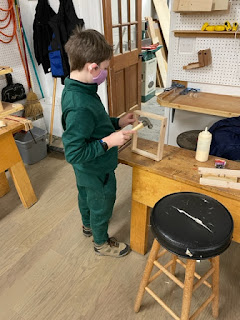
We've had a challenging week as a number of students and one staff member were out with illness and possible exposure to covid-19. But it was a good week with students building interesting things with blocks and making bird feeders with the outdoors study group. 

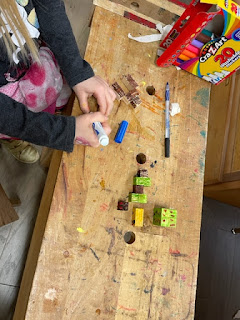
My assistant Dustin suggested the use of glue sticks for gluing blocks of wood together and we found that even though glue sticks are often  almost worthless on paper, they do work with blocks of wood. They are far less messy than wet glue and far safer than hot glueguns. Adding glue sticks to assembly kits we hope to develop will make them a more complete kits, less reliant on other things being provided from a household supply.

I've been working on an op ed piece I hope will be useful in promoting my new book and that reminded me of when I was quoted in the New York Times regarding school wood shops. The article was "Kindergarten Shop Class" published on March 30, 2011.  I was quoted as follows with regard to a renewed interest in woodworking education for kids:

“There is an awakening going on for sure,” said Doug Stowe, a longtime woodworker and educator in Arkansas, who was named a Living Treasure there in 2009 for his efforts at preserving and teaching the craft. Since he started a blog five years ago called Wisdom of the Hands, named after the program he founded in 2001 at Clear Spring School in Eureka Springs, Mr. Stowe said parents, educators and woodworkers from around the country have been contacting him for advice on starting projects and classes in their communities.

“Up until the early 1900s, there was a widespread understanding that the use of the hands was essential to the development of character and intellect,” said Mr. Stowe, 62. “More recently, we’ve had this idea that every child should go to college and that the preparation for careers in manual arts was no longer required.” "Somewhere along the way," he added, “we have forgotten all the other important things that manual training conveys.”

If you are a subscriber to the New York Times you can find the article online. 

Make, fix and create... 

Monday, January 24, 2022

Toys that inspire creativity

Many educational theorists complain about the toys made for kids.  They note that most of the creativity is put in by the designers and manufacturers leaving little to exercise the creative imaginations of kids. 

So today we did a simple experiment with each student being given 8 blocks. The idea was for them to observe their own creativity. Each came up with something different to made from their 8 blocks. When done with one project the students asked for 8 more to build something else. Of course this experiment was derived from Froebel's Kindergarten.

One of our objectives is to develop a set of project kits that the kids can sell in their study of small business. You can buy kits for children to assemble at Lowe's or Home Depot, and aside from giving the kids a chance to use a hammer they are of less value than a set of 8 blocks if your point is to develop both the skill and imagination we want our children to have.

My new book has received a positive review from Foreword Reviews. The review will go in the March/April edition. I'll not share the whole review here except for one line: 

The Wisdom of Our Hands encourages people to engage themselves in crafting, applying their hearts and minds to the art of bringing about a better world.
They note that Foreword Reviews only reviews books that they love. 

Make, fix and create... Assist others in learning likewise.

Friday, January 21, 2022

at sea in a sea of change

Kids deserve the opportunity to do life building/altering things. For instance, going to sea to learn history as well as other things about character and relationship.

This article: https://www.postandcourier.com/news/aboard-the-schooner-harvey-gamage-students-learn-about-african-american-history/article_7378800e-6fc8-11ec-83bb-f7debfe070ec.html describes going to sea with students from the Met School in Providence, RI and students from New Hampshire's Proctor Academy. The article notes despite the diverse backgrounds of the students, on board all are the same: 

Put a bunch of people on a big sailboat and watch what happens.

Differences evaporate like fog on a warm morning. On the water, it matters little where you come from, how you grew up, how much money you have or who your people are.

The moment you step onto the boat, you are a sailor, nothing more, nothing less. You have a job to do, and you have to coordinate your work with all the others. You are a member of the crew, and the crew has a narrow focus: to stay safe and sail well.

For these students going for a sail brings lessons for a lifetime. And this kind of lesson is not only important to kids. They will be our important citizens of tomorrow.

Make, fix and create... 

The Institute for the Future of Learning

The Institute for the Future of Learning (the-IFL.org), has mentioned my new book, The Wisdom of Our Hands in their January Newsletter as follows:

"Doug Stowe's beautifully written book, "The Wisdom of our Hands," grounds us in the power of meaningful, useful, beautiful work and how it provides a path to unleash the potential that lies within each of us." https://mailchi.mp/048529ae046c/ifl-january-2022
Julie (Wilson) Jungalwala, director of the organization offers praise for my book as follows:
"Somewhere along the way we seem to have forgotten that the brain and the hands are "intricately intertwined". In "Wisdom of Our Hands," Doug Stowe (re)introduces us to the life giving, shaping and affirming power of working with our hands. A beautifully written book, Doug shares his 45-year journey as a woodworker and weaves the research-based evidence of how handcrafts shape us as we shape them. As an educator, Doug has experienced first hand the atomization and abstraction of content - and the negative impact on student motivation and learning as a result. This book reminds us of the power of meaningful, useful, beautiful work and how it provides a path to unleash the potential that lies within each of us."
Julie's own book is called "The Human Side of Changing Education."  It is "... centered on the premise that when we ask schools to change, we are asking human beings to change and this requires special tools and a human-centered approach. We cannot change the heart of the system without enabling the hearts and minds of those who give their all every day to making schools work."

In the US, teachers are regarded by the system and by policy makers as being of far less than their potential value. They're expected to be "classroom managers" and  "information delivery specialists" with too large class sizes allowing them no opportunity to take more meaningful roles in the growth of their students.

My wife Jean is planning a book signing to promote my new book and support our local library that will be held at the conservatory at the Crescent Hotel on April 3, 2022. We are on a 60 day countdown for the book's release.

Make, fix and create...

Thursday, January 20, 2022

entanglements

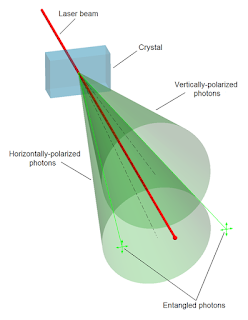
Physicists have noted and proven that if you take two particles, introduce them to each other and then thrust them apart to the furthest reaches of the universe, what is done to one is noted within the behavior of the other. The phenomenon is called quantum entanglement and may someday help us to understand higher levels of human interconnectedness.

Friedrich Froebel had been born the son of a Lutheran minister and his mother had died at a very early age. He was a bright child and cherished by his father's second wife until her own children came along. At that point he was left to fend for himself to obtain the emotional support every child needs. At an early he was apprenticed to  an uncle, a forester, and it was there in the Thuringen forest that Froebel discovered a love of botany and the seeds were planted for what would become Kindergarten, a garden of children. In witnessing the wonders of nature he likely gained a first glimpse of the interconnectedness of all things.

In college Froebel had planned to become an architect but had an opportunity to work as an assistant to Christian Samuel Weiss, a leading authority on minerals and crystallography. Helping to organize the collection of minerals for Dr. Weiss, Froebel was to witness how things of great beauty grow from patterns inherent within. Should children, given the right circumstances, not grow in the same manner? You see the impact of his work with Dr. Weiss in Froebel's development of his gifts, one through 6 which were designed to lead the child into an exploration of the structure of the universe and through association with other Kindergarten activities, understand their place within it.

Many of us have seen, even before the internet and before facebook, evidence of our interconnectedness. Living in a small town and knowing a few folks, I'll think of someone as I drive through town and then see them coming in the next car. This is not always the case but happens often enough to make me wonder. Under such circumstances, we don't need facebook to remind us that we are a part of one another and that what we do reflects who we are and may be guided by unseen patterns within.

And so, what are we to make of all this? Froebel had suggested three uses for the Froebel gifts. One was to use blocks to create what he called forms of knowledge. Forms of knowledge were used to represent numbers and mathematical constructs important to the growth of the child. Another use was to create forms of beauty. These were to develop the child's design sense through representations of symmetry and rhythm. The third use was to create what Froebel referred to as forms of life, representing the objects to be found in everyday life, thus connecting with the child's natural inclination to serve others by making useful things. So you take these three things, development of intellect, artistic sense, and inclination to serve and you have the formula for growth.

It's ironic that Froebel did not become an architect of buildings, but instead an architect for a system of education that allowed the child to grow from within, as a crystal or flower might grow. In his autobiography Frank Lloyd Wright said about his play with Froebel blocks and their impact, "I can still feel those maple blocks in my hands to this day."

The illustration from wikipedia shows an experiment demonstrating quantum entanglement.

If you are reading this, we are entangled.

Make, fix and create...


Wednesday, January 19, 2022

Path to learning podcast

I've been listening my way through the path to learning podcast and finding each episode to be quite meaningful. There are times in my wood shop when the noisy tools are off and I'm doing handwork, and that's the perfect time to fill my head with hope. 

Looking at education in general one might become depressed. But to hear our nation's experts in learning express their ideas and ideals, even when they are ignored by educational policy makers, tells me that with some work, investigation of some old ideas and recognition of the value of teachers, we can make things better.

In Finland, they attribute the success of their educational system to two factors. One is that the profession of "teacher," is a highly respected one. The other is that they train their teachers well to observe closely the needs of each child. In fact, the Finnish folks schools were originally established to follow the model of learning established by Froebel's Kindergarten.

You can a find the path to learning podcast available on all the usual podcast services. For example, I listen on an amazon device. I ask, "Alexa, play path to learning podcast." If I enunciate carefully the podcast comes right up.

I am very sorry to have lost a dear friend over the weekend. Steven Foster was the father of two of my students, a long time friend of the Clear Spring School, a vital trustee of our City Parks, and a world renown authority on medicinal herbs and plants. He will be sorely missed, not only here in Eureka Springs, but in the world at large and I offer my condolences to his family. 

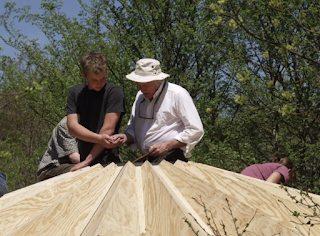
Steven was the one who first introduced me to Bill Coperthwaite, a friend in Maine whom I've written about before in my blog. https://wisdomofhands.blogspot.com/search?q=coperthwaite The photo shows Steven's son Colin with Bill Coperthwaite building a yurt with students from the Clear Spring School.

Make, fix and create...
Saturday, January 15, 2022

building a sense of commonality

We had a great time on Thursday at the Eureka Springs School of the Arts as members of the staff and I made boxes. Shared experience in a common venture builds a sense of commonality, that we're all in this together, and even though each person in class was working on their own box, the journey through the process required taking turns at the saw and allowing for the needs of each other. 

At one point I looked around the room at my students and each was holding their box as though it was a small child to whom they'd just given birth. That's directly a part of the nature of such things.

In selecting woods for lids, the students would take a board and work out with each other which portion would become the lid of their box. If anyone out there needs to find a location for a corporate retreat with built in team building exercise, ESSA might be the place for it, and box making might be an exercise around which various folks might gather.

Friedrich Froebel is remembered most for his invention of instructional materials related to his invention of Kindergarten. He was also intent on the creation of a sense of commonality within children through which they sensed their relationship to others and their place and potentials within community life and beyond.

These days a lot of politicians and policy makers are focusing their attention on devising a sense of common history, by prohibiting teaching about the uglier parts of American history. Slavery for example. That's a strategy that offers no potential for the development of empathy and leaves us divided against one another. But when we seek commonality through the shared process of creating useful beauty, walls come down. We take turns, not only at the saw, but also in listening to each other and building space for each other in each other's lives.

And I again assert that the creation of useful beauty should be a requirement for children in school as it can be instrumental in developing a sense of shared community.

Make, fix and create...
Friday, January 14, 2022

staff class at ESSA

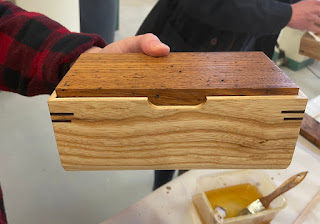
Yesterday I taught a one day box making class for the staff at ESSA. Seven staff members were able to attend and each made a box similar to the box shown. 

I supplied ash for the box sides, walnut corner keys and a variety of woods that students could select from for making the lids.

It's my belief that no one in the US should be allowed to graduate from high school without having had the opportunity to make something beautiful and useful from wood. A box, lovingly crafted, would hold memories for a lifetime. I thank the staff of the Eureka Springs School of the Arts for joining me in a day of box making. I can train others to share the same experience.

My week of teaching at the Clear Spring School was disrupted by a serious spike in covid cases in Arkansas and the local community. Other schools are also closed. At ESSA we kept each other safe by being fully vaccinated, tested the day before class and masked with KN95s. Please stay safe and keep others safe. We want all to survive this and keep our health care workers safe Please!

Make, fix and create...

Wednesday, January 12, 2022

small town life, page 3.

Valley Nebraska, where my father's store was located, was famous apart from being on the edge of Omaha and trapped between the Union Pacific Railroad lines and the Platte River. The Platte has been described as a mile wide and an inch deep, and that traverses the state of Nebraska from one end to the other. 

Valley is also the home of Valmont Industries, originally Valley Manufacturing, one of the early manufacturers of the circular irrigation systems that are in use throughout the world. 

Valmont, with an expanded product line remains a major employer. And so it was with many small towns in America. Small towns would grow from unique ideas that had a significant effect on the world at large. Educational policy makers attempt to standardize education and make all students look at things the same way, and teach all students exactly the same things, and we suffer culturally and economically as a result. We are led to ignore the value of things that grow large from small things. Instead of standardizing education, we'd do better  for ourselves and our kids by diversifying. The arts are one of the best ways to do that.

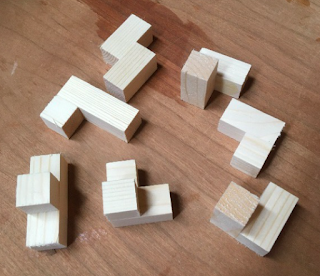
At the Clear Spring School this week with our group studying small business, I mentioned possible sale of woodworking kits, and I provided kits I'd prepared for building Soma Cube Puzzles from wooden blocks for our students to assemble. The students sanded and glued the blocks into the arrangement shown. The Soma puzzle consists of seven pieces, each consisting of 3 or 4 blocks representing the only 7 ways sets of 3 or 4 blocks can be arranged other than being in a straight line.

Concurrently, the core teacher got a 3 D printer for Christmas and is interested in learning its use. I am concerned that 3D printing of things not designed by the students can be a waste of time and talent, and of less educational value so we'll be using Tinkered software for the students to design objects that can be printed, and that reflect their experimenting with objects made of wooden blocks.

The experiment involves some interesting connections with educational sloyd. First start with the interests of the child. The kids love Minecraft, a game that involves pixelate creatures and landscape that appear as through they're made of blocks. In order to go from the easy to the more difficult, and from the concrete to the abstract are two principles from Educational Sloyd. It's easy to build with blocks and thus experiment with pixelated designs. (And it's very easy for me to make lots of uniform wooden blocks). 

It can be difficult to learn and used 3D design software, so we'll use Tinkercad on iPads for the students to make designs reflecting their arrangements of blocks. Wooden blocks are concrete in that they have texture, and weight. Tinkercad is abstract. The finished, 3D printed objects will become concrete representations of student thought. And the play with blocks brings Friedrich  Froebel back into the 21st century classroom.

Make, fix and create.

Monday, January 10, 2022

Small town life, p. 2

Valley Nebraska where my dad's store was located was typical of the situation all across the US as small towns were gradually being gobbled up by the expansion of larger cities. Shopping in Omaha offered a much wider variety of goods than what my father could offer in his store. He did take a lower than normal markup on many things and gave credit to many folks who could not have been afforded credit at the time. 

Working in my dad's store put me in touch with people from all walks of life. Louis Siebenaler for example, operated an auto salvage at King Lake, Nebraska, an unincorporated town nearby. He and his son-in-law Coy would come in covered with grease from head to toe. Louis was a large man and Coy small, and it was always apparent in how Louis smiled that they had serious affection for each other. 

Ted Reser was the town blacksmith at a time when most folks would rather buy new than fix old. He was rather deaf from the sound of his hammer striking the anvil, smelled of soot and sweat and was very proud of his physique. He told me more than once that the ladies in the bar next door expressed their admiration for his shoulders and strong arms. 

There were of course, others that came in throughout the day. farmers in overalls, women hunting through the selection of greeting cards and the like. My dad had a genuine warmth for all. And so, why in the world would any of this be important now? Perhaps because we've let things grow completely out of hand, and no longer matter as much to each other as we once did.

Because of my banking in the local bank and being known there, when a Chevy dealer in Indiana called the Bank of Valley to assure themselves that the hippy with a broken down Chevy van could actually pay for their service to my truck, the dealer was shocked at the glowing credit report offered by the bank on my behalf. "Yes, Mr. Stowe," they said. "We'll get right to work."And so when we live on a smaller scale and make a few friends along the way, and stay put long enough to be known and are kind enough to be respected, there's a very simple formula in that, and it's one that can be repeated even without living in a small town.

Make, fix and create...

small town life, p. 1

 In 1963 my father and mother bought a small store in Valley Nebraska. My father, having worked for various corporations and as manager of a large hardware and sporting goods store in Omaha wanted a business of his own and a small inheritance from my great aunt Allene, gave my parents some funds to invest. 

Valley Home Furnishings, as the store was called featured hardware on one side and a variety of other goods on the other, and I worked in the store with my dad on weekends and summers when I was in high school and summers during my 4 years of college. My mother was teaching kindergarten in Omaha, so my parents kept their home there and my father commuted each day for the 30 mile trip to and from Valley.

Valley was sandwiched between the Union Pacific Railroad on one side and the Platte River on the other and business was gradually being shifted from the town to the larger city to the east. One poet had called Omaha the "Paris of the Pigbelt," and shopping malls being developed on the west side of the city were gradually taking business away from outlying small shops like the one my mom and dad bought in 1963.

The effects of the railroad passing through town, and Valley being a switching yard for trains going east, west and north north, meant that autos passing in and out of town often had to stop and wait for trains, not just passing by, but going slowly back and forth as freight cars were unhooked and rearranged.

My time working in my dad's store had a profound effect on my attitudes about life and about people, and it had some effect on my choosing to live in a small town dedicated to the arts. 

Shall, I tell more while we wait for a passing train? Or is it OK that we as a society are consumed and swallowed up in the pigbelt? I have this idea (shared with many others, that small is wonderful as well as beautiful and that our souls call out for less, not more).

In the wood shop I've been finishing boxes that were started as demonstration boxes for teaching. Get them finished well and get them out of here! It's part of my plan to simplify.

Make, fix and create...


Wednesday, January 05, 2022

modest homes

On our travels to and from Worcester MA, I compared the huge Amazon warehouses along the way, with the modest homes on the hillsides in the small towns of Pennsylvania and West Virginia. 

Compared to the mac mansions folks build around here now, those smaller homes seem most reasonable and conservative. If people lived in such small homes and at one time raised large families within them we have to wonder where they had put all their stuff. We must also wonder how we've become such willing participants in planetary destruction.

We live in immodest times and if we want to save the planet and ourselves, we must reconsider our reliance on cheap, imported, meaningless stuff and return to a simpler relationship to our planet and to each other. We can try our hands at making a few things.

According to the news folks are leaving the labor market in droves in a movement they call "the Great Resignation." Has work has become increasingly abstract unsatisfying and detached? Can it be because the need for a simpler life has become apparent?

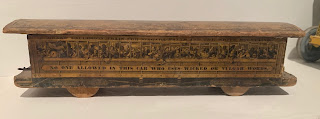
A friend, Mike, sent me the photo of a toy in a museum in Santa Fe. It's a box so naturally interesting to me. It had been part of a model excursion train that traveled from the Niagara Falls to the White Mountains. A banner on the side notes that "no one allowed in this car who uses wicked or vulgar words." Did they have a special car to carry the uncouth?

Make, fix and create...

Tuesday, January 04, 2022

"tool-wrapt"

An article in the New York Times describes those who live their lives surrounded by real books as being "Book-wrapt." https://www.nytimes.com/2021/12/24/realestate/why-do-people-keep-books.html  

Books that have brought changes in our lives can feel like friends and are held close. I had a book that I kept at bedside for years until I recently decided to loan it to a friend. It was about the Battle of the Hurtgen Forest during WWII. I kept it at bedside because my father was there, had described to me how beautiful the forest was, and neglected to tell me of its horrors. His 104th Infantry Division, the fighting Timberwolves, had played an important role there in the attempt to end the Nazi regime.

There are things that happen in wars that reasonable parents choose to shelter from their kids. Keeping that book at bedside reminded me of that aspect of parental love and helped me to hold his memory close.  

I have friends who could be called "book-wrapt," and someone looking in my office at my collection of old books could call me by the same term. The books have been important resources for me and may continue to serve. I could also be described as "wood-wrapt," due to my collection of woods intended for use, and as "tool-wrapt," because I have a large collection of tools available to my work. I hope to simplify over the coming years.

Folks these days are "screen wrapt" as we sit around with each other and watch our social media feeds from elsewhere coming in on tiny screens and as we ignore the people in the immediate world around us. As a new year's resolution let us be more wrapt in each other without tiny screens standing between.

We got home yesterday from a road trip from Arkansas to Worcester, MA and home again. The highways were flooded with trucks on our way to Worcester but with reduced holiday and weekend traffic on the way home. If there's a supply chain problem, one would never know it from the big Amazon warehouses along the way or from the Amazon Prime trucks hauling things to us.

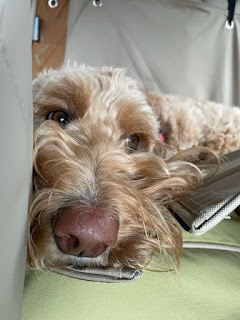
The photo shows our dog Rosie, bored by the journey and keeping her nose where she can keep sense of us along the way.

Make, fix and create...

Saturday, December 25, 2021

A pitch to the choir

One of the things that must happen as we get together to sing in harmony with each other is to settle on the perfect pitch. And when someone sings a solo in the choir, they do not perform alone. And so it is with a revolution. 

There are times when we take turns at the lead, letting our own voices rise and fall in pitch and in volume, and there are times when we hold back, taking a breath.

I want to introduce you to a branch of the choir, led by soloist Joe Youcha, who in the spirit of a great choir does not sing alone. The organization he founded, Teaching with Small Boats Alliance, is a good one. I made a small donation today because I believe they, by building small wooden boats with kids, offer many students a chance to actually learn hands on. 

When you build a boat, it either floats and floats well, or you must be prepared to swim, and so in building a boat, students do a learning task that really matters to them, unlike most of the time they spend being taught abstract stuff. When they ride the waters in something they've crafted themselves, no standardized test is needed to assure them of their accomplishments. The link for making a charitable donation to Teaching with Small Boats Alliance is here:

https://www.teachingwithsmallboats.org/index.php/donate

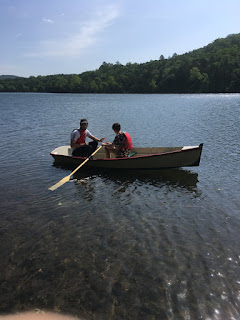
The boys in the boat shown are in the boat they built following Joe Youcha's instructions and plans at the Clear Spring School. Being one of the leaders in the revolution, too, Clear Spring School will also benefit from your annual end of year giving. https://www.clearspringschool.org/giving

Make, fix and create...


Friday, December 24, 2021

a Christmas greeting.

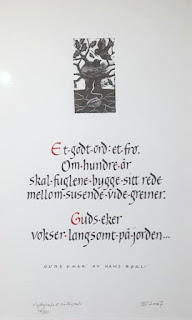
A friend, Knud in Stavanger sent these words from Norwegian poet/lumberjack Hans Børli.

”A good/kind word : a seed. – In a hundred years – birds shall build their nests – in whistling wide branches. – God’s oaks – grow slowly on earth…”

May these gentle words serve as my season's greetings to you. In a world where whole forests in the Southeastern US are destroyed and marketed as green energy to feed power plants in Europe, and too many of us are consumed and corrupted by the short term, may we think in longer terms (lengre sikt). May we plant seeds that grow into finer things that nourish our families in more meaningful ways. May we think of the days a hundred years hence in which birds nest in our branches.

The image is also from my friend Knud. It is of the same quote in Norwegian, done in calligraphy by one of his friends. It hangs on his wall in Stavanger.

Make, fix and create...

.

Wednesday, December 22, 2021

Book list

My new book, "The Wisdom of our Hands" has been reviewed and recommended by Booklist, a review service maintained by the American Library Association as an aid to librarians selecting books for their collections. 

https://www.booklistonline.com

They say in part, "This book will appeal to readers who wish to learn more about woodworking and crafting, but from a broader perspective, anyone looking for a way to reconnect with the Earth would do well to read Stowe's wisdom." 

The full review will go live on their website on January 13, 2022. Foreword Reviews will review the Wisdom of Our Hands in their March/April print magazine. Forewordreviews.com

Make, fix and create...

Monday, December 20, 2021

Rigor and joy

In the past I've mentioned that joy can provide a means through which we can observe and measure student and school success. I proposed a Beaufort-like scale to observe and measure joy. But joy is not just a happy thing. It fits in balance with effort and manageable frustration. In the late 1970s I had product cards printed (Thanks Jacquie Froelich) to be given along with the sale of my boxes. In the text I noted that frustration was an inevitable part of the process of growth, and that without the balance it provides the moments of joy we find are without context. How much sweeter is success when it arrives through serious effort than when it's delivered without.

So schooling is not just a process of passing a child from one happy day to another, but one of presenting obstacles and a path forward to build toward transcendence.

You can witness joy in the happy faces of children at play. A parent can see it in the excitement their child expresses for going to school each day. An observer in school will see it clearly through the students' engagement in learning. Students can even witness it in themselves and in others, so clearly, joy would be a better measurement of school success than standardized tests.

And then there's the other side. In order for joy to have value and greater meaning it requires some obstacles having been in the path, some expenditure of effort and resolve.

That's where craftsmanship comes in, and the use of the principles of Educational Sloyd to establish rigor. Educational Sloyd had a model series for the students to complete. Each model was to bring the students from a reasonable starting point, in a direction that challenged their growth and then further growth. If we look at the model series today, and for the wide range of students, so many of whom have no knowledge of craftsmanship, the use of simple tools or the growth of character and intellect required, the models seem incredibly difficult (or impossible). But the quest for joy demands rigor and growth. What satisfied the craftsman's need for growth today will not suffice for tomorrow and will bring less joy.

This all demands further clarification. Join me in thinking of these things.

Make, fix and create...

Sunday, December 19, 2021

stowe cases

I was cleaning in the wood shop today and ran across a bit of memorabilia from about 1980. At the time I was making display cases for various shops around town, many of which are still in use. I thought briefly of branding them as "Stowe Cases" and attempting to market them outside of town. Not all ideas are good ones, and to market them outside of town would have taken me away from crafting other things. 

The brass plaque was intended to be a branding device, setting my own work apart from others on the market and it was engraved by Jim MaGee, whose shop in downtown Eureka Springs has a number of display cases I made.

Make, fix and create...

Saturday, December 18, 2021

great books or great works

An article in the New Yorker asks, What's so great about the great books?  https://www.newyorker.com/magazine/2021/12/20/whats-so-great-about-great-books-courses-roosevelt-montas-rescuing-socrates 

How you feel about that subject might hinge on what you see the purpose of eduction being. Is it to provide a career, or to provide a sense of your own humanity? 

My daughter went to Columbia University mentioned in the article and as a freshman and sophomore was required to take the Core Curriculum as were other liberal arts majors. The idea is that all would be required to read and discuss a number of books considered important to our civilization. The Core Curriculum is considered to be a sacred part of the Columbia experience and was to bring students to a common understanding of human culture.

Otto Salomon, one of the founders of Educational Sloyd discussed two primary purposes of education. One he described as economic, that of preparing students to earn livings upon graduation. The other Salomon described as "formative" in that it did exactly what Columbia University proposes as the outcome of the Core Curriculum... bring the students to a common understanding of their own humanity and place within human culture.

But there is a difference between Educational Sloyd and the Core Curriculum in that Sloyd proposed the education of the hands, a thing not to be found in books alone.

While my daughter was at Columbia University, I tried to contact university president Lee Bolinger proposing to alter the core curriculum to bring students to learn about human culture by doing real work in the real world of craftsmanship. Of course I was unsuccessful. Who would listen to a woodworker from Arkansas. But craftsmanship is the real core of civilization and culture, and Socrates sucks in comparison to what students can learn from the real world.

Right across the street from the university is the unfinished cathedral, St. John the Divine, and the opportunity it presents is obvious. What could be better for college freshmen than to get real world experience chiseling stone?

To do so would fit the basic principles of educational Sloyd, most particularly that of moving from the concrete to the abstract.

Make, fix and create...