Wednesday, September 22, 2010

National security tied to "made in USA"

Makes you wonder... what were they thinking? Between the balance of payment deficit, which is like having an open wound through which our children's future is bled, and the loss of American jobs and creative intelligence in the workforce, how in the world did they think it was OK to lose our manufacturing sector? And now they suddenly notice what they've done! We know better than to expect anyone to accept responsibility for it.

Those who actually make things have been pointing this out for years, and actually doing something about it.

Today at in the Clear Spring School wood shop, the first, second, and third grade students finished their trains with the second and third grade students shown in the photo above.

Watching as a parent you notice when children are engaged in doing real things beyond classroom memorization and worksheets. Even if your child is shy and inexpressive in words, the objects he or she has made invite conversation. By observing the things a child brings home from the wood shop, a mother might see the growth of her child moving from the easy to the more difficult, the known to the unknown, and the simple to the complex. She might even see things like growth in confidence and creative imagination. She might notice these things and giver her child praise, thus reinforcing the partnership between home and school.

Second grader Oakley told his mother that he wants to build a desk. He says he knows how to do it. He just needs some materials. His confidence is impressive. In the wood shop he applies himself with diligence. Two of the things that a parent witnesses in a child are growth of ambition and growth of confidence. Can you see how craftsmanship and the arts might provide an easy and direct means of assessment to revitalize our nation's schools? I will, in my spare time, set things into a "Beaufort scale of educational excellence". You are welcome to help. An interesting point is that the same relational scale applies throughout a child's education. In other words, you won't need a whole battery of standardized tests, each intended for specific grade levels when every parent and teacher is trusted as a witness of growth. And there is no stopping point in the development of craftsmanship.

My train making students asked, "Can we take these home today?" And it is important that children have that kind of feeling about their work.

Tuesday, September 21, 2010

using gesture to teach math

what is a craftsman?

In order to extend the child as craftsman metaphor, it is important to examine the concept of "craftsman" and to see how it offers a more reasonable, more easily measurable form of school assessment requiring no experts or trained expertise, but is instead most deeply engaging of those who have the greatest interest in the success of each child. I heard an interview this afternoon with the director of the new documentary on education, "Waiting for Superman." He mentioned that nearly all parents are interested in the success of their own children. Its why he chooses to send his children to an independent school. until we develop the national will to make certain each and every child has an opportunity for the same level of success. Unfortunately, parents are rarely empowered to participate in meaningful ways that would help guarantee ALL children's success. If you are lucky enough to send your child to a better school, that's about as good as it gets. Waiting For Superman is somewhat controversial in that its focus is on charter schools and 5 children keeping their fingers crossed for admission to the opportunities that a higher quality school might bring. But I think we have bigger issues to discuss here than charter schools which will always be limited to a few students randomly singled out for success... A fresh look at student and school assessment has the potential of being even more revolutionary.

Both Richard Sennett, in the Craftsman and David Henry Feldman, in "the Child as Craftsman" essay extend the notion of craftsmanship beyond the traditional idea of making stuff. Sennett uses the term in his example of code writers for computers. And so, we can explore many things having a craftsman-like quality. Even the mathematician standing at the black board working through a quadratic equation could be examined through his or her display of craftsman-like qualities. It is easier to follow him or her to the understanding of a correct solution if the letters and numbers of the equation are written legibly and in the right order and with a craftsman's concern with personal expression rather than being carelessly expressed. There are even craftsman-like qualities involved in "crafting" today's blog post.

I keep going back in my thoughts to the old saying, "In Bali, we have no arts, we do everything as well as we can." In other words, "who needs arts when we have craftsmanship in everything? When each and everything is done with an eye toward the expression of quality and care?" There are qualities inherent within craftsmanship of caring and growth that reflect those qualities we would most like our children to learn in school and that most closely reflect what we want them to BE when they get out on their own as adults.

As I mentioned before, using what is expressed through the arts as a form of assessment is not an exact quantitative or statistical science, but rather one that can be reasonably well understood by anyone interested in taking time to observe and compare. It is like the difference between measuring the wind using the Beaufort Scale, or using an anemometer. The anemometer will tell you approximate wind speed in the abstract scale of miles per hour or kilometers per hour, but not its direct effect or the relevance of that effect on the sails and the performance of your boat. The anemometer is an abstract tool upon which we might easily become dependent but that is less descriptive of real circumstances. Testing in schools gives us an abstract view of educational reality understood by few. But do you want to know if your school is going 35 mph or whether it is performing in the best interests of your child?

As I've been saying, creating a new framework and user friendly means of assessment won't all happen overnight, and being a collaborative experience, you can help. As I see it right now, the Beaufort Scale of Educational Excellence will be a scale in which the four fundamental principles of educational sloyd will be linked with other discernible indicators of growth and health in confidence and love of learning.

Today is to be a busy day in the wood shop.

Monday, September 20, 2010

human connections start with touch

This was broadcast this morning on NPR. Human Connections Start With Touch. It followed another brief article about how physicians are becoming less sensitive and intuitive because they have become more reliant on expensive technology and are losing their hands-on diagnostic capabilities. The Fading Art of the Physical Exam. If indeed we are becoming a nation of insensitive idiots, it will be because we have neglected the wisdom of our hands.

busy day...

Today I had the 4th, 5th and 6th grade classes in the morning and the 10th, 11th, and 12th in the afternoon, an Etsy order to ship and an edited chapter to review, so I really should not have much time for the blog. So I'll make things brief, and quick.

I am continuing to develop a Beaufort like scale for educational assessment, and much earlier in the blog I had proposed that the arts be used as a primary assessment tool, and also that like the original Beaufort scale we needed both an at sea version which could serve in the classroom perspective and points of reference that would serve the parent watching from shore. The parent watching from shore is where the arts as assessment idea comes to the fore.

In the Theory of Educational Sloyd (both the book and theory developed by Otto Salomon,) a set of educational principles is laid out for the development of models and curriculum that I have shared many times before in the blog, so you may have them memorized and taken to heart. These are:
Move from the known to the unknown
Move from the easy to the more difficult
Move from the simple to the complex
Move from the concrete to the abstract
Through projects that capture the interest of the home and the child.
Again, I want to be quick and brief. These points are not only observable classroom principles, but can be witnessed in the objects of art the child carries home from school.

As you may know from having children of your own, there are many many things that children won't necessarily be able to talk about when they return home from school, but objective expressions of learning in the form of art, are quite expressive and descriptive of learning.

I want to go very briefly back to the earliest days of Salomon's school at Nääs. Salomon and his uncle August Abrahamson were Jews, and while it had been the heart's desire of Abrahamson and his wife to create a school for the education of the children from his surrounding area, their religion was a barrier causing distrust amongst the local Lutheran populace. In order to overcome this difficulty, Abrahamson set the policy that continued throughout the history of Nääs, even as it became a school for teachers, that education would be free and the costs borne by the Abrahamson foundation. First in Salomon's mind, therefore, was the relationship between home and school, and so, as Salomon developed models for teaching sloyd, he chose that the children make objects that reinforced the relationship between home and school, and gave the parents an important position in observing and reinforcing the child's growth in school. Making beautiful, useful objects was a means to reinforce the essential relationship between home and school that so many schools have neglected, particularly now that we have educational experts in charge of nearly everything.

What I want most to share with you this morning is that the fundamental principles of educational sloyd as described above are also observable results that fit a framework for assessment. And so, you can see how the parent notices in the things the child brings home from school, the developmental progression from easy to more difficult and from simple to complex and from concrete to abstract. The parent need not be trained in the the arts or capable of assessing the merits of the arts in order to serve as witness to these marks of child development and learning progress.

You may have heard the story of the Columbus egg. If not, you can learn about it by typing Columbus egg in the search block at upper left. Otto Salomon had what he believed to be his own Columbus egg which I discussed earlier in the blog. At this point, I am beginning to think that this might be mine... that the arts can be used as a simple form of assessment that builds stronger bonds between home and school and gives the parents a long neglected handle on school success. Of course the narrative is not complete. There will be more to come and I invite your help.

Students always want to do new things rather than refine what they have done before, but practice is one of those things that apply to woodworking just as in everything else. Today's 4th 5th and 6th grade students worked again on Sloyd trivets. They were wanting to do new things from their own imaginations, but I was insistent and they did enjoy finding new ways to make their work easier and more interesting as shown in the sanding operation in the photo above.

Sunday, September 19, 2010

simple things can be a challenge

This morning, I am having a crisis of confidence in that I'm making small cabinets that I'm not sure of yet, and I've proposed a simple "Beaufort Scale" of Educational Assessment in place of an incredibly complex and esoteric methodology practiced and understood only by highly trained experts in statistics. And of course that is nearly impossible, right? We don't arrive at interesting places without walking on difficult and uneven ground.

The problem with the existing system of assessment is that it is concerned only with those things that are easiest to measure with standardized tests and completely ignores other important areas of child development. What we can't effectively measure we effectively ignore, and so to have a means of directly observing other things would be important. It would also be very significant to have parents and teachers acknowledged as able to make significant contributions in the matter of school and student assessments.

So far, I've been looking at what happens in the classroom as a key toward observing educational success, looking at things like teamwork, emotional and physical safety from bullying, and opportunities for creative multidisciplinary, multi-intelligent engagement in learning.

But what if you are a parent and wondering whether or not a school is meeting your child's needs for learning and growth? What are the markers that help us to see that your child is on a pathway toward learning success? Unfortunately, it is a bit like watching the effects of wind on a small boat offshore. We can see when the boat is becalmed, or we can see it knocked down by a sudden gust, or if we are lucky we may see it move in a steady pace across the horizon and feel secure knowing our children are onboard. My first parts of the scale are prescriptive in that they explain what needs to be done to make a classroom environment and learning experience more effective and meaningful. Now we get to the harder part... that of understanding what is happening in school even though we may stand onshore. Remember that we are working on two versions of the scale dependent on perspective of the viewer, in or out of school.

One of the simple observational tools that a parent can use to put things in perspective is joy. Does your child like school? Is he or she ready for it in the morning, and excited to report on school when he or she gets home? Or is school just a thing which must be carried as a burden of youth?

This is a teamwork exercise. You can leave me with my saw, out on a limb, or you can comment below or email at right.

Saturday, September 18, 2010

arrowmont stays put.

I seem to have come late to this news, but the Arrowmont Board of Directors has decided to keep the school in Gatlinburg, Tennessee on its current 14 acre site. It was being evicted by the Pi Beta Phi fraternity which after many years as host of the campus, had decided to sell to developers at a price Arrowmont could not match. It seems that hands-on learning was no longer an exciting enough service mission for the fraternity's current membership. The land had been given to the fraternity back when land in Tennessee was practically worthless and now it has become worth millions.

Fortunately, the residents of Gatlinburg decided that keeping Arrowmont in their own community was an important goal and a drive for community support by the mayor and city manager won the day as well as Arrowmont board support. They had been preparing to pick up lock, stock, and lathes and move to North Carolina. As a once in awhile faculty member I am relieved by this turn of events. Arrowmont's wonderful studios and a constant flow of newly energized hand work students will continue into the future, and donors can feel assured of their investment in hands on learning. Its woodworking studio shown in the photo above is among the finest in the world.

Staying put will not be an easy thing. Buying the property from the Pi Phis will add significantly to the usual fund raising challenge faced by every craft school. You can help. Or read about my own teaching experience at Arrowmont, Turning Left at the Hard Rock Cafe.

As you can see in the photo below, I am continuing my very friendly competition with the Chinese, by making things. The photo is filled with the lids for small inlaid boxes to fill holiday season orders. At the lower right are award bases for the Arkansas Governor's Award for Quality. I may not win the award, but I do get to make it. All this flurry of work is to get my usual production to the point that I can assemble, sand and finish small batches of boxes in my spare time without messing up too much else in the wood shop.

testing ain't everything

Unbeknownst to many American educators and politicos, testing doesn't reach into the important areas of school and student success. One of the things that corporate execs will tell you is that they are needing and wanting "team players." An important point in my Beaufort Scale for educational excellence is whether or not a school offers all students opportunities for teamwork utilizing diverse intelligences. One important aspect of teamwork is leadership development, but another equally important one is that each student can learn his or her own strengths and learn that each has important skills, intelligence and strength to offer toward a common goal. Kids quickly learn who is good at what and to value, reward and encourage each other's specific talents and contributions. One of the best ways for teamwork potential to be activated in school is through service projects. "I'll do this, and will you do that thing you do so very well?" is the perfect preparation for real world participation.

I am not sure whether this will be the 4th item on the scale, or whether it should be broken down in steps as specific indicators on 4, 5 and 6. One level of teamwork common in schools is that of the basketball, football or soccer team... but the common athletic team involves primarily kinesthetic intelligence, and not the wide range of skills that can be expressed through other kinds of team project. Athletic teams are usually selected by adults, controlled by adults (including who plays when) and are exclusive to those students selected for participation.

This time of the year students at Clear Spring School are busy preparing for the fall camping trip. It involves every child grades 1-6. All are assigned to "patrol groups" with each group having to take turns with specific important camping community tasks. The group leader and each position within the group are selected by democratic process (vote) within the group, and there are a variety of positions, each requiring specific skills. Each child has very clear responsibilities to the group and to the student body. Do other schools have this kind of teamwork opportunity in place? Certainly not all, but teamwork opportunities are essential to the development of each child. And so, you can see a complete and total disconnect. CEOs want teamwork, but they do nothing to help schools become the kinds of places where teamwork skills can be learned and they apply pressure for standardized testing instead even though it will never give them what they really want. I could say something mocking, sarcastic and stupidly appropriate here. Maybe "Duh." Teamwork is something you can't measure on a standardized test, but will be the measure of our culture, our civilization and our economic success.

I think you will see that effective teamwork is dependent on the previous levels of the Beaufort Scale of educational assessment. Kids must feel safe to express themselves and multiple intelligences (including the arts) must be equally treasured components of the curriculum in order for children's diverse contributions to be valued by all.

And so this is not ready for prime time yet, and I present it you, my team, as a work in progress. You can be thinking about teamwork as I work somewhat noisily in my wood shop. As a member of a team, feel free to connect via the comments or by email. Go team! Go.

Friday, September 17, 2010

standing on the shore...

The Admiral Beaufort Scale for wind velocity was created in two versions, one for land and the other for sea, and so, I'm working on two versions of my Beaufort scale for school assessment, one for use in schools by teachers and administrators, and the other for observation from outside that might best be used by a parent observing from home. The wind is the same whether on land or sea, but if you are on land, and not able to directly observe what is taking place in the classroom, you will still need specific indicators to monitor school progress and the well-being of your own child.

As with most of my woodworking projects, I am in over my head, making things up as I go along, and so, you may chime in at any point and help me out. It was reader JD who noticed that I need two scales or at least two sets of related markers depending on where you are standing when the wind blows, at home or at sea.

I realize that the few readers I have for the blog are not really enough to make a big mark on American education. But I am honored to have a few faithful readers, none the less. Today I got an email from Paramount pictures wanting me to sign a petition pressuring the Arkansas governor to do more testing and agree to new "standards." The idea is that now we have enough data to know what's needed for school reform and must demand change. It's funny to think, 200 years after Comenius, 150 years after Froebel, 100 years after Dewey and Montessori, that thanks to standardized testing some educators think they have arrived at the point of actually knowing what they are doing. Do you not see the absurdity of that? To the current batch of educational reformers, data mined from standardized testing is more real than direct, compassionate observation of real children. I was excited to see some fresh enthusiasm for educational reform, and then realized that there are those using it to continue screwing things up.

Make, fix, sew, sow, make do, do, learn, grow. The idea that testing will fix everything is a deceit, but there are real things in the world that are far more rewarding and compelling and at the end of the day, some having little or no notion of such things will awaken to discover themselves at the center of diddly squat.

Tomorrow I will address teamwork and collaboration as important observable unmeasurable indicators of school success.

assessment scale

Yesterday, I began creating a Beaufort Scale for Education, using the arts to formulate a scale through which parents and teachers untrained in statistics can observe, measure and create educational excellence. I'll be working on this for days, as I also have other things to do with my life, and I work best in short spurts between hours of hands on engagement... You can help via the comments function on the blog, or by the email link at right. If you think I am onto something and this is worthy of encouragement, let me know.

First children must be safe for creative expression. That means all bullying by students and school staff must be brought to an end. That is not as easily done as one might think. It requires training of all staff in conflict resolution and an active program to eliminate bullying to and from and within the school grounds. Bullying is always a two way street, and students are damaged at both ends. And so, moving from zero on the scale to one is not something that can come quick. It should be noted that verbal and emotional abuse can be as damaging as physical abuse.

There are other things you can be preparing to do while you tackle number one aggressively in your spare time. Moving from one to two and three on the scale requires arts and PE, a growing commitment and regular engagement in each. We've had thirty years of Howard Gardner's multiple intelligences theory which is widely known and accepted, and it is past time for us to act on what we know... that all children don't learn in the same way, are not smart in the same ways, and all children deserve opportunities to develop and demonstrate their full intelligences in schools, not only those who are "number smart" and reading smart. This too, is not an easy mark to make, as most teachers have been advanced in their educations based on number smarts and reading smarts, and the greater emphasis placed on these, traditionally in education makes the other intelligences appear of lesser importance. They are not. A school that does not apply equal emphasis to all human intelligences by allowing each child to discover his or her own meaningful contributions to culture and econony, does a disservice to all.

So here's the Beaufort scale so far as it has developed. It will be 10 points, more or less, rising to a full blown hurricane of learning and growth, and allow parents and teachers to see what they are getting from their investment.
1. Children are safe and the school actively supports each child physically and emotionally in expressions of their creativity.
2. Children are offered art, music and PE.
3. Children have a regular opportunity to express themselves and their intelligences through through a variety of crafts and art, music and PE as thoroughly as through reading and math and receive equal acknowledgment for their efforts.
One thing that a person might notice is that the failure in schools to acknowledge and validate non-discursive intelligence can be viewed as a subtle but widely accepted and commonly approved form of bullying, that allows one form of intelligence to unreasonably dominate others and causes children and society to suffer the effects. One of the consequences of No Child Left Behind legislation and teach-to-the-test pressures has been that arts and PE have been reduced or eliminated in many schools. Recess time has been curtailed or eliminated. Those are wrong steps if you are concerned about quality education.

If you want to see the original Beaufort Scale of wind velocity you can find a number of versions on-line

At this point, one in 7 Americans is living in poverty while some American industries are unable to find qualified workers. It is obvious that some changes are long past due. It was proposed that we were to become a "service economy" rather than an industrial one. It was sold to us all as a great idea. We then exported most manufacturing to developing nations, and have been diminished as a result. One of the only ways to fix that is through a renewed emphasis on quality education, which must include the arts.

Today in my wood shop, I am working on small boxes for an order, trying to figure out my next steps in making my tie cabinets, and working on bases for the Arkansas Governor's Award for Quality.

Thursday, September 16, 2010

Ingenious Britain

James Dyson, British engineer and inventor of the Dyson vacuum cleaner and other interesting things is working to restore the UK to its creative roots. This download .pdf file, Ingenious Britain, explains his view, which has a lot to do with increasing support for science, technology, engineering and mathematics education (STEM). Joe Barry alerted me to an article in this week's New Yorker about James Dyson which can be found here.

On the same subject, a friend was telling me about the woodworking program in a neighboring community. They have two large computer controlled routers in a room behind a glass wall, so the kids can see them go to work without ever having to touch wood. And there's very little more I can say about that.

do the math

When was the last time YOU factored a binomial equation? Perhaps, like most of us, it was in high school. You may have struggled with it and you may have been made to feel stupid and unworthy, or it may have come easily for you and you may have felt selected as being smart. It might even have been fun. Then again, you may have wondered, "This is OK, I can do it, but will I ever find some way to actually use it?" And the answer was "probably not."

It is widely accepted and completely unquestioned that the ability to do math is an important building block for reasoning skills, and even though most college graduates don't do much algebra, the ability to do it is considered predictive of success in higher levels of learning.

We have widely assumed that success in math is directly predictive of success in all else. But we all know what assumptions make of u and me. There is no direct evidence that our assumptions are at all correct, even though they have driven American education for over 100 years.

And so, I would like to work towards spelling out the means through which the arts can serve as the primary assessment tool to measure school and student performance. First of all, it won't be an individually assigned number grade, or an exacting percentage, but more akin to the Beaufort scale... based on directly discernible phenomenon, like a leaf turning gently in the wind or smoke rising straight up from a chimney or like a morning with the air so still that the sails of your small boat hang in breathless anticipation. The interesting thing about the original Beaufort Scale was that it allowed a common seaman without instruments or external authority to become a skilled observer of scientific phenomenon and take part in assessment of wind and weather that had direct application to the performance of his ship. The captain, the first mate and the lowliest hand on deck could observe, accurately measure and agree on exactly the same thing.

This morning you have the chance to participate in the creation of a Beaufort Scale for education... a conceptual tool that anyone can use to observe educational failure or success. It is time to extract assessment from the clutches of educational authority and place it squarely in the hands of parents, teachers, and the like where it can do the very most good in reshaping American education.

This act of creating a new scale won't be done in a single post, and I invite you to help me work things out using the comments function on this site, or by private email through which your thoughts and observations may support or help shape my own. I had mentioned before that assessment by the arts is a revolutionary concept. Revolution is not something that arises from the top down but from the bottom up, and just imagine parents and teachers empowered with a full comprehension of how to build great schools!

The first thing I want to state is that many parents send their kids to schools that they know to be unsafe, where they encounter bullying by students and derogatory comments from teachers and yet these parents send them having no other choice. I want to point out that the Beaufort Scale for education works works like that for wind, except that Hurricane force learning is the state to be desired rather than frightened of, and the zero is exactly what we think of as an absolute zero in education. A complete waste of time. In the Beaufort Scale for Education, it is the zero that is potentially the most destructive. The scale rises sequentially from stuffed still air at zero to a fully engaged whirlwind of human comprehension and creativity. The baseline, moving from 0 to 1 on the scale involves the question, "Is my child physically and emotionally safe?" And if you are having a tough time getting your child to go to school, the answer is "possibly not."

In my own Admiral Beaufort Scale of Educational Assessment, being safe to express oneself in the arts is a building block for everything else, and if your children are not creatively, emotionally and physically safe to express themselves in school, you had best keep them at home and teach them yourself, or find a school like Clear Spring in your neighborhood and invest there in your children's education. If there is no Clear Spring School nearby, be prepared to go to school as a parental hurricane, Beaufort number 10, raising holy hell to make certain that ALL children, not just your own, are physically, emotionally and artistically safe to create.

Wednesday, September 15, 2010

Today in the woodshop

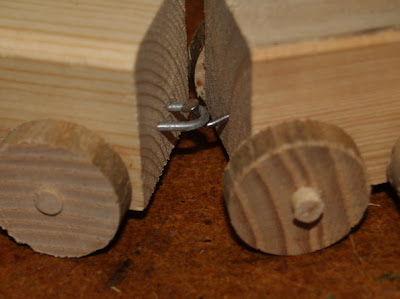
Today in the CSS woodshop my first, second and third grade students continued making their trains. This is a nice project, in that it is large enough that the students see clearly that it can't be done and taken home in a single class, and they are excited about the results. We use a simple method to connect the cars to each other using a bent nail and a wire fencing staple.

I want to talk just a bit about assessment and the role that the arts can play in bringing assessment out of the domination of standardized testing expertise and into the hands of the lay scientist... the parent wanting to see results and the greatest growth opportunities for his or her child.

Most standardized testing necessarily has to do with things that can be measured by a battery of questions having approved right and wrong answers. Even the essay portion of the SAT has to do with the following the rules of proper and effective writing.

And so, let's look at what corporations say they want in someone they hire. They want: creative problem solving, teamwork, and demonstrated responsibility. A schooling built on the basis of what we can most easily measure through standardized testing does not deliver on any of these three things.

I want to go back for just a moment to some earlier posts about David Henry Feldman's essay, The Child as Craftsman. I have been granted permission by the author to distribute it to interested scholars, so will send it to you if you make a request for it via email.

In the Child as Craftsman, Feldman offers three metaphors for schooling. I will grossly simplify: One the child is an empty vessel to be filled to his or her capacity by the nearly all knowing teacher. The second metaphor is related to Pavlov's and Skinner's work on environmental conditioning, and offers that learning is "a function of the environmental arrangements that a good teacher is able to make." The third metaphor is one derived from Piaget and other developmental psychologists, that the child goes through universal stages of development, and that these are natural and sequential for all children. Feldman uses A.S. Neill mentioned in yesterday's post as an example of an educator taking the Piaget metaphor to the extreme.

Feldman offers a "new metaphor," that of the child as craftsman, and simultaneously points us toward a different way of assessing performance and learning success.

He proposes "twin signs of progress toward a fruitful education for the future... 1) an increasing number of individuals engaged in and committed to pursuit of mastery of their field and 2) the number of novel, unprecedented, or unique contributions that occur in these fields." The interesting thing here, is that you don't have to be an educational expert, trained in statistics to walk into a classroom and observe whether or not it is fulfilling its mission. Assessment by the arts is the only way to measure the three things that American employers want schools to produce.

It is interesting that a trained and experienced educator CAN walk in to a classroom and quickly see its effectiveness. He or she will see students seriously engaged (or not). He will see students working effectively in teams (or not) and he or she will see evidence of creative problem solving in the form of projects at varying levels of completion (or not). A parent visiting the class can witness exactly the same thing, and has the additional opportunity of seeing the child's enthusiasm each morning as they prepare for school.
"What the best and wisest parent wants for his own child, that must the community want for all of its children. Any other ideal for our schools is narrow and unlovely; acted upon it destroys our democracy." - John Dewey
The new movie, Waiting for Superman was produced by Davis Guggenheim who would drive by 3 public schools on his way each morning to take his children to private school and felt a sense of guilt that he was unable to give the best quality education to others as well. I am looking forward to seeing the movie, as I suspect that Guggenheim was inspired by what John Dewey knew to be true. School should not be contrived but should be made authentic and true for each child.

Craftsmanship (and the arts) is the essential metaphor for the new education, not because it provides an alternate means to assess, but because it is really how we learn, how we grow, and how we become engaged passionately with the future.

On another subject the poll at right was interesting. Thank you all for taking time to participate. Just under half my readers were interested in woodworking. Just under half found my writing strangely entertaining. A full 91 percent were here for the philosophy of hands-on learning. I feel complimented by each response. Make, fix, do. There is growth and pleasure in the whole thing.

Tuesday, September 14, 2010

who decides what is important?

Who decides what's important and why is it important who decides? Those are important questions as we contemplate educational reform, and one of the things we've allowed to happen is for those who write the standards and devise the standardized tests to answer the important questions for us. When you write the test, you have chosen which matters of intelligence, which matters of character are important for our schools to "deliver" to our children and our communities. And you have chosen which of our children will be preselected for the greatest opportunities for success.

It is kind of a subtle thing, inexplicable, right? We all want our children to prosper. We want each to arise to his or her greatest potential. We believe that the experts know what is needed and what is right for our children. They are experts, after all. They study stuff in depth and they work hard at it. They have all the educational credentials to back themselves up. Besides, very few Americans really understand standardized tests, how they work, and what the standards should be.

But did you know that parents are quite capable of making assessments of their own? Did you know that parents could be reasonably empowered with tools for improving education without the standards and standardized testing that have come to dominate the movement toward quality education?

And so, why does all this matter? Artificially derived standards ride roughshod on individuality, diversity and creativity. They don't deliver the kinds of employees that corporations say they want. They limit the artistic options that have deeply engaged American learners. Carried to extremes they turn schools into sweatshops in which children are immersed in tremendous pressure during the stages of their development in which unstructured play is most essential.

And so that is why I propose that school assessment be made through the arts and that parents be empowered to make those assessments. I will have more on this later. In the meantime, I suspect some of my readers will not be familiar with the educational classic, Summerhill, A New View of Childhood by A.S. Neill. In this highly recommended text, teachers had been deeply concerned about one child who refused to read and spent all his time running in the woods until he decided that he wanted to become an engineer, and then quickly excelled at reading and math. As you probably know from having made a few quirky steps of your own, intrinsic motivation is a very powerful force and to assume that it is something that our children will not discover on their own is a mistake.

I had been in small alternative school study group back in the early 70's after having completed my own formal education and the problems of it were fresh on my mind. Being the son of a Kindergarten teacher and reading Neill's book set me up for a very long running interest in education.

Standards do not allow for the individuality and creativity of human expression. They don't allow for the variability of development in children. They are the collaborative efforts of a segment of society to control what happens in the future and may be the inadvertent tool of repression. And what I would like my readers to know is that despite what we may see occasionally on the news, a very small proportion of parents unable to cope, most parents have their children's very best interests at heart, and are capable of perceiving those things that bring them joy. From that position of authentic authority, parents are quite capable, given resources, of making the very best decisions for their kids and their schooling.

And of course that is why some parents and children choose Clear Spring School.

Monday, September 13, 2010

beginning sloyd

Today in the Clear Spring School wood shop, the 4th, 5th, and 6th grade students made trivets from Gustav Larsson's Book, Elementary Sloyd and Whittling. The project is a great way to introduce new-to-the-wood shop students to woodworking (I had a few) and it offers a good refresher course in safety for those students who have been busy during the summer doing other things. Even though most of the students had done this project before, to do it again offered the opportunity to improve skill and refine their work. Each and every woodworking scholar took pleasure in their work. At the high school level, we are beginning a Clear Spring School wood collection, and beginning to gather as many local species as we can. It should be easy to come up with at least 30 different species, and perhaps more, just from our local forests.

bowls

The ESSA class on bowl turning wrapped up yesterday in the Clear Spring wood shop, as led by Greg Thomas, a skilled and attentive turning teacher. A wooden bowl is a simple thing that requires a surprising amount of concentration. If your mind wanders the bowl gouge can catch rather than cut, tearing out a chunk rather than a thin ribbon of wood. It can yank the gouge from your hands, pull the wood loose from the chuck and destroy your work. It is why you always wear a safety mask when you work.

There are things that happen when we work to develop skill. Some of Greg's students were at the lathe for the first time. Some had finished the class and left with their work before I arrived to take these pictures. The point that is so often missed is that when we craft skilled work, the true shaping that takes place is within the self. And that is the point that is so often missed when non-craftsmen observe the use of crafts for developmental or formative purposes in schools. As Otto Salomon had observed, The value of the carpenter's work is in the usefulness of the object he makes. The value of the student's work, making the same object is in the student.

People take objects for granted. We are swamped by too many cheap and meaningless things. But whole schools can be built with crafts as both foundation and central focus. Early educational theorists, like Rousseau, Comenius, Pestalozzi, Froebel, Cygnaeus, Montessori, and Dewey, understood this but modern educators have completely missed this point. What you see in the photos above and below is evidence of learning and of growth, that can be the foundation of educational enthusiasm for children and adults. It is why I propose the strategic implementation of the hands. A young man or woman standing at a lathe gives shape to much more than wood.

Don't forget the poll at right. One day left to vote.

Sunday, September 12, 2010

Forget What You Know About Good Study Habits

Reader John Grossbohlin sent this link to an article in the New York Times, upending much of what we think we know about good study habits. Forget What You Know About Good Study Habits

When parents set up study situations for their kids, idealized opportunities to cram stuff in their heads, how closely does that approximate real life learning conditions? You may not regard that as a valid question. You may not regard it as relevant. But kids and adults are natural learners. We just don't learn so well when we know the lessons to be contrived, artificial, with little direct impact and essentially irrelevant to our own lives.
Cognitive scientists do not deny that honest-to-goodness cramming can lead to a better grade on a given exam. But hurriedly jam-packing a brain is akin to speed-packing a cheap suitcase, as most students quickly learn — it holds its new load for a while, then most everything falls out.

“With many students, it’s not like they can’t remember the material” when they move to a more advanced class, said Henry L. Roediger III, a psychologist at Washington University in St. Louis. “It’s like they’ve never seen it before.”

When the neural suitcase is packed carefully and gradually, it holds its contents for far, far longer. An hour of study tonight, an hour on the weekend, another session a week from now: such so-called spacing improves later recall, without requiring students to put in more overall study effort or pay more attention, dozens of studies have found.
Far better than study habits for kids would be the habit of doing real things that create a sense of relevance and relationship as a scaffold for what they learn.

Also on the subject of schools, Time Magazine's Cover Story for the week is about "What Makes a School Great." Part of the article is stimulated by a new movie, "Waiting for Superman," a documentary by the producer of An Inconvenient Truth. I have not had time to study the article, but it is very nice to see education taking an important place in the American discourse. Now, the challenge is simply to get people to better understand our hands. If we want education to move from the artificial and abstract to the concrete, reality based, experiential learning we all know most deeply engages us all, then the strategic implementation of the hands is the key to revolution.

Greg Thomas' bowl turning class for ESSA in the Clear Spring School wood shop is going well as you can see in the photos above and below.

Saturday, September 11, 2010

the most compelling argument...

The most compelling argument for hands-on learning cannot be made. There are no words for it. All we can really do is talk around the subject and tell or demonstrate what we feel. If you are here looking for statistics, you may have come to the right place, but statistics won't be enough to clinch the case. We have statistics about all kinds of things that never lead to change. If you are looking for academic authority for these perspectives, what you will find instead is the voice of a man who works with wood.

My wood shop is a mess. With the start of school, and with travels to New York, I have not gotten enough time in it. Today, I am cleaning a bit, but also simply noting more, being observant of those quiet qualities that arise within me. There are simple things that take place when one takes wood and tools and begins to shape wood. Whether working curved as on the band saw or lathe, or flat with cabinetry makes little difference if you can make the material cooperate, conform step-by-step to what already exists as a notion within your mind's eye. It is an affirmation of self, of power, and of humanity.

I prefer to start with rough wood. It's texture is hostile to the touch. There are splinters and the wood must be tamed and earned as my collaborator and best friend. To take coarse material and pass it across the jointer and make it smooth and beautiful provides the first glimpse of its readiness to yield to human touch. That is a powerful moment in which I begin to understand the wood's potential and my own. When my senses have been dulled by other things, and I turn rough wood to smooth and begin to sense its beauty, I also begin to sense joy.

I have realized that it is nearly impossible to reshape American education if my students know so little about themselves and their own hands-on creative capacities. There are important feelings that arise when one is empowered with tools and materials to create real things. I can tell about that.

I can spend thousands of posts pointing toward academic agreement amongst scholars that what I say here is right and true. I will probably continue to do that. But at my best, I can point you toward the wood shop and other hands-on creative endeavors and what they can do for you. The most compelling argument for hands-on learning arises in our own hands as we fix, make, create, plant, and care for. When you have done these things with your mind's eye alert to their pedagogical value and I tell you that those are the things we must be doing with our children both inside and out of schools, your own wisdom of your own hands will tell you that I am right.

The British Disease

David Brooks took a look at the American economic problems from a useful historic perspective in his New York Times editorial, the Genteel Nation. He describes our current state of economic downturn and lack of confidence as "the British disease."
After decades of affluence, the U.S. has drifted away from the hardheaded practical mentality that built the nation’s wealth in the first place.
So how do we get back to our economic strength? We've got to make some real stuff, erase the balance of payments deficit by making what we make efficiently and at high standards, and seek greater meaning in the things we buy and spend money on.

Brooks points out that it isn't exactly socially acceptable for a graduate of the Ivy league colleges to go back to Akron to make auto parts, but that is exactly what we need... for the best and brightest to get into careers beyond "consulting and finance."

We now have schools in which there are few hands-on activities beyond the keyboard and worksheet. We have Ivy League schools and universities in which all teaching is by lecture. We have homes in which children are sedated by TV and video games and are no longer building things in their back yards. So we may have nearly laid waste a generation in that few know anything at all about their own real-hands-on possibilities.

Brooks also points out that one of the odd things about this recession is that there are so many skilled jobs that are being left unfilled.
Manufacturing firms can’t find skilled machinists. Narayana Kocherlakota of the Minneapolis Federal Reserve Bank calculates that if we had a normal match between the skills workers possess and the skills employers require, then the unemployment rate would be 6.5 percent, not 9.6 percent.
So you can see that by failing to understand the significance of our hands and the wisdom they impart toward culture and economy, we have screwed things up.

In David Brooks editorial he takes on Michelle Obama, critically as follows:
The shift away from commercial values has been expressed well by Michelle Obama in a series of speeches. “Don’t go into corporate America,” she told a group of women in Ohio. “You know, become teachers. Work for the community. Be social workers. Be a nurse. ... Make that choice, as we did, to move out of the money-making industry into the helping industry.” As talented people adopt those priorities, America may become more humane, but it will be less prosperous.
But Brooks fails to see how what Michelle Obama proposes might help to alleviate the following:
Finally, there’s the lower class. The problem here is social breakdown. Something like a quarter to a third of American children are living with one or no parents, in chaotic neighborhoods with failing schools. A gigantic slice of America’s human capital is vastly underused, and it has been that way for a generation.
So, lets hope some good things come from the recession. Can you imagine Ivy League graduates becoming so inspired by hands-on learning that they put our nation back at work? Not just the white middle class, but those too, who have been so long ignored and whose talents have been wasted? We are way past due for a revolution in education.

It seems we have been coming to our senses and realizing we have screwed things up. We can fix things, too. You can start by fixing something that's broken. What's broken in your home today? Fix it yourself or at least try. Can't fix it? Let your kids take it apart and learn how things work. Get out the tools and paints and make messes in your own family explorations of real physical reality. Even the greatest things have humblest beginnings.

Friday, September 10, 2010

woodturning at ESSA

Today my classroom at Clear Spring School is being used by the Eureka Springs School of the Arts for a class in bowlturning taught by Greg Thomas. The class focuses primarily on one tool, the bowl gouge. Getting one sharpened at the right bevel is crucial to the student's success, so naturally the class began with sharpening, using a Wolverine jig mounted at the base of the grinder.

The students are turning Bradford Pear, a smooth cutting wood, that helps them to focus on refining their technique.


I received a small booklet in the mail today from Teachers College, that had been withdrawn from circulation and passed along. The title is The Trade and Training of the Carpenter and Joiner, published by His Majesty's Stationery Office, London, 1933. You really can't blame libraries for discarding books that are seldom read. This one, according to the date due card at back had not been checked out since 1943. But for those of us who celebrate the wisdom of our hands, to hold such things is a connection with things that we had best not forget. This slender volume is also a connection with people from the past, the unnamed authors, the people about whom the book was written and even that last person to check it out in 1943, a much earlier time in which our nation was also at war.

The booklet is fragile. The cover is broken loose. My favorite part is the university ID (Teachers College Library CU) spelled out in tiny stamped holes, both on the cover and on the title page inside.

My readers might enjoy this pdf article by Leon Botstein which had been published a few years ago in the New York Times, in response to the shootings at Columbine,Let Teenagers Try Adulthood. In his examination of schooling, Botstein suggests:
Secondary education must be rethought. Elementary school should begin at age 4 or 5 and end with the sixth grade. We should entirely abandon the concept of the middle school and junior high school. Beginning with the seventh grade, there should be four years of secondary education that we may call high school. Young people should graduate at 16 rather than 18. They could then enter the real world, the world of work or national service, in which they would take a place of responsibility alongside older adults in mixed company. They could stay at home and attend junior college, or they could go away to college.

For all the faults of college, at least the adults who dominate the world of colleges, the faculty, were selected precisely because they were exceptional and different, not because they were popular. Despite the often cavalier attitude toward teaching in college, at least physicists know their physics, mathematicians know and love their mathematics, and music is taught by musicians, not by graduates of education schools, where the disciplines are subordinated to the study of classroom management.

Thursday, September 09, 2010

geezers in garages

The age of American ingenuity seems to have passed or at least skipped a generation. Today, I want to celebrate a friend whom I've featured before in the blog, Bill Sherret. In his basement machine shop he's made every kind of steam engine model imaginable. Each is machined as a work of art. In his spare time, Bill made much of the cherry and walnut furniture in his home. It is a shame that not so many are inclined these days to follow Bill's example of ingenuity.

"Geezers in Garages" is my American version of Australian Mark Thompson's "Blokes in Sheds". If you want to see other basement and back yard workshops, type Blokes or Geezers in the search block at upper left. You'll find more, and below you will find my own geezer hangout. If you would like to submit your own geezer hideaway, take some photos and, I would welcome the chance to share it with my other readers.


Don't forget the poll at right. So far, no one has admitted coming here as a big mistake. You could be the first.

if not wall street?

Many people have been disappointed by their investments on Wall Street. Where does one invest if not on Wall Street? How about your own community? Small business has the greatest potential for growth, and the smallest aren't on Wall Street. If a sole proprietorship hires a single worker, the work force and maybe profits can double. The government thinks that "small" business is 500 or more employees, but they, as usual don't know jack. There are thousands upon thousands of very small businesses that are having trouble getting support from our bailed out banks and their growth might depend on you or others more willing to invest in community.

In the meantime, most trading and exchanges on Wall Street these days are driven by formulas that are actually unrelated to the actual performance of the company. Stock prices are driven up or down by government reports on hiring, inventory and consumer confidence, not by actual performance and profit. Firms like Goldman Sachs are there to make money whether the market goes up or down, and the more things go up and down, the better the investment banks make out (like bandits.)

Does any of that make sense to you? More and more investors are starting to notice and pull back from what is becoming regarded as a casino form of investing. The house wins. The investor often does not.

And so what are some investment opportunities? Look for organic gardeners, builders, rental property managers whose work you can support and invest in. Did you know you can loan money to your plumber and make 6 percent? Buy something that needs fixing that you can save and sell. Learn a craft. Get down to the most basic level. Start with your own growth as a maker and see where it might lead. It will lead, no doubt, to greater sense of community and reports on earnings that aren't printed out of a computer but that can be seen each day when you drive through your own home town. You might even make greater profit at the same time.

Today I am working on boxes, finishing an order to ship. I will also be getting the Clear Spring wood shop ready for a weekend bowl turning workshop with Greg Thomas, master wood turner from Fayetteville.

Don't forget to participate in the poll at right.

Wednesday, September 08, 2010

hand work and community 2....

I have talked about this many times before. There are things that happen when we invest in each other. There are things that happen when we listen to real music rather than that on the iPod, or when we buy something someone we know made, rather than stuff made in China or some other still productive nation that was imported by multi-national corporations and sold in the big box store.

The things that happen are these... someone is encouraged in their growth. Someone is given meaningful employment that leads to greater participation in community life. Homes, schools and relationships are made more stable. People see value in their own lives and find hope. We begin to feel neighborliness or experience what Ivan Illich called conviviality. Next comes joy.

What we often have instead is a state that can best be described as benumbedness. But we had none of that today in the woodshop. I won't be lying to tell you that wood working is a favorite subject at Clear Spring School.

The photos above and below are of the current first, second and third grade project, and of the first grade students at work.

a compelling hypothesis

When at a turning point in my own education a craftsman friend informed me that he believed my brains to be in my hands. Of course that is an odd thing to say to someone. We all know that brains are stuffed in our heads. But is the total of our intelligence there as well? My friend's observation led me to examine the pleasure I found in craftsmanship, reexamine my own goals, and I became a woodworker as a result. What could be simpler than that?

It seems there aren't all that many craftsmen left. We have almost given up on manufacturing. We assign skilled trades a lesser value in our culture than work done requiring a college degree. Many of those with degrees find that there is nothing to do in their field. We made a national decision to outsource manufacturing to become a "service economy" and now have even outsourced accounting and law. The experts proclaimed that we would be an "information economy." In other words, we wouldn't need to make anything, or do anything and the only viable business left would be Google. But then Google would be a whopper, right? And its isn't really about information, but about advertising.

And so, as a member of the lonely band of the few craftsmen left, I have a few things to say. By abandoning the ideals of craftsmanship and hands-on learning, we have put ourselves and our nation in a very tough place.

My simple, compelling hypothesis? By taking more time to be cognizant of our hands, to take greater interest in them, we have the power to bring things to right, to raise standards, to increase dignity, to bring greater intelligence to our schools, our homes, our communities and our lives. Just as I was challenged by my craftsman mentor/friend to examine the intelligence in my own hands, I invite you to do the same for yourself and our nation. The hypothesis is one you can examine for yourself, with or without my help. And let's not forget the pleasure and the joy... there are feelings that arise in the making of real things. I can tell you all about it but it is best that you discover these feelings for yourself.

Today at the Clear Spring School wood shop, the first, second and third grade students will begin making trains.

Tuesday, September 07, 2010

time to throw the bums out?

Is it time to throw the administrators and politicians out of American classrooms and let teachers teach? From the New York Times: In a New Role, Teachers Move to Run Schools. As you can see in the photo above, I am inlaying the wooden ties in the front of the veneered cabinets, using a router inlay kit. The template controls the travel of the router, and the bit is set just deep enough to rout through the veneer glued to the face of the cabinet.

abacus math and brain development

While American kids may be punching buttons and getting right answers, Asian students are doing more to develop their brains through the use of eyes and hands on an ancient tool. According to this month's National Geographic, using abacuses is "common throughout Asia, where youngsters flex their finger muscles in abacus contests. Studies show that abacus mastery helps develop the brain's visuospatial areas." According to Seattle educator, Vinaya Kulkarni, using the abacus "contributes to all aspects of thinking, not just math."

Just to remind that Clear Spring School is ahead of the game, we have been making abacuses of various designs for different grade levels in the wood shop for several years and using them in the classroom. The photo above is of last year's 1st grade class.

If you are a regular reader or not, please participate in the new poll at right.

Monday, September 06, 2010

the problem with non-fiction...

One of the scary things about non-fiction is that it may, as your knowledge about issues grows, require that you actually do something about what you have learned. Some fiction can actually induce change, too. For instance, To Kill a Mockingbird was so powerful that it led people to reexamine their feelings about race. But most fiction is read for the simple pleasure of it and for the way it carries you away in mind and spirit from day to day concerns. Escape. Non-fiction doesn't always allow you to.

So, what the heck are you doing here? I'm curious. Does all this talk about making stuff actually lead you to the wood shop? I have a brief poll that you can take that will help me to better understand how you use this blog. So why are you here? Choose your answer at right and share it with others. You have one week.

Making a generation of "thinkerers"

Elliot Washor has an article in the Huffington Post on Creating a Generation of Thinkerers. And it makes me wonder why all children are not engaged in making. Shame on us.

Elliot's article is a thoughtful review of our meeting at Dearborn, Michigan centered around the Maker Faire and the Henry Ford Museum.

From Elliot's report:
Educational historian Larry Cremin once wryly noted, that educators respond to a new area of learning by creating a course in it. Recall how schools responded to technology by creating a course "down the hall at fifth period" without ever thinking about changing every course because technology existed. Similarly, educators run the risk of demeaning hand and mind work by creating separate courses for making rather than bringing making into all aspects of the school curriculum and thereby thoroughly reconstituting it.
And of course the answer is NOT to make making a separate course, but the bring the arts into every classroom and every discipline as a means of assessment. Here is some startling stuff from Elliot's article:
We reviewed disturbing data on how young people spend their time. We learned, for example, that they use the Internet about 12 hours a week, more time than they spend watching television (about 10 hours per week), talking on a cell phone (13 hours per week), and doing homework (9 hours per week).

The research reveals that the U.S. is becoming a nation of "non-tinkerers." In a poll of 1,000 U.S. adults, nearly six in 10 (58%) said they never have made or built a toy. More than a quarter (27%) have not made or built even one item from a list of eight common projects ranging from a dollhouse or piece of furniture to a fence or flower box.
When we introduced ourselves in Dearborn, we were asked to tell about something we had made. I told that I get to make things every day and every week, but that if it were not for woodshop at Clear Spring School, some of our kids would not have ever had the opportunity.

Happy Labor Day, to my readers. Labor once meant something more. Not only drugery, but problem solving, not just the opposed forcesof labor and management, but skill and pride of workmanship as this article sent by Will Simpson affirms. Whatever Happened to Labor?

Sunday, September 05, 2010

extraordinary education

A cover story in the New York Times tells that Secretary of State Hillary Clinton is making a "hands-on effort" toward peace in the middle east. The term hands-on is associated with extraordinary effort. We know when someone engages hands-on, it is with their whole being and complete attention. Doesn't it make you wonder whether we care for our children or not? Why have we chosen to give them less than our best? Is hands-on learning a special quality of eduction? Do I need to ask, or is it something that you have experienced for yourself? What does hands-on mean if not?

I think it is time for extraordinary effort toward extraordinary education. The simple means toward this end? The Strategic engagement of the hands. Make, make do, fix, mend, create, plant, harvest, care, care for, etc.

On a slightly different subject, German automaker BMW is facing the challenge presented by an aging field of skilled employees and a lack of skilled workers to take their places on the lines to fill holes left by retirement. To help take greater charge of their future, BMW set up an assembly line of older workers, and asked their advice on what improvements could be made to enable factories to maintain efficiency with older workers. The workers came up with a list of improvements costing the company $50,000 and increasing efficiency by 7 percent. In other words, by asking skilled workers for advice, the company made millions on a very small investment. It is what happens when management trusts the wisdom of the hands. We have learned to associate European craftsmanship with quality, but they like we, have been making schools more efficient and less effective. And so we have to ask ourselves what we want schooling to do, and make the changes necessary to get what we want. Do we really want a nation of idiots?

Friederich Karl Biederman

Biederman was influential in the manual arts movement in Germany, and the following is from 1852.
Since practical work is consistent with the nature of youth, there is no particular need of awakening an interest by artificial or compulsory means. Pedagogy itself will accomplish through practical instruction that which it conceives as its first duty; namely, to secure by investigation a correct knowledge of the true characteristics of its pupils.

Individuality presupposes a distinct self-activity, and can never be the result of receptivity alone. Every teacher has known boys who were remarkable for their dullness while at school, and who, when put in other surroundings, became active and useful, while some of the so-called excellent pupils grew to be lazy and unprincipled men.
And so, what you find here is not anything new. Manual arts education began in Germany in the same way it began in the US, the UK, France, and so many other countries. There were two major voices, that of industry, demanding trained labor from outside the apprenticeship model, so they could pay less for it, and that of education itself, which recognized through the teachings of Rousseau, Commenius, Pestalozzi, Froebel and Uno Cygnaeus (Finland) that the greatest method for engaging children in learning was to engage their hands in making.

I want my readers to pay particular attention to the last line from Biederman's quote. Think Wall Street, and those highly educated persons, who, lacking in hands on experience were quite willing to plunder the American economy for their own short term gain. They learned nothing from the experience but to try, try again.

Saturday, September 04, 2010

If I had a hammer...

Today is upper class move-in day at Columbia University, so we are poised with boxes and suitcases to load out by taxi for a trip up Broadway to the upper Westside. Lucy's hammer is packed away in college boxes which will be delivered late in the day, so I made a quick trip to Home Depot on W. 23rd. Who would think that there might be a Home Depot so close to the Flatiron Building. The hammer is needed to knock her bed apart so that it can be lowered, and I suspect that the hammer is one of the most convivial of tools. No special degree or training required. With a simple hammer, a man becomes powerful in ways that a man without a hammer is not.

Years ago, when I was studying pottery at Memphis State University, we had a student go wacko. He earned the name, "Mack the Hammer," by coming into the clay studio with hammer in hand, and smacking on his hand and on the table, making threatening gestures. His threat was that he would shatter finished work or hit someone on the head. Security and psychological intervention stepped in before he was able to do much damage. Every single tool has mixed potential, destructive as well as creative use. Some of the destructive capacity of each tool is less easy to perceive than a smack on the head or busted pots.

It is a busy day, and not much to blog about. I want to begin describing how the arts can be used as an assessment tool for all other subject areas, even beyond the arts themselves. That will come later.

Thursday, September 02, 2010

tools for assessment

In American schools, standardized testing has been adopted as the primary tool of assessment. In essence, a standardized test is a tool used to get a view of performance, or cognitive abilities, and in that way, it's similar to using a magnifying glass to examine bugs, a microscope to examine germs, or a telescope to examine the stars. But of course there is a difference in that these last mentioned tools are used to examine real things, not contrived amalgamations of narrow statistical slices of real people. We know that statistical examination of real stuff is subject to gross misinterpretation and distortion, even though the parties involved may have the very best of intentions.

Ivan Illich, in Tools for Conviviality states the following:
Tools are intrinsic to social relationships. An individual relates himself to his society through the use of tools that he actively masters, or by which he is passively acted upon. To the degree that he masters his tools, he can invest the world with his meaning; to the degree that he is mastered by his tools, the shape of the tool determines his self image. Convivial tools are those which give each person who uses them the greatest opportunity to enrich the environment with the fruits of his or her vision.
The point about the arts as a means of assessment is a matter of conviviality. To witness the arts as a tool for understanding is to participate in human growth. To attend a performance or demonstration of the arts in schools is an enrichment of community. In comparison, to pass out test scores may inflate the perceived potentials of some and drastically impede the perceived potentials of others. In the case of students in New York City public high schools who received B-level grades, but cannot pass basic placement tests at community colleges, Diane Ravitch said, "We are lying to our children." For many, demoralizaton by low test scores lead parents, and teachers to completely overlook the child's greatest potentials. That may not be criminal but should be.

Can you see that something should be done about this? All during the last 10 years, during both the Bush and Obama administrations, standardized testing has driven school development at the expense of the arts. Let's just cut the crap and get back to what is really important in schools. OK? Restoring the wood shop is the best place to start.

We think of assessment as something to assign to experts, and yet each of us is involved in the continuing assessment of our surroundings. We can tell whether something was done as a matter of care, or as a matter of expedience. For instance, as we stay in a New York apartment, I can't help but notice all the thick layers of paint applied over a half century of renovations. The paint in the photo above was applied layer upon layer, each time to make the place look better, but by never addressing the growing misshapen mass beneath, a display of real painting skill will never emerge. The photo above. What can you say? Is it an illustration of conviviality? The challenge of meaningful assessment is to use what we really know to counter the mis-perceptions of external expertise and then design schools and schooling in which children are allowed to reach their full potentials.

explicable assessment

One of the hardest courses I took in college was called "behavioral statistics" and one of the books presented as required reading was "How to Lie With Statistics", a classic valuable to anyone hoping to understand the deliberate obfuscation present in modern culture. You take a statistical framework like that devised through standardized testing and what you get is an abstracted, conglomerated view of educational reality. A friend of mine, Elliot Washor, is co-founder of the Big Picture Schools and he had been called to a school conference concerning his son. They, a team of experts, began telling him all the bad news about his son, based on their examination of his grades and test scores. After listening patiently for some time, Elliot asked, "Did you know my son is a Jazz musician and performs regularly with a group?" The experts, of course, new nothing about it. They hadn't bothered to gather any personal information that might have given a more complete view of Elliot's son.

One of the great dangers of our current standardized testing schema is that understanding it is the exclusive domain of experts, who are so detached from actual circumstances so as to push forth a complete distortion of facts regarding the students they are supposed to safeguard and educate. For that reason, I ask for what I have come to call "explicable assessment".. a means of assessment that can be clear to all regardless of training or expertise, and that considers the individuals involved and the communities in which they live. Anything less is an insult to the intelligence inherent in each community and the wisdom of each and every parent and child. Anything less is to do great harm.

And so, how do we develop explicable assessment? The arts have it. Within the arts we discover character, diligence, expertise, skill, care, attention and the opportunity to engage every other aspect of school curriculum. Even the most casual observer can see it. And creativity? That is a bonus.

There is a possibility that no one will listen to me. After all, I am just a woodworker turned shop teacher. What would I know? I am grateful to have a few friends in education and am also aware that the situation in American schools is ready for some thinking outside the box. So, let's you and I roll up our sleeves and get a few things accomplished.

Redefining accountability

Yesterday I visited with Dr. Thomas James, Provost of Teachers College and as I sat in his office I found a publication describing Diane Ravitch's recent lecture there. Dr. Ravich was an early proponent of No Child Left Behind testing but then became very vocal in opposition when she became witness to its destructive effects. Now she says that testing should be used as a diagnostic tool rather than be used for ranking and for teacher and student accountability.

Under NCLB and "Race to the Top" schemes, underperforming schools have faced forced closure, and Ravitch maintains that if we were to apply that same logic to making cities crime free, "we would be firing cops and closing police stations and turning a bad situation into complete disaster." That is what we have chosen to do to some of our poorest schools. Can you see how it is quite reasonable to assume that we have become a nation of idiots?

Dr. Ravitch said we should be looking for another means of assessment. "Schools are part of the community, representing traditions, values and cultures. It's not like managing a stock portfolio, it's like managing a family."

That is exactly why the arts should be the assessment tool used in our nation's schools. As I mentioned to Dr. James yesterday, if you ask parents to come to a ball game, they have a 400 percent greater likelihood of showing up than for conference night. Standardized testing is abstract and impossible for most people, parents, teachers and administrators to understand, and we have thus done a tremendous harm to our children and our schools by making our tools of assessment distant from commonly comprehensible community values.

Diane Ravitch, in being an early proponent of testing, was sincere in her belief NCLB testing might help. That it hasn't and won't is a matter that she has honestly faced and we must as well.

So what will work? My proposal is unusual. While some like those involved in Harvard's Project Zero, are concerned with figuring out how to assess of the arts so they can compete with other separate subject areas, we are overlooking the most valuable assessment tool for achievement of quality schools. Assessment by and through the arts. The arts illustrate engagement, sincerity, attention to detail, breadth of interest, successful intellectual grasp of material, skill, and mastery of intellectual concepts and a very long list of more. An examination of a child's engagement in the arts is the one tool that parents, teachers, children and community can actually understand and relate to.

Last night my wife and daughter and I went to see Billy Elliot on Broadway. It was an incredible show. That it was about a child's engagement in the arts, his passion for ballet, is something that anyone in his right mind, hand and heart could understand.

And so what the heck are we waiting for? Chuck the reliance on standardized testing, and restore the arts. Where to begin? I propose wood shop. By crafting things from wood, the child exhibits a whole range of important skills, intelligence and character that can be easily observed without taking a college level course on statistics.

Wednesday, September 01, 2010

manual arts in Ghana

My daughter brought back this photo of children's toys in Ghana. The wheels are foam cut from old flip flops and of course you can recognize the tin cans. The blue strings are used to pull these trucks along the streets of Obodan, Ghana.

Manual arts in France

From Senator A. Corbon, 1879
It is high time to understand the indications furnished by the instinct of children and to give as soon as possible satisfaction to their two-fold need of working with the hands and of knowing the reason of things; that is to say, it is time to bring about a veritable revolution in the manner of rearing youth. If one wishes, to follow resolutely the course of nature and the clear indications furnished by the instinctive dispositions of children, if manual exercises are considered as essential, they should have a serious part in education commensurate with their importance. In the end, it will be found that it is possible to shorten the time of class work in order to give a sufficient amount of time to manual exercises; and that this will be done not only without injury to the intellectual development, but that on the contrary, it will promote it. In the first place, manual exercises are not carried on without awakening he intelligence, and still further, it is doing violence to the active nature of the children to confine them three hours in succession, twice a day, before the school desk. They submit, but with reluctance; they are subject to constraint; they are ill at ease physically and morally. The would certainly learn better in two hours if the third were given to manual exercises. It should also be observed also, in order to obtain more time for the exercise of the workshop, that there is a tendency in primary education, as well as in secondary and higher, to overload the program of study more and more. It seems as if the aim were less to develop the intellectual capacity than to heap up knowledge upon knowledge in the head of the children at the risk of exhausting the intellectual force.
Corbon's statement reflects what had become a widely shared perspective in the early manual arts movement. France and Germany along with the Scandinavian countries and the United States all shared the understanding that to educate the mind required the use of the hands. Today in Manhattan, I plan to visit the Tenement Museum and make a quick trip to Teachers College.